
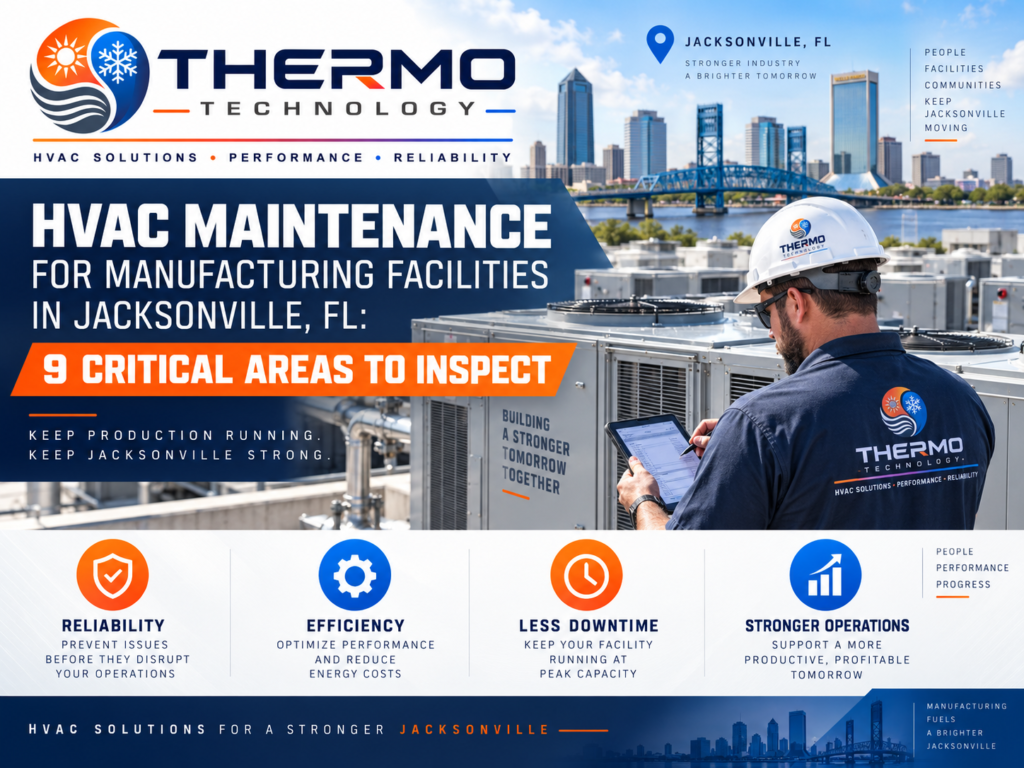
Manufacturing HVAC maintenance plays an important role in keeping production facilities, factories, warehouses, assembly areas, electrical rooms, offices, and other industrial spaces operating reliably.
In a manufacturing facility, HVAC equipment often does much more than provide employee comfort. Temperature, humidity, airflow, ventilation, and equipment reliability may affect production areas, electrical equipment, stored materials, process-support spaces, and daily operations.
Jacksonville’s long cooling season, high humidity, heavy HVAC runtime, outdoor contamination, and demanding industrial environments can place significant stress on heating, ventilation, and air-conditioning equipment.
A structured maintenance program gives plant managers and facility managers an opportunity to identify developing problems before they become emergency repairs or unexpected operational interruptions.
Here are nine critical areas that should be considered when developing a manufacturing HVAC maintenance strategy for an industrial facility.
Why Manufacturing HVAC Maintenance Is Different
Manufacturing facilities can place HVAC equipment under operating conditions that differ considerably from traditional office or residential environments.
Depending on the operation, HVAC systems may be exposed to:
- Dust and airborne particles
- Production contaminants
- High equipment heat loads
- Frequent door openings
- Extended operating hours
- High outdoor-air requirements
- Humidity
- Process-generated heat
Manufacturing facilities may also contain several different HVAC system types.
- Packaged rooftop units
- Air-handling units
- Split HVAC systems
- Make-up air units
- Exhaust systems
- Supply and return fans
- Variable-frequency drives
- Building automation systems
- Chilled-water equipment
The correct manufacturing HVAC maintenance program should therefore reflect the actual equipment, operating environment, production schedule, manufacturer requirements, and importance of each system to facility operations.
1. Inspect Air Filters and Airflow
Proper airflow is fundamental to HVAC performance.
Filters protect coils, fans, ducts, and occupied spaces from airborne contamination, but manufacturing environments can load filters more quickly than cleaner environments.
Restricted filters may contribute to:
- Reduced airflow
- Longer HVAC runtime
- Reduced cooling capacity
- Higher fan workload
- Evaporator coil freezing
- Uneven temperatures
Filter replacement schedules should consider actual operating conditions instead of relying only on a fixed calendar interval.
Facility teams should monitor filter condition and determine whether certain production areas require more frequent inspection than others.
2. Inspect Evaporator and Condenser Coils
HVAC coils depend on clean heat-transfer surfaces to operate effectively.
Manufacturing environments can expose coils to dust, dirt, grease, fibers, and other airborne material.
Dirty coils may contribute to:
- Reduced heat transfer
- Longer equipment runtime
- Higher operating pressures
- Reduced cooling capacity
- Additional compressor stress
Coil inspection should be an important part of manufacturing HVAC maintenance, particularly where equipment operates near production processes or outdoor contamination.
Cleaning methods should be appropriate for the equipment and coil condition so fins and other components are not damaged.
3. Inspect Belts, Pulleys, Fans, and Bearings
Many industrial HVAC systems use belt-driven fans and larger air-moving assemblies.
Mechanical components can continue operating even after their condition begins deteriorating.
Maintenance inspections may include:
- Belt condition
- Belt tension
- Pulley condition
- Fan alignment
- Fan blade condition
- Bearing condition
- Unusual vibration
- Abnormal noise
Worn belts or deteriorating bearings can reduce fan performance and eventually cause unexpected equipment shutdown.
Changes in vibration or sound should be documented so technicians can compare equipment condition between maintenance visits.
4. Check Motors and Electrical Components
Industrial HVAC equipment contains motors, contactors, relays, variable-frequency drives, electrical terminals, control boards, and other electrical components.
Heat, vibration, moisture, long operating hours, and repeated electrical cycling can gradually affect these components.
Depending on the equipment, maintenance may include evaluation of:
- Motor condition
- Electrical connections
- Contactors
- Capacitors where applicable
- Relays
- Wiring
- Terminal condition
- Variable-frequency drives
- Control panels
Signs of overheating, discoloration, damaged insulation, loose terminals, abnormal current, or unusual motor temperatures should be investigated.
Electrical inspections should be performed using appropriate safety procedures and qualified personnel.
5. Verify HVAC Controls and Building Automation
Equipment condition is only one part of HVAC performance.
Controls determine when equipment starts, stops, changes speed, opens dampers, adjusts temperature, and responds to changing facility conditions.
Problems may develop when:
- Schedules are outdated
- Temperature setpoints are incorrect
- Overrides remain active
- Sensors provide inaccurate information
- Heating and cooling operate simultaneously
- Fans operate outside necessary hours
A strong manufacturing HVAC maintenance program should therefore include control-system review where appropriate.
Facilities with building automation systems can use trends to review equipment runtime, temperatures, alarms, fan status, VFD speeds, and control commands.
6. Inspect Condensate Drainage
Cooling equipment removes moisture from indoor air and produces condensate.
Jacksonville’s humid climate can result in substantial condensate production during extended cooling operation.
Drainage problems can include:
- Blocked drain lines
- Damaged drain pans
- Failed condensate pumps
- Improper drain slope
- Overflowing pans
- Water around HVAC equipment
Water leaks inside industrial facilities can affect insulation, ceilings, floors, controls, electrical equipment, and nearby production areas.
Condensate inspection should therefore be part of routine preventive maintenance rather than addressed only after a visible water leak occurs.
7. Evaluate Ventilation and Make-Up Air Systems
Manufacturing facilities may require substantial ventilation because of processes, exhaust systems, occupancy, heat, or indoor-air requirements.
Exhausted air often needs to be replaced with properly conditioned outdoor air.
If make-up air and exhaust systems are not balanced correctly, the facility may experience:
- Negative building pressure
- Doors that are difficult to open
- Uncontrolled outdoor-air infiltration
- Temperature problems
- Humidity problems
- Higher HVAC load
Facility managers should consider the complete ventilation system instead of evaluating individual HVAC units in isolation.
Changes to production equipment, exhaust fans, building use, or facility layout may also change ventilation requirements.
8. Monitor HVAC Energy Performance
An HVAC system can continue operating while gradually consuming more energy.
Facility managers should investigate unexplained changes in:
- Equipment runtime
- Electrical consumption
- Fan speeds
- Temperature recovery
- Cooling demand
Possible causes may include dirty coils, restricted filters, control problems, motor issues, incorrect schedules, or deteriorating equipment.
ENERGY STAR provides energy-management resources specifically for manufacturing plants and notes that manufacturers can treat energy as a controllable operating cost.
Facility managers can review
ENERGY STAR Industrial Energy Management
for additional tools and resources.
Learn more in our guide about
industrial HVAC energy efficiency
.
9. Review HVAC Maintenance History and Open Recommendations
One of the most valuable parts of manufacturing HVAC maintenance is the equipment history created over time.
Facility managers should track:
- Maintenance dates
- Equipment identification
- Model and serial numbers
- Previous repairs
- Components replaced
- Measurements
- Recurring alarms
- Technician recommendations
- Open corrective work
This information can help identify recurring failures and equipment requiring increasingly frequent repairs.
Open recommendations should also be reviewed regularly instead of remaining indefinitely on maintenance reports.
Manufacturing HVAC Maintenance and Equipment Criticality
Not every HVAC asset inside a manufacturing plant has the same operational importance.
A small unit serving a low-use storage area may have limited impact if it fails.
HVAC equipment serving one of the following areas may require higher priority:
- Production lines
- Electrical rooms
- Control rooms
- Server rooms
- Temperature-sensitive storage
- Quality-control areas
- Critical employee workspaces
Critical equipment may justify more frequent inspections, faster repair response, critical spare-parts planning, backup capacity, and additional monitoring.
Preventive vs. Reactive Maintenance in Manufacturing Plants
Reactive HVAC maintenance means repairing equipment after a problem has already occurred.
Preventive maintenance evaluates equipment according to a planned schedule.
Manufacturing facilities generally benefit from using different strategies according to equipment criticality.
For critical HVAC assets, waiting for complete failure may create unnecessary operational risk.
The U.S. Department of Energy describes reactive, preventive, predictive, and reliability-centered maintenance as approaches that can be balanced according to facility needs.
Facility managers can review the
U.S. Department of Energy Operations and Maintenance Best Practices Guide
.
Also read our guide:
Preventive vs. Reactive HVAC Maintenance
.
Signs a Manufacturing HVAC System Needs Repair
Facility teams should investigate significant changes in HVAC operation.
Warning signs may include:
- Increasing temperature complaints
- Unexpected humidity changes
- Longer equipment runtime
- Unusual mechanical noise
- Excessive vibration
- Repeated electrical trips
- Recurring control alarms
- Water leaks
- Weak airflow
- Repeated component failures
If these conditions appear repeatedly, corrective work may be needed rather than routine maintenance alone.
Read our guide to
industrial HVAC repair in Jacksonville FL
for additional warning signs.
How Often Should Manufacturing HVAC Equipment Be Maintained?
There is no single service interval appropriate for every manufacturing facility.
Maintenance frequency should consider:
- Manufacturer recommendations
- Equipment type
- Operating hours
- Environmental contamination
- Equipment criticality
- Equipment age
- Service history
- Production schedules
- Seasonal cooling demand
An air handler operating in a dusty production environment may require a different inspection frequency than equipment serving an administrative office.
For this reason, risk-based manufacturing HVAC maintenance is generally more useful than assigning an identical schedule to every asset.
Create an HVAC Asset List for Your Manufacturing Facility
A structured maintenance program starts with knowing what equipment the facility actually owns.
For each HVAC asset, consider documenting:
- Equipment name or asset number
- Location
- Manufacturer
- Model
- Serial number
- Equipment type
- Approximate age
- Area served
- Operational criticality
- Maintenance frequency
An accurate asset list makes it easier to develop preventive-maintenance schedules, identify critical equipment, plan spare parts, and review repair history.
Track Corrective Work After Every Inspection
Preventive maintenance becomes less valuable if inspection findings are documented but never corrected.
Recommendations can be separated into categories such as:
- Immediate repair required
- Schedule corrective work
- Monitor condition
- Plan future replacement
This creates a clearer workflow between technicians, maintenance managers, plant management, and purchasing.
Manufacturing HVAC Maintenance in Jacksonville FL
Thermo Technology provides professional manufacturing HVAC maintenance, industrial HVAC diagnostics, repair, and equipment-condition evaluation for facilities throughout Jacksonville and Northeast Florida.
Our approach begins with understanding the facility and identifying which HVAC systems are most important to daily operations.
Depending on the equipment, maintenance may include evaluation of filters, airflow, coils, fans, belts, motors, electrical components, controls, VFDs, drainage, refrigeration performance, and other HVAC components.
A maintenance strategy can then be structured around equipment condition, manufacturer requirements, operating environment, production demands, and asset criticality.
For a broader overview, read our guide to
industrial HVAC maintenance in Jacksonville FL
.
Build a More Reliable HVAC Maintenance Program for Your Plant
HVAC failures do not always happen during convenient production windows.
A structured manufacturing HVAC maintenance program can help your facility identify developing problems, prioritize critical equipment, and plan corrective work before unexpected failures disrupt operations.
Contact Thermo Technology to discuss HVAC maintenance and industrial service for your Jacksonville manufacturing facility.
Call or text:
(904) 240-2725
Frequently Asked Questions About Manufacturing HVAC Maintenance
What is manufacturing HVAC maintenance?
Manufacturing HVAC maintenance is planned inspection and service of heating, ventilation, and air-conditioning equipment used in manufacturing and production facilities.
Why is HVAC maintenance important in a manufacturing plant?
HVAC systems may support production areas, employee workspaces, electrical rooms, storage areas, ventilation systems, and other parts of daily facility operation. Maintenance can help identify developing problems before complete equipment failure.
How often should manufacturing HVAC equipment be serviced?
Frequency depends on equipment type, manufacturer recommendations, operating hours, contamination levels, equipment age, service history, and operational criticality.
What equipment should be included in manufacturing HVAC maintenance?
Depending on the facility, maintenance may include rooftop units, air handlers, split systems, ventilation equipment, make-up air units, exhaust fans, motors, VFDs, controls, pumps, and chilled-water equipment.
Can manufacturing HVAC maintenance reduce downtime?
Preventive maintenance cannot eliminate every failure, but it can identify many developing problems early enough for facility managers to schedule corrective work before an emergency occurs.
Can HVAC maintenance improve energy efficiency?
Proper maintenance can address restricted filters, dirty coils, airflow problems, motor conditions, incorrect controls, and other issues that may cause HVAC equipment to operate longer or work harder than necessary.
Does Thermo Technology provide manufacturing HVAC maintenance in Jacksonville FL?
Yes. Thermo Technology provides manufacturing HVAC maintenance, diagnostics, repair, and industrial HVAC services throughout Jacksonville and Northeast Florida. Call or text (904) 240-2725 to discuss your facility.