
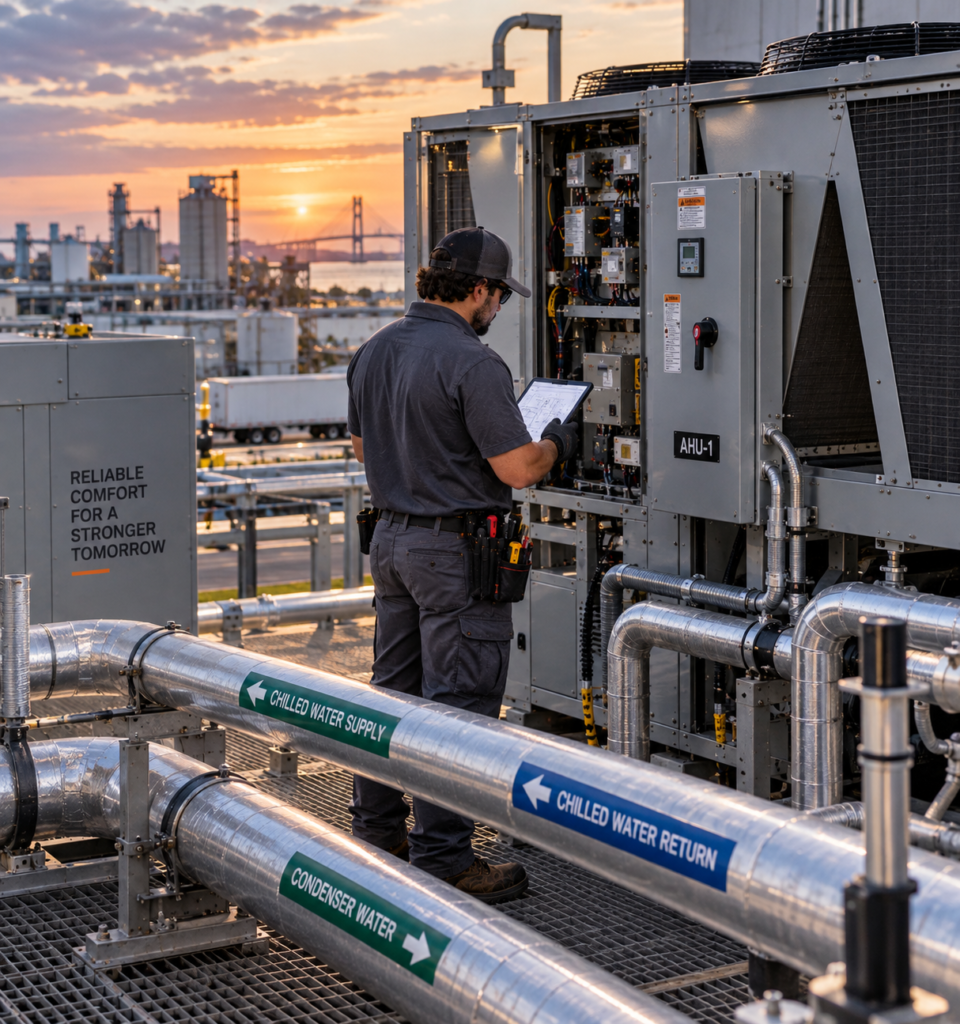
Industrial HVAC maintenance is a critical part of keeping manufacturing plants, warehouses, distribution centers, production facilities, and other industrial buildings operating reliably.
In an industrial environment, HVAC equipment often does much more than provide comfort. Heating, ventilation, cooling, airflow, temperature control, and humidity management may directly affect employees, production areas, electrical rooms, stored materials, equipment, and daily operations.
Jacksonville’s long cooling season, high humidity, heavy equipment runtime, dust, outdoor contaminants, and demanding operating conditions can place significant stress on industrial HVAC systems.
A preventive maintenance strategy helps facility managers identify developing problems before they become emergency repairs, expensive failures, or unplanned operational downtime.
This guide explains seven important benefits of industrial HVAC maintenance, what should be inspected, and how Jacksonville facilities can build a more reliable HVAC maintenance strategy.
Why Industrial HVAC Maintenance Is Important
Industrial HVAC systems often operate under conditions that are considerably more demanding than typical residential equipment.
Depending on the facility, equipment may operate for extended hours, serve large areas, manage significant heat loads, or support spaces with specific ventilation, temperature, or humidity requirements.
Industrial HVAC equipment may include:
- Packaged rooftop units
- Large air-handling units
- Split and packaged HVAC systems
- Exhaust systems
- Make-up air units
- Supply and return fans
- Variable-frequency drives
- Building automation systems
- Chilled-water systems
- Pumps and hydronic equipment
- Process-support HVAC systems
Because industrial facilities vary significantly, the correct industrial HVAC maintenance program should be based on the equipment, operating environment, manufacturer recommendations, equipment criticality, service history, and consequences of failure.
1. Industrial HVAC Maintenance Helps Reduce Downtime
One of the biggest concerns for industrial facility managers is unplanned downtime.
An HVAC problem that might be considered inconvenient in another type of building can become operationally significant inside a production or industrial facility.
A failed rooftop unit, air handler, exhaust fan, control component, or cooling system may affect:
- Production areas
- Employee work zones
- Electrical rooms
- Warehouses
- Equipment rooms
- Temperature-sensitive materials
- Critical indoor environments
Preventive inspections may identify developing problems before equipment stops completely.
These conditions may include:
- Loose electrical connections
- Worn belts
- Motor deterioration
- Dirty coils
- Restricted filters
- Drainage problems
- Abnormal vibration
- Control problems
- Unusual temperatures or pressures
A structured industrial HVAC maintenance program gives facility managers more time to schedule repairs instead of reacting only after a system failure occurs.
2. HVAC Maintenance Can Support Energy Efficiency
HVAC equipment can represent a substantial portion of energy consumption in industrial and commercial facilities.
Equipment does not need to fail completely to become inefficient.
Several common conditions can cause HVAC systems to operate longer or work harder than necessary.
- Dirty condenser coils
- Dirty evaporator coils
- Restricted filters
- Incorrect control schedules
- Improper temperature setpoints
- Airflow problems
- Fan or motor problems
- Damaged insulation
- Simultaneous heating and cooling
Professional industrial HVAC maintenance should evaluate both equipment condition and the way the system is operating.
A mechanically healthy system can still waste energy if controls, schedules, sensors, or setpoints are configured incorrectly.
Facilities using building automation systems may also benefit from reviewing equipment runtime, temperature trends, alarms, operating schedules, and control sequences.
3. Preventive Maintenance Can Help Extend Equipment Life
Industrial HVAC equipment represents a significant capital investment.
Compressors, motors, fans, electrical components, bearings, belts, coils, and controls all experience normal wear during operation.
Poor operating conditions can accelerate that wear.
For example:
- A dirty condenser can increase compressor operating stress.
- A restricted filter can reduce airflow.
- A loose belt can affect fan performance.
- A failing bearing can create vibration and heat.
- An overheated electrical terminal can damage wiring and components.
- Incorrect controls can cause excessive cycling.
Routine industrial HVAC maintenance allows technicians to identify these conditions before they repeatedly place unnecessary stress on major components.
Maintenance cannot prevent every future failure, but it can reduce the likelihood that preventable operating conditions shorten equipment service life.
4. Stable Temperature and Humidity Can Protect Operations
Industrial HVAC systems may support more than employee comfort.
Depending on the type of facility, indoor temperature and humidity may influence:
- Production environments
- Raw materials
- Finished products
- Electronics
- Control equipment
- Storage conditions
- Employee productivity and comfort
Facilities with specific environmental requirements should monitor HVAC performance closely.
Temperature sensors, humidity sensors, thermostats, airflow, coils, controls, and mechanical equipment should operate consistently with the facility’s actual requirements.
A reliable industrial HVAC maintenance strategy helps reduce the risk of environmental conditions drifting unnoticed.
5. Industrial HVAC Maintenance Supports Safer Equipment Operation
Industrial HVAC equipment contains electrical circuits, compressors, motors, rotating fans, belts, pressurized refrigerant systems, and other components that require proper inspection and service practices.
Preventive maintenance can help identify:
- Overheated electrical connections
- Damaged wiring
- Loose components
- Abnormal vibration
- Water or condensate leaks
- Motor overheating
- Mechanical deterioration
HVAC maintenance should always follow manufacturer requirements, site safety procedures, lockout/tagout requirements where applicable, and appropriate electrical and mechanical safety practices.
Documentation is also important in industrial environments.
Facility managers should know what equipment was inspected, what conditions were found, what repairs were completed, and which recommendations remain open.
6. Preventive Maintenance Makes Repair Planning Easier
Reactive maintenance often creates difficult operational decisions because repairs occur after the equipment has already failed.
Emergency failures may require:
- Urgent parts procurement
- Overtime labor
- Emergency service
- Temporary operating changes
- Production adjustments
- Accelerated replacement decisions
With planned industrial HVAC maintenance, facility teams have more opportunities to prioritize recommendations before equipment fails.
Maintenance findings can be separated into:
- Immediate repairs
- Near-term corrective work
- Conditions requiring monitoring
- Long-term capital replacement planning
This helps maintenance managers coordinate HVAC work with production schedules, shutdown windows, budgets, and parts availability.
7. Maintenance Records Improve Equipment Decisions
A well-managed industrial maintenance program creates valuable equipment history.
Repeated inspection records can identify patterns that may not be obvious during a single service visit.
Useful HVAC maintenance records may include:
- Equipment identification
- Location
- Model and serial number
- Maintenance date
- Operating temperatures
- Electrical measurements
- Filter condition
- Belt condition
- Motor observations
- Repairs completed
- Parts replaced
- Recurring alarms
- Recommended corrective work
Over time, industrial HVAC maintenance records can help facility managers identify equipment with recurring failures and determine when continued repair may no longer be the most economical long-term option.
What Should Industrial HVAC Maintenance Include?
Maintenance scope should be customized to the HVAC equipment installed at each facility.
Depending on the system, inspection may include:
- Air filters
- Supply and return airflow
- Evaporator coils
- Condenser coils
- Fan assemblies
- Belts and pulleys
- Bearings
- Motors
- Electrical connections
- Contactors
- Capacitors where applicable
- Refrigerant-system operation
- Condensate drainage
- Thermostats
- Temperature sensors
- Humidity sensors
- Control sequences
- Economizers
- Variable-frequency drives
- Building automation controls
Larger industrial facilities may also require maintenance specific to chillers, pumps, hydronic systems, cooling towers, specialized air-handling equipment, boilers, or process-support HVAC systems.
A generic checklist alone is not enough. The maintenance scope should reflect the actual assets and operational requirements of the facility.
How Often Should Industrial HVAC Equipment Be Serviced?
There is no single maintenance frequency that is appropriate for every industrial HVAC system.
Maintenance intervals should consider:
- Manufacturer recommendations
- Equipment type
- Operating hours
- Equipment criticality
- Environmental conditions
- Dust and contamination levels
- Equipment age
- Previous failures
- Service history
- Seasonal cooling and heating demand
A rooftop unit serving a clean office environment may require a different maintenance schedule than an air handler serving a dusty manufacturing area.
For that reason, a risk-based industrial HVAC maintenance schedule is often more effective than assigning the same maintenance frequency to every asset.
Preventive vs. Reactive vs. Predictive HVAC Maintenance
Reactive Maintenance
Reactive maintenance means repairing equipment after a failure has already occurred.
This strategy may be appropriate for certain low-cost, noncritical assets where equipment failure does not significantly affect operations.
Preventive Maintenance
Preventive maintenance means inspecting and servicing equipment according to a planned schedule.
Filters, coils, belts, motors, electrical components, controls, drainage systems, and operating conditions can be evaluated before complete equipment failure occurs.
Predictive Maintenance
Predictive maintenance uses equipment-condition data to identify developing problems.
Depending on the facility, this may include:
- Vibration monitoring
- Temperature measurements
- Electrical measurements
- Building automation trends
- Motor current
- Pressure trends
- Equipment runtime data
Many industrial facilities benefit from combining preventive, predictive, and reactive maintenance strategies according to equipment importance.
Facility managers can review additional operation and maintenance information from the
U.S. Department of Energy Operations and Maintenance Best Practices Guide
.
Industrial HVAC Maintenance and Energy Management
Maintenance and energy management are closely connected.
HVAC systems with dirty coils, restricted filters, malfunctioning controls, incorrect schedules, poor airflow, or failing motors may consume more energy than necessary.
Facility teams should consider monitoring:
- Equipment runtime
- Energy consumption
- Temperature trends
- Setpoints
- Equipment schedules
- Fan speeds
- Recurring alarms
ENERGY STAR provides additional information for commercial and industrial building operators through its
ENERGY STAR Buildings and Plants
resources.
Why Jacksonville Industrial Facilities Need a Local HVAC Strategy
Northeast Florida creates demanding operating conditions for HVAC equipment.
Jacksonville facilities may experience:
- Long annual cooling seasons
- High humidity
- Extended compressor runtime
- Heavy condensate production
- Outdoor dirt and debris
- High summer temperatures
- Corrosive environmental conditions in certain locations
Outdoor coils should be inspected for contamination and deterioration. Drain systems should remain clear. Electrical connections and enclosures should be inspected for signs of heat, moisture, and corrosion.
For this reason, industrial HVAC maintenance in Jacksonville should consider the real environmental conditions surrounding each HVAC asset.
Signs Industrial HVAC Equipment Needs Attention
Facility managers should investigate changes in HVAC performance before those changes become accepted as normal.
Warning signs may include:
- Increasing temperature complaints
- Uneven temperatures
- Unexpected humidity changes
- Long equipment run times
- Recurring alarms
- Unusual vibration
- New mechanical noises
- Electrical buzzing
- Water or condensate leaks
- Frequent overload trips
- Repeated component failures
- Increasing energy consumption
Repeated changes are especially important.
One abnormal event may not always indicate a major failure, but recurring problems involving the same equipment should be investigated.
What Facility Managers Should Track
A strong industrial HVAC maintenance program should create information that can support future decisions.
Facility teams may benefit from tracking:
- Asset identification
- Equipment location
- Maintenance frequency
- Open recommendations
- Recurring failures
- Critical spare parts
- Equipment downtime
- Repair costs
- Energy trends
- Runtime trends
This approach transforms HVAC maintenance from a series of isolated service calls into a long-term equipment-management strategy.
Industrial HVAC Maintenance vs. Waiting for Failure
Waiting until equipment fails may appear less expensive in the short term because fewer scheduled maintenance visits are performed.
However, equipment failure rarely occurs at the most convenient time.
HVAC systems can fail:
- During peak production
- During extreme weather
- At night
- On weekends
- When replacement parts are unavailable
A proactive industrial HVAC maintenance strategy gives facility managers more control over when corrective work is performed.
Industrial HVAC Maintenance in Jacksonville FL
Thermo Technology provides professional HVAC diagnostics, maintenance, repair, and installation for industrial facilities in Jacksonville and Northeast Florida.
Our approach begins by understanding the facility, identifying HVAC assets, and determining which systems are most important to daily operation.
From there, an industrial HVAC maintenance plan can be developed based on equipment condition, operating environment, manufacturer requirements, service history, and facility priorities.
Thermo Technology can support industrial customers with preventive maintenance, HVAC troubleshooting, corrective repairs, and equipment-condition evaluation.
Learn more about
Thermo Technology HVAC services in Jacksonville
or visit our
HVAC resource center
for additional maintenance and troubleshooting information.
Build a More Reliable Industrial HVAC Maintenance Plan
If HVAC reliability affects your facility’s daily operation, waiting for equipment failure should not be your only maintenance strategy.
Contact Thermo Technology to discuss industrial HVAC maintenance, preventive inspections, HVAC repairs, and equipment-condition monitoring for your Jacksonville facility.
Call or text:
(904) 240-2725
Frequently Asked Questions About Industrial HVAC Maintenance
What is industrial HVAC maintenance?
Industrial HVAC maintenance is the planned inspection, testing, cleaning, adjustment, and servicing of heating, ventilation, and air-conditioning equipment used in industrial facilities.
How often should industrial HVAC systems be maintained?
Maintenance frequency depends on equipment type, operating hours, manufacturer recommendations, environmental conditions, equipment criticality, age, and service history.
Can industrial HVAC maintenance reduce downtime?
Preventive maintenance can identify developing equipment problems before they cause unexpected failures. It cannot prevent every breakdown, but it can improve the facility’s ability to plan corrective work.
Can HVAC maintenance reduce industrial energy costs?
Maintenance can support energy efficiency by correcting dirty coils, restricted filters, airflow problems, control issues, unnecessary runtime, and other conditions that cause HVAC equipment to work harder than necessary.
What equipment is included in industrial HVAC maintenance?
Depending on the facility, maintenance may include rooftop units, air handlers, packaged equipment, ventilation systems, fans, motors, VFDs, controls, pumps, chilled-water equipment, and other mechanical systems.
What is the difference between preventive and reactive HVAC maintenance?
Reactive maintenance repairs equipment after failure. Preventive maintenance inspects and services equipment according to a planned schedule so developing problems can be identified before complete failure occurs.
Does Thermo Technology provide industrial HVAC maintenance in Jacksonville FL?
Yes. Thermo Technology provides industrial HVAC maintenance, diagnostics, repair, and installation for facilities throughout Jacksonville and Northeast Florida. Call or text (904) 240-2725 to discuss your facility.