
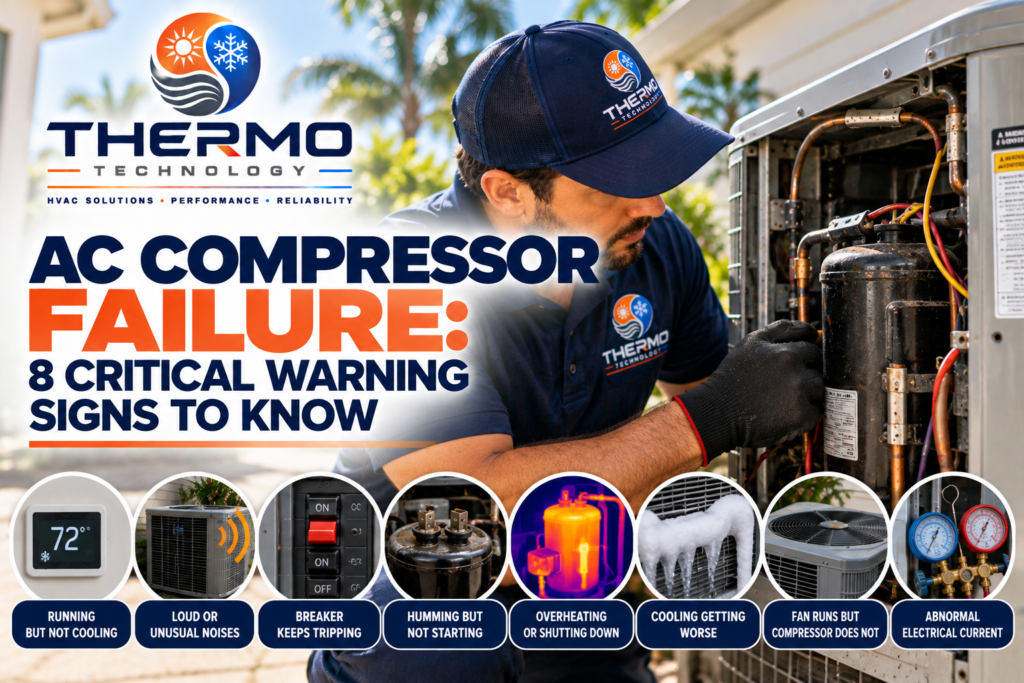
AC Compressor Failure: 8 Critical Warning Signs to Know
An AC compressor failure is one of the most serious problems an air-conditioning system can develop. Because the compressor is responsible for moving refrigerant through the refrigeration cycle, a major compressor problem can significantly reduce cooling or stop the system from cooling altogether.
However, symptoms that appear to indicate an AC compressor failure can sometimes be caused by less expensive components such as a capacitor, contactor, thermostat, electrical connection, fan motor, or refrigerant problem.
This guide from Thermo Technology explains eight common warning signs of compressor trouble, what can cause compressor problems, how HVAC technicians diagnose them, and when repairing or replacing the system may make more sense.
What Does an AC Compressor Do?
The compressor is a central component of the refrigeration cycle inside an air conditioner or heat pump.
Its job is to compress refrigerant vapor and move refrigerant through the HVAC system so heat can be transferred from inside the home to the outdoors.
A typical cooling cycle involves:
- Indoor heat being absorbed at the evaporator coil
- Refrigerant carrying that heat through the system
- The compressor increasing refrigerant pressure and temperature
- The condenser coil releasing heat outdoors
- The refrigerant returning to the indoor side to repeat the cycle
Without proper compressor operation, the refrigeration cycle cannot function normally.
According to
Carrier’s AC compressor guide
,
the compressor circulates and compresses refrigerant so the air-conditioning system can transfer heat and cool the home.
What Is AC Compressor Failure?
AC compressor failure occurs when the compressor can no longer start, run, or compress refrigerant correctly.
Compressor problems may involve:
- Electrical failure
- Internal mechanical damage
- Overheating
- Motor winding problems
- Lubrication problems
- Refrigerant-related operating conditions
- Long-term wear
Some compressor problems develop gradually, while others can cause a sudden loss of cooling.
1. The AC Is Running but Not Cooling
One of the most common warning signs associated with AC compressor failure is an air conditioner that appears to be operating but does not provide normal cooling.
The indoor blower may still move air through the vents even when the refrigeration system is not operating correctly.
You may notice:
- Warm or room-temperature air from the vents
- The thermostat temperature continuing to rise
- Long cooling cycles
- The outdoor unit operating abnormally
- Little difference between supply and return air temperature
However, poor cooling does not automatically mean the compressor has failed.
Other causes can include:
- Dirty air filter
- Frozen evaporator coil
- Refrigerant leak
- Bad capacitor
- Contactor problem
- Thermostat issue
- Restricted airflow
This is why proper diagnosis should come before recommending compressor replacement.
2. Loud or Unusual Noises From the Outdoor Unit
Strange noises can be another warning sign of AC compressor failure.
A properly operating compressor normally produces a relatively consistent operating sound.
Unusual noises may include:
- Grinding
- Banging
- Rattling
- Screeching
- Excessive vibration
- Abnormally loud humming
Some noises can indicate internal mechanical problems, while others may be caused by loose components, fan problems, contactors, capacitors, or refrigerant conditions.
Trane’s compressor guidance
also identifies unusual banging, clattering, hissing, and screeching sounds as reasons to have the HVAC system professionally evaluated.
3. The Circuit Breaker Keeps Tripping
A repeatedly tripping breaker can sometimes be related to AC compressor failure.
A compressor experiencing electrical or mechanical problems may draw abnormal current or overheat.
However, a tripping breaker can have many causes, including:
- Shorted wiring
- Failed fan motor
- Bad capacitor
- Loose electrical connections
- Contactor problems
- Compressor electrical failure
If the air-conditioning breaker repeatedly trips, do not continue resetting it.
The breaker is a safety device designed to interrupt abnormal electrical conditions.
The cause should be diagnosed before the HVAC system continues operating.
4. The Compressor Tries to Start but Cannot
Another possible sign of AC compressor failure is a compressor that attempts to start but cannot remain operating.
You may hear:
- Humming
- Repeated startup attempts
- A click followed by silence
- The outdoor unit attempting to restart after several minutes
This does not automatically mean the compressor itself has failed.
Starting problems can also involve:
- Run capacitor
- Start capacitor
- Potential relay
- Contactor
- Voltage problems
- Loose electrical connections
Testing these components before condemning the compressor is important because they may create very similar symptoms.
5. The Outdoor Unit Overheats or Shuts Down
Overheating can be associated with AC compressor failure or abnormal compressor operation.
HVAC systems include protective devices designed to shut components down when temperatures or electrical conditions become unsafe.
Possible contributors to compressor overheating include:
- Dirty condenser coil
- Condenser fan failure
- Incorrect refrigerant conditions
- Electrical problems
- High outdoor temperatures
- Low voltage
- Internal compressor problems
A system that repeatedly shuts down and restarts should be professionally evaluated rather than forced to continue operating.
6. Cooling Performance Is Gradually Getting Worse
Not every AC compressor failure happens suddenly.
Some problems develop gradually.
You may notice that the air conditioner:
- Runs longer than before
- Struggles during the hottest part of the day
- No longer maintains the thermostat setting
- Uses more electricity
- Produces less cooling than it previously did
A gradual decrease in cooling performance can also be caused by dirty coils, airflow problems, duct leakage, refrigerant loss, or building changes.
The compressor should be evaluated as part of the complete HVAC system.
7. The Outdoor Fan Runs but the Compressor Does Not
Sometimes the condenser fan is operating while the compressor is not.
This can make an AC compressor failure seem likely, but additional testing is still required.
Possible causes include:
- Failed capacitor section
- Compressor thermal overload
- Electrical connection problem
- Contactor issue
- Control problem
- Internal compressor failure
The outdoor fan and compressor are separate components even though they operate inside the same condenser unit.
One can operate while the other does not.
8. The Compressor Draws Abnormal Electrical Current
An AC compressor failure may also appear through abnormal electrical measurements.
An HVAC technician can evaluate:
- Compressor amperage
- Supply voltage
- Motor winding resistance
- Electrical continuity
- Ground faults
- Starting behavior
These measurements can help determine whether the compressor motor is operating within expected conditions.
This type of testing should be performed by trained HVAC personnel because the outdoor unit contains high-voltage electrical components.
AC Compressor Failure vs. Bad Capacitor
A bad capacitor can create symptoms that closely resemble AC compressor failure.
Both problems may cause:
- Humming
- Difficulty starting
- No cooling
- Outdoor unit shutdown
- Electrical problems
The difference can be extremely important.
A capacitor is a separate electrical component that supports compressor motor operation.
If the capacitor fails but the compressor remains healthy, replacing the correct capacitor may restore normal operation.
Carrier notes that capacitor problems can prevent compressors or fan motors from starting normally, which is why electrical testing is important before diagnosing compressor failure.
AC Compressor Failure vs. Refrigerant Leak
A refrigerant leak can also create symptoms similar to AC compressor failure.
Low refrigerant conditions may result in:
- Reduced cooling
- Long operating cycles
- Frozen evaporator coils
- Abnormal system pressures
The compressor itself may still be functional.
A qualified technician can evaluate refrigerant pressures, temperatures, compressor operation, airflow, and other system conditions to identify the actual cause.
What Causes AC Compressor Failure?
AC compressor failure can result from many different operating conditions.
Common contributing factors include:
- Electrical problems
- Incorrect refrigerant charge
- Refrigerant leaks
- Dirty condenser coils
- Condenser fan problems
- Poor airflow
- Voltage problems
- Contamination inside the refrigeration system
- Long-term mechanical wear
A compressor rarely operates completely independently from the rest of the HVAC system.
Problems elsewhere in the system can create conditions that place additional stress on the compressor.
Dirty Condenser Coils and Compressor Stress
The outdoor condenser coil must release heat from the refrigerant to the surrounding air.
If the coil becomes heavily restricted by dirt or debris, the system may have difficulty rejecting heat.
This can contribute to elevated operating temperatures and pressures.
Keeping the condenser coil properly maintained is therefore important for the entire refrigeration system, including the compressor.
Can a Refrigerant Leak Damage the Compressor?
Significant refrigerant problems can create abnormal operating conditions that may contribute to compressor stress.
The refrigeration system is designed to operate with a specific refrigerant charge and proper refrigerant flow.
If those conditions change substantially, cooling performance and compressor operation can be affected.
A refrigerant leak should therefore be diagnosed rather than repeatedly adding refrigerant without locating the cause.
Can Electrical Problems Cause AC Compressor Failure?
Yes. Electrical conditions can play an important role in AC compressor failure.
Potential electrical problems include:
- Incorrect voltage
- Loose electrical connections
- Contactor damage
- Capacitor failure
- Power surges
- Wiring problems
- Motor winding faults
Because compressors use high-voltage electricity, electrical diagnosis should be performed by trained HVAC professionals.
AC Compressor Failure in Hot Climates
AC compressor failure can be especially disruptive in hot climates because air conditioners may operate many hours each day.
In areas such as Florida, HVAC systems experience:
- Long cooling seasons
- High outdoor temperatures
- High humidity
- Heavy annual operating hours
These conditions make correct installation, clean coils, proper airflow, correct refrigerant conditions, and preventive maintenance particularly important.
Coastal Conditions and Compressor Reliability
Homes near coastal environments face another challenge: corrosion.
Salt exposure can damage:
- Condenser coils
- Electrical terminals
- Cabinet components
- Fasteners
- Wiring connections
Corrosion does not directly mean the compressor will fail, but deterioration elsewhere in the outdoor unit can contribute to operating problems that affect overall HVAC reliability.
For properties near Jacksonville Beach, Atlantic Beach, Neptune Beach, Ponte Vedra Beach, Mayport, and other coastal communities, outdoor equipment condition deserves additional attention.
How HVAC Technicians Diagnose AC Compressor Failure
A professional diagnosis of AC compressor failure should include more than listening to the outdoor unit.
A technician may evaluate:
- Thermostat call for cooling
- Supply voltage
- Contactor operation
- Capacitor condition
- Compressor amperage
- Motor windings
- Refrigeration pressures
- System temperatures
- Condenser fan operation
- Compressor temperature
The objective is to determine whether the compressor itself has failed or whether another component is preventing it from operating correctly.
What Is a Locked Compressor?
A compressor motor may sometimes be unable to start even though electrical power is reaching it.
This condition is sometimes described as a locked rotor or locked compressor.
Possible causes can include internal mechanical problems or electrical startup problems.
A technician may need to evaluate the compressor along with:
- Capacitor
- Starting components
- Voltage
- Electrical connections
- Motor windings
A compressor should not be declared mechanically failed until appropriate electrical testing has been completed.
Can an AC Compressor Be Repaired?
Some external problems affecting compressor operation can be repaired without replacing the compressor itself.
Examples include:
- Bad capacitor
- Electrical connection problem
- Contactor failure
- External wiring fault
However, residential hermetic compressors are sealed components.
Severe internal mechanical or motor failure commonly requires compressor replacement rather than internal field repair.
AC Compressor Replacement vs. New AC System
When true AC compressor failure is confirmed, one of the biggest decisions is whether to replace the compressor or replace more of the HVAC system.
Several factors should be considered:
- Equipment age
- Compressor warranty
- Labor cost
- Refrigerant type
- Coil condition
- Overall equipment condition
- Previous repair history
- Current system efficiency
A relatively new system with a compressor covered under warranty may justify compressor replacement.
An older system with severe corrosion, coil problems, repeated repairs, or other major deterioration may deserve a broader replacement evaluation.
Carrier similarly recommends considering equipment age, warranty, repair cost, efficiency, and overall system condition when deciding between compressor and system replacement. :contentReference[oaicite:1]{index=1}
Does a Compressor Warranty Cover Everything?
Not necessarily.
A manufacturer parts warranty may cover an eligible compressor itself while other expenses can remain the responsibility of the property owner.
Depending on the warranty and installation, these may include:
- Labor
- Refrigerant
- Shipping
- Diagnostic charges
- Additional materials
Warranty terms vary by manufacturer, model, registration status, and installation date.
Always verify the specific warranty associated with the equipment rather than assuming all compressor replacement costs are covered.
Can Preventive Maintenance Help Protect the Compressor?
Preventive maintenance cannot guarantee that AC compressor failure will never occur.
However, maintenance can identify conditions that may contribute to compressor stress.
A professional HVAC maintenance visit may include:
- Condenser coil inspection
- Electrical inspection
- Capacitor testing
- Contactor inspection
- Refrigerant system evaluation
- Airflow inspection
- Condenser fan inspection
- Operating temperature evaluation
Identifying problems early can help prevent some minor issues from developing into larger failures.
What Should You Do if You Suspect AC Compressor Failure?
If you suspect an AC compressor failure, avoid repeatedly restarting equipment that is humming, tripping breakers, overheating, or shutting down abnormally.
You can safely verify:
- The thermostat is set to Cool
- The thermostat temperature is below room temperature
- The indoor blower is operating
- The outdoor unit is operating
- The HVAC breaker has not tripped
Do not open electrical compartments or attempt to test the compressor yourself.
The outdoor condenser contains high-voltage electrical components and pressurized refrigerant.
Trane specifically advises that compressor inspection and service should be performed by qualified HVAC technicians because of high-voltage electrical hazards. :contentReference[oaicite:2]{index=2}
Professional AC Compressor Diagnostics
A suspected AC compressor failure should be properly diagnosed before an expensive replacement is authorized.
At Thermo Technology, we provide residential and commercial HVAC diagnostics, repair, maintenance, and installation.
Our services include:
- Compressor diagnostics
- Air-conditioning repair
- Electrical HVAC diagnostics
- Refrigerant-system diagnostics
- Heat pump repair
- Preventive HVAC maintenance
- HVAC system replacement
- Commercial HVAC service
Learn more about
HVAC services from Thermo Technology
.
Visit the
Thermo Technology HVAC Blog
for additional information about AC repair, capacitor failure, refrigerant leaks, airflow problems, system efficiency, and HVAC maintenance.
Do Not Assume Every Cooling Problem Is AC Compressor Failure
AC compressor failure is a major HVAC problem, but several less expensive components can create similar symptoms.
A bad capacitor, electrical connection, contactor, refrigerant problem, thermostat issue, or fan failure can sometimes prevent the compressor from operating correctly.
Accurate diagnosis is therefore essential before replacing one of the most expensive components in the HVAC system.
Contact Thermo Technology for professional AC compressor diagnostics and HVAC repair.
Thermo Technology — HVAC Solutions • Performance • Reliability.
Frequently Asked Questions About AC Compressor Failure
What are the signs of AC compressor failure?
Common signs of AC compressor failure can include poor cooling, unusual noises, repeated breaker trips, difficulty starting, overheating, abnormal shutdowns, and a condenser fan running while the compressor remains off.
Can a bad capacitor look like compressor failure?
Yes. A failed or weak capacitor can prevent a compressor from starting and can produce humming or no-cooling symptoms similar to a compressor problem.
Can a refrigerant leak damage the compressor?
Severe refrigerant problems can create abnormal operating conditions that may place additional stress on the compressor. The leak and overall refrigeration-system operation should be professionally diagnosed.
Why does my compressor hum but not start?
Possible causes include a bad capacitor, starting-component problem, voltage issue, electrical connection fault, thermal overload, or internal compressor failure.
Can a bad compressor trip the breaker?
Yes. Certain compressor electrical or mechanical failures can cause abnormal current draw and trip the circuit breaker. Other electrical problems can create the same symptom.
Can an AC compressor be repaired?
External electrical problems affecting compressor operation may be repairable. Severe internal failure of a sealed residential compressor generally requires replacement of the compressor.
Is replacing an AC compressor worth it?
It depends on equipment age, warranty coverage, refrigerant type, overall system condition, labor cost, repair history, and the cost of replacing the HVAC system.
Should I keep resetting the breaker if my AC compressor trips it?
No. Repeated breaker trips indicate an electrical problem that should be diagnosed before the system continues operating.
Can maintenance prevent AC compressor failure?
Maintenance cannot prevent every compressor failure, but it can identify dirty coils, electrical problems, capacitor deterioration, fan problems, and abnormal refrigeration conditions that may place additional stress on the compressor.