
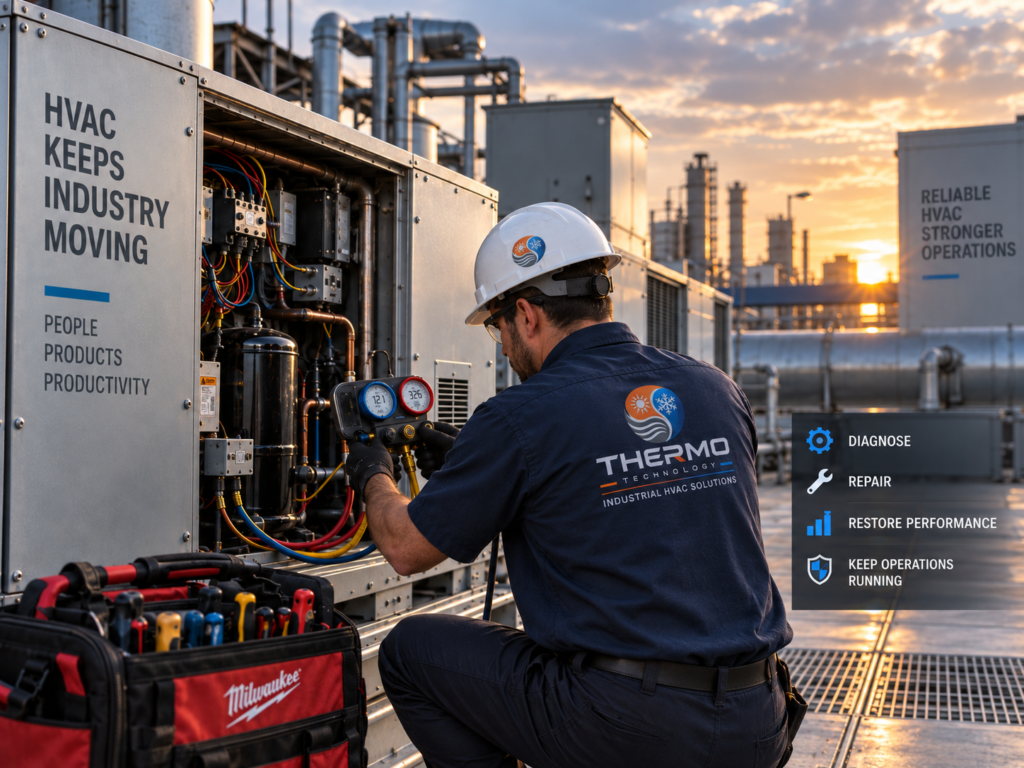
Industrial HVAC repair should not begin only after equipment completely stops operating. Many heating, ventilation, and air-conditioning systems show warning signs before a major failure occurs.
For manufacturing plants, warehouses, distribution centers, production facilities, and other industrial buildings, recognizing those warning signs early can give facility managers more time to plan repairs, obtain parts, coordinate shutdown windows, and reduce operational disruption.
Jacksonville’s long cooling season, high humidity, outdoor contamination, and heavy HVAC runtime can place significant demand on industrial equipment throughout much of the year.
Changes in temperature, airflow, sound, vibration, electrical operation, energy consumption, or equipment runtime should not automatically be considered normal aging.
Here are nine warning signs that may indicate your facility should schedule industrial HVAC repair before a developing problem becomes an emergency.
Why Early Industrial HVAC Repair Matters
Industrial HVAC systems often serve areas where equipment reliability affects much more than comfort.
Depending on the facility, HVAC performance may influence:
- Production environments
- Electrical rooms
- Control rooms
- Warehouses
- Employee work areas
- Temperature-sensitive materials
- Equipment rooms
- Process-support spaces
Waiting until equipment completely fails can reduce the facility’s ability to control when and how repairs are performed.
Early diagnosis gives maintenance teams an opportunity to determine whether the condition requires immediate corrective work, monitoring, planned repair, or long-term replacement.
1. Increasing Temperature Complaints
Repeated temperature complaints are one of the clearest signs that HVAC performance may be changing.
A single complaint does not necessarily indicate equipment failure. However, recurring temperature problems in the same area deserve investigation.
Possible causes can include:
- Reduced airflow
- Dirty coils
- Fan problems
- Control issues
- Refrigeration-system problems
- Sensor errors
- Equipment capacity issues
Facility managers should pay attention to trends rather than isolated events.
If an area that previously maintained temperature reliably begins struggling under similar operating conditions, the HVAC system should be evaluated.
2. HVAC Equipment Runs Longer Than It Used To
Longer operating cycles can indicate that the equipment is working harder to maintain the same indoor conditions.
Possible causes may include:
- Dirty condenser coils
- Dirty evaporator coils
- Restricted filters
- Airflow problems
- Control problems
- Refrigeration-system conditions
- Changes in facility load
Runtime should always be evaluated together with outdoor temperature, production conditions, occupancy, and building load.
However, a significant unexplained increase in runtime can be an early warning that industrial HVAC repair or maintenance is required.
3. New or Increasing Mechanical Noise
Industrial HVAC systems contain motors, fans, belts, bearings, compressors, and other moving components.
Some mechanical sound is normal. A new or increasingly loud sound is different.
Warning noises may include:
- Grinding
- Squealing
- Metallic banging
- Repeated clicking
- Excessive humming
- Rattling
These sounds may indicate loose components, fan problems, worn belts, bearing deterioration, motor problems, electrical faults, or compressor-related conditions.
Continuing to operate equipment with severe mechanical noise may allow a relatively small problem to affect additional components.
4. Excessive Vibration
Fans, motors, compressors, and other rotating equipment naturally produce some vibration.
A noticeable increase in vibration deserves investigation.
Possible causes include:
- Fan imbalance
- Loose mounting hardware
- Bearing wear
- Belt problems
- Motor alignment issues
- Damaged fan components
- Compressor vibration
Excessive vibration can also loosen electrical connections, damage mounting points, and accelerate mechanical wear.
Facilities using predictive maintenance may track vibration over time to detect changes before equipment failure occurs.
5. Repeated Electrical Trips or HVAC Alarms
Repeated breaker trips, motor overloads, control alarms, or equipment resets should not be considered normal operation.
Possible causes may include:
- Motor problems
- Compressor electrical problems
- Loose electrical connections
- Overheated components
- Control faults
- Abnormal equipment load
Repeatedly resetting protection devices without identifying the underlying condition can hide a developing equipment problem.
Industrial HVAC repair involving electrical components should include proper testing rather than simply resetting controls and returning the equipment to operation.
6. Water or Condensate Problems
Cooling equipment naturally produces condensate as moisture is removed from the air.
Water appearing where it should not may indicate:
- Clogged drain lines
- Damaged drain pans
- Poor drainage
- Frozen coils
- Condensate pump problems
- Damaged insulation
Industrial facilities should take water problems seriously because leaks can affect floors, ceilings, insulation, electrical equipment, controls, and nearby building materials.
A small drainage problem can become considerably more expensive if it is ignored.
7. Unexpected Humidity Changes
In Jacksonville, humidity management can be an important part of HVAC performance.
If an area becomes noticeably more humid than before, the HVAC system may not be removing moisture effectively.
Possible conditions include:
- Airflow problems
- Control issues
- Equipment short cycling
- Reduced cooling capacity
- Sensor problems
Humidity changes may be especially important in facilities containing sensitive materials, electronics, production equipment, or products requiring controlled storage conditions.
8. Energy Consumption Increases Without an Obvious Reason
Rising HVAC energy consumption can have many causes.
Changes in weather, production load, occupancy, facility schedules, and building use should always be considered.
If these conditions remain relatively stable, increasing HVAC energy use may indicate:
- Dirty coils
- Restricted airflow
- Fan or motor problems
- Control problems
- Incorrect operating schedules
- Equipment running longer than necessary
Facilities with building automation or energy-management systems can compare current operating data with historical periods to identify abnormal trends.
ENERGY STAR provides energy-management resources specifically for commercial buildings and industrial plants through its
ENERGY STAR Buildings and Plants
program.
An unexplained increase in energy consumption does not automatically mean major industrial HVAC repair is necessary, but it is a strong reason to investigate system performance.
9. The Same HVAC Problem Keeps Returning
Repeated failure of the same equipment deserves a deeper evaluation.
If a component is replaced several times without understanding why it continues to fail, the underlying problem may exist somewhere else in the system.
Recurring failures can involve:
- Operating conditions
- Electrical problems
- Airflow
- Control sequences
- Installation conditions
- Equipment sizing
- Environmental contamination
Maintenance history becomes especially valuable in these situations.
Reviewing previous repairs, electrical measurements, component replacements, operating conditions, and alarm history may reveal a pattern that isolated service calls do not show.
Industrial HVAC Repair vs. Preventive Maintenance
Repair and preventive maintenance are closely related, but they serve different purposes.
Preventive maintenance focuses on inspecting and servicing equipment before a failure occurs.
Repair corrects a condition that has already developed.
The strongest facility strategy uses preventive maintenance to identify problems early and planned industrial HVAC repair to correct them before emergency failure whenever possible.
Read our guide about
preventive vs. reactive HVAC maintenance
to understand how these approaches compare.
When Does an Industrial HVAC Problem Become an Emergency?
The urgency of an HVAC problem depends on the facility and the equipment affected.
Immediate attention may be appropriate when:
- Critical production areas lose cooling
- Electrical or control rooms exceed acceptable temperatures
- Smoke or burning odor is present
- Equipment repeatedly trips electrical protection
- Severe mechanical noise develops
- Water threatens electrical or production equipment
- Ventilation serving a critical process stops operating
Facility managers should establish escalation procedures before these events occur so employees know how critical HVAC failures should be handled.
Repair or Replace Industrial HVAC Equipment?
Not every HVAC failure justifies complete equipment replacement.
Facility managers should consider:
- Equipment age
- Overall condition
- Repair history
- Current repair cost
- Parts availability
- Energy performance
- Equipment criticality
- Expected remaining service life
A relatively new system with a repairable electrical problem may be a strong repair candidate.
An older asset with repeated major failures, declining efficiency, and difficult-to-source parts may deserve a broader replacement analysis.
How Maintenance Records Improve Industrial HVAC Repair Decisions
Good maintenance documentation makes repair decisions more informed.
Useful records may include:
- Previous failures
- Parts replaced
- Electrical measurements
- Operating temperatures
- Motor data
- Refrigerant-related work
- Recurring alarms
- Repair costs
- Technician recommendations
Without equipment history, each repair can become an isolated event.
With reliable service records, technicians and facility managers can identify recurring conditions and make better long-term decisions.
Industrial HVAC Repair and Operations & Maintenance Best Practices
Industrial facilities can also improve reliability by combining corrective repair with a structured operations and maintenance strategy.
The U.S. Department of Energy provides guidance covering preventive, predictive, and reliability-focused maintenance strategies in its
Operations and Maintenance Best Practices Guide
.
Using equipment history, condition data, operating trends, and scheduled inspections can help facility managers move from repeated emergency repairs toward more predictable asset management.
What Should Facility Managers Do Before Calling for HVAC Repair?
Before scheduling service, gather as much useful information as possible without opening or working on unsafe equipment.
Record:
- Which HVAC asset is affected
- Equipment location
- When the problem started
- Current indoor temperature
- Alarm codes
- Unusual noise or vibration
- Whether electrical protection has tripped
- Whether the equipment is still operating
- Whether the problem has happened previously
This information can help the HVAC technician understand the condition more quickly and compare it with previous equipment behavior.
Industrial HVAC Repair and Equipment Criticality
Not every HVAC system deserves the same repair priority.
Facilities should classify equipment according to the operational consequences of failure.
High-priority HVAC assets may serve:
- Production lines
- Electrical rooms
- Server or control rooms
- Critical employee areas
- Temperature-sensitive storage
- Specialized manufacturing processes
Critical equipment may justify faster response requirements, spare-parts planning, backup capacity, additional monitoring, and more frequent preventive inspections.
Can Industrial HVAC Repair Reduce Future Downtime?
An effective repair should do more than simply restart the equipment.
When possible, technicians should determine why the component failed and whether related systems or operating conditions contributed to the failure.
For example, replacing a failed motor without addressing excessive vibration, poor airflow, overheating, or abnormal electrical conditions may leave the original cause unresolved.
Effective industrial HVAC repair combines correction of the immediate failure with evaluation of the conditions that contributed to it.
Industrial HVAC Maintenance Can Help Prevent Emergency Repairs
Preventive maintenance cannot eliminate every equipment failure, but it can identify many conditions before they result in complete shutdown.
A maintenance program may include inspection of:
- Air filters
- Belts and pulleys
- Motors
- Electrical connections
- Coils
- Drainage systems
- Controls
- Refrigeration-system operation
If your facility is developing a broader maintenance strategy, read our complete guide to
industrial HVAC maintenance in Jacksonville FL
.
Industrial HVAC Repair in Jacksonville FL
Thermo Technology provides professional industrial HVAC repair, diagnostics, maintenance, and installation for facilities throughout Jacksonville and Northeast Florida.
Our approach focuses on identifying the actual cause of equipment problems before recommending repairs or major component replacement.
Depending on the equipment, industrial HVAC diagnosis may include evaluation of:
- Motors
- Fans
- Belts
- Electrical components
- Controls
- Airflow
- Coils
- Refrigeration-system performance
- Drainage systems
- Building automation operation
The goal is not simply to return equipment to operation, but to help facility managers understand what failed, why it failed, and whether additional corrective action should be considered.
Do Not Wait for a Complete Industrial HVAC Failure
New vibration, temperature problems, repeated alarms, unusual noise, water leaks, longer runtime, and electrical trips can all be early warnings of developing HVAC problems.
Contact Thermo Technology for professional industrial HVAC repair and diagnostics in Jacksonville and Northeast Florida.
Call or text:
(904) 240-2725
Frequently Asked Questions About Industrial HVAC Repair
What are common signs an industrial HVAC system needs repair?
Common warning signs include temperature changes, increased runtime, unusual noise, excessive vibration, repeated electrical trips, water leaks, humidity problems, rising energy consumption, and recurring equipment failures.
Should industrial HVAC equipment be repaired before it completely fails?
When developing problems can be identified early, planned repair may allow facility managers to coordinate parts, labor, and shutdown timing before complete equipment failure occurs.
What causes repeated industrial HVAC failures?
Recurring problems can involve equipment condition, electrical issues, airflow, controls, installation conditions, environmental contamination, operating conditions, or another problem that was not corrected during a previous repair.
When should industrial HVAC equipment be replaced instead of repaired?
Replacement decisions should consider equipment age, condition, repair history, repair cost, parts availability, energy performance, criticality, and expected remaining service life.
Can preventive maintenance reduce industrial HVAC repairs?
Preventive maintenance cannot eliminate every failure, but it can identify many developing conditions before they create larger repair needs or emergency shutdowns.
Why is HVAC equipment criticality important?
Equipment serving production, electrical rooms, control areas, temperature-sensitive spaces, or other critical operations may require faster response and more intensive maintenance than lower-priority assets.
Does Thermo Technology provide industrial HVAC repair in Jacksonville FL?
Yes. Thermo Technology provides industrial HVAC repair, diagnostics, preventive maintenance, and installation services throughout Jacksonville and Northeast Florida. Call or text (904) 240-2725 to discuss your facility.