
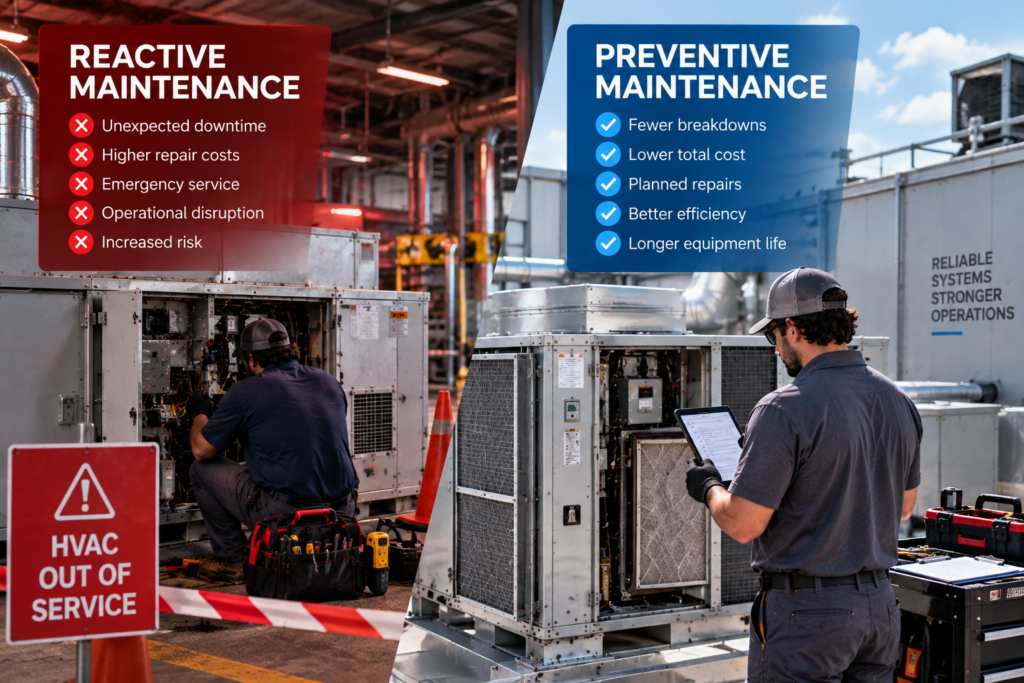
Preventive HVAC maintenance and reactive HVAC maintenance represent two very different ways of managing industrial heating, ventilation, and air-conditioning equipment.
In a reactive strategy, equipment is repaired after something fails. In a preventive strategy, systems are inspected and serviced on a planned schedule so developing problems can be identified before they interrupt operations.
For manufacturing plants, warehouses, distribution centers, production facilities, and other industrial buildings, the difference can affect much more than the HVAC repair bill.
Unexpected HVAC failures can create production interruptions, uncomfortable working conditions, emergency labor, urgent parts procurement, and difficult operational decisions.
This guide explains how preventive HVAC maintenance compares with reactive maintenance and seven ways a planned maintenance strategy can help industrial facilities control risk and downtime.
What Is Preventive HVAC Maintenance?
Preventive maintenance means inspecting, testing, cleaning, adjusting, and servicing HVAC equipment according to a planned schedule.
Instead of waiting for equipment to stop working, technicians inspect systems while they are still operating.
Depending on the equipment, preventive maintenance may include:
- Air filter inspection and replacement
- Coil inspection and cleaning
- Belt inspection and adjustment
- Fan and motor inspection
- Electrical connection inspection
- Contactor and capacitor evaluation
- Condensate drainage inspection
- Refrigeration-system evaluation
- Temperature and sensor verification
- Control-system testing
- Building automation review
The exact scope should depend on equipment type, manufacturer requirements, operating hours, environmental conditions, and the importance of the equipment to facility operations.
What Is Reactive HVAC Maintenance?
Reactive maintenance means repairing equipment after a problem has already affected operation.
In its simplest form, the strategy is:
- Operate the equipment.
- Wait until performance declines or failure occurs.
- Call for service.
- Diagnose the problem.
- Locate parts.
- Complete the repair.
Reactive maintenance is not always inappropriate.
For inexpensive, noncritical equipment with backup capacity, allowing the asset to operate until failure may sometimes be economically reasonable.
The problem occurs when the same strategy is applied to HVAC equipment that is critical to production, facility operation, employee working conditions, or temperature-sensitive areas.
1. Preventive Maintenance Gives Facilities More Control Over Downtime
The biggest disadvantage of reactive maintenance is that the equipment determines when the repair occurs.
HVAC failures do not necessarily happen during convenient maintenance windows.
Equipment can fail:
- During peak production
- During extreme summer temperatures
- At night
- On weekends
- During a major customer order
- When replacement parts are difficult to obtain
Preventive HVAC maintenance gives facility teams more opportunities to identify deterioration before complete failure.
A worn belt, overheated terminal, failing motor bearing, dirty coil, or abnormal electrical measurement can sometimes be addressed during a planned service period instead of becoming an emergency later.
2. Planned Maintenance Makes Repair Costs More Predictable
Emergency repairs create costs that can be difficult to predict.
The repair itself may only be one part of the total impact.
An unexpected HVAC failure can also create:
- Emergency service costs
- Overtime labor
- Expedited parts shipping
- Temporary cooling requirements
- Production interruptions
- Employee relocation
- Operational delays
With a preventive strategy, maintenance recommendations can often be categorized before they become urgent.
Facility managers can separate findings into:
- Immediate corrective work
- Near-term repairs
- Items that should be monitored
- Long-term capital replacement
This creates more time to obtain quotations, schedule labor, order parts, and coordinate the work with facility operations.
3. Preventive HVAC Maintenance Can Identify Problems Earlier
HVAC equipment often shows signs of deterioration before complete failure occurs.
During preventive HVAC maintenance, technicians may identify conditions such as:
- Loose electrical connections
- Abnormal motor current
- Worn belts
- Dirty condenser coils
- Restricted evaporator airflow
- Drainage restrictions
- Unusual vibration
- Abnormal operating temperatures
- Control problems
Not every abnormal condition requires immediate component replacement.
The advantage is knowing that the condition exists and monitoring how quickly it changes.
Maintenance history can also reveal recurring problems that may not be obvious during a single emergency repair.
4. Preventive Maintenance Can Support Energy Efficiency
HVAC equipment does not have to fail completely to become inefficient.
A system can continue cooling while gradually requiring more runtime or energy to accomplish the same work.
Conditions that can increase HVAC workload include:
- Dirty condenser coils
- Dirty evaporator coils
- Restricted filters
- Fan problems
- Incorrect control schedules
- Improper temperature setpoints
- Airflow restrictions
- Simultaneous heating and cooling
A good preventive HVAC maintenance program should therefore consider both mechanical condition and system operation.
Facilities with building automation systems may also benefit from reviewing:
- Equipment runtime
- Temperature trends
- Fan commands
- Setpoints
- Operating schedules
- Recurring alarms
5. Preventive Maintenance Can Help Protect Major Components
Compressors, motors, fans, bearings, drives, and electrical components operate together as a system.
A problem with one component can increase stress on another.
For example:
- A dirty condenser can increase compressor operating stress.
- A restricted filter can reduce airflow.
- A worn belt can reduce fan performance.
- A deteriorating bearing can increase vibration and motor load.
- A loose electrical connection can generate excessive heat.
Correcting these conditions does not guarantee that a component will never fail.
However, preventive maintenance can reduce unnecessary operating stress created by avoidable maintenance problems.
6. Maintenance History Improves Replacement Decisions
One emergency repair tells facility managers what failed today.
Several years of maintenance history can reveal much more.
Useful records may show:
- How frequently the equipment fails
- Which components repeatedly require replacement
- How repair costs are changing
- Whether performance is becoming less stable
- Whether parts are becoming difficult to obtain
This information can help facility managers decide whether continued repair or planned replacement makes more financial and operational sense.
A strong preventive HVAC maintenance program should therefore create useful service records rather than simply completing isolated maintenance visits.
7. Preventive Maintenance Helps Prioritize Critical HVAC Assets
Not every HVAC asset inside an industrial facility has the same importance.
A small unit serving an unused storage room may have little operational impact if it fails.
A system serving a production line, electrical room, laboratory, control room, or temperature-sensitive area may be much more critical.
Facility managers should classify equipment according to the consequence of failure.
Critical systems may justify:
- More frequent inspections
- Detailed operating measurements
- Critical spare parts inventory
- Backup equipment
- Building automation alarms
- Predictive monitoring
This allows maintenance resources to be concentrated where a failure would create the greatest operational risk.
Reactive Maintenance Is Not Always Wrong
A mature maintenance strategy does not necessarily eliminate reactive maintenance completely.
For low-cost, noncritical assets, repairing equipment after failure may sometimes be an acceptable strategy.
The key is making that decision intentionally.
Facility managers should consider:
- Equipment criticality
- Replacement cost
- Availability of backup systems
- Part availability
- Consequences of failure
- Repair lead time
The most effective industrial maintenance programs often combine reactive, preventive, and predictive strategies.
Preventive vs. Predictive HVAC Maintenance
Preventive maintenance is generally based on time or usage intervals.
Predictive maintenance uses equipment-condition information to determine when service may be required.
Predictive tools may include:
- Vibration analysis
- Motor current monitoring
- Temperature measurements
- Building automation trends
- Operating pressure trends
- Runtime monitoring
The U.S. Department of Energy describes reactive, preventive, predictive, and reliability-centered maintenance as different approaches that can be selected according to equipment and facility requirements.
Facility managers can review the
U.S. Department of Energy Operations and Maintenance Best Practices Guide
.
What Should Be Included in Preventive HVAC Maintenance?
The correct scope depends on the HVAC equipment installed at the facility.
Typical inspections may include:
- Filters
- Coils
- Belts
- Pulleys
- Bearings
- Fan assemblies
- Motors
- Electrical connections
- Contactors
- Capacitors where applicable
- Condensate drains
- Thermostats
- Sensors
- Refrigeration-system performance
- VFD operation
- Control sequences
Specialized industrial systems may require additional procedures for air-handling equipment, chillers, pumps, cooling towers, hydronic systems, boilers, exhaust systems, or process-support equipment.
How Often Should Preventive HVAC Maintenance Be Performed?
There is no single maintenance interval that works for every industrial facility.
Frequency should consider:
- Equipment manufacturer recommendations
- Operating hours
- Equipment type
- Criticality
- Environmental contamination
- Equipment age
- Previous repair history
- Seasonal operating demands
Equipment installed in dusty manufacturing environments may require more frequent filter and coil inspection than equipment operating in cleaner areas.
A risk-based preventive HVAC maintenance program is generally more useful than applying the exact same service interval to every asset.
Why Jacksonville Industrial Facilities Need Preventive HVAC Maintenance
Northeast Florida places significant seasonal demand on cooling systems.
Industrial HVAC equipment in Jacksonville may experience:
- High summer temperatures
- Long annual cooling seasons
- High humidity
- Heavy condensate production
- Long compressor runtime
- Outdoor contamination
- Corrosion in certain environments
Maintenance plans should consider the actual conditions surrounding each HVAC asset rather than relying only on a generic checklist.
How to Start a Preventive HVAC Maintenance Program
Facility managers can begin by creating an accurate HVAC asset list.
Record:
- Equipment identification
- Location
- Manufacturer
- Model number
- Serial number
- Equipment type
- Approximate age
- Operational importance
Next, classify the equipment according to criticality.
Then establish maintenance procedures and frequencies appropriate for each group of assets.
Finally, document findings and corrective recommendations after each maintenance visit.
Preventive HVAC Maintenance in Jacksonville FL
Thermo Technology provides industrial HVAC diagnostics, maintenance, repair, and installation for facilities throughout Jacksonville and Northeast Florida.
Our approach begins with understanding the equipment and how each system affects facility operations.
From there, a preventive HVAC maintenance plan can be structured around equipment condition, criticality, operating environment, manufacturer recommendations, and facility priorities.
If you are developing a larger industrial HVAC maintenance strategy, also read our guide to
industrial HVAC maintenance in Jacksonville FL
.
Reduce Reactive HVAC Repairs at Your Facility
Industrial HVAC failures cannot always be prevented, but a structured maintenance program can give your facility more opportunities to identify problems before they become emergencies.
Contact Thermo Technology to discuss preventive HVAC maintenance for your industrial facility in Jacksonville or Northeast Florida.
Call or text:
(904) 240-2725
Frequently Asked Questions About Preventive HVAC Maintenance
What is preventive HVAC maintenance?
Preventive HVAC maintenance is planned inspection and service performed before equipment fails. It can include filters, coils, belts, motors, electrical components, controls, drainage, and system-performance checks.
Is preventive HVAC maintenance cheaper than reactive maintenance?
The answer depends on the equipment and facility. Preventive maintenance creates planned service costs but can help reduce emergency repairs, unplanned downtime, and operational disruption for critical equipment.
Can preventive HVAC maintenance prevent every breakdown?
No. Mechanical and electrical components can still fail unexpectedly. Preventive maintenance helps identify many developing conditions earlier but cannot eliminate every possible failure.
How often should industrial HVAC equipment be maintained?
Maintenance frequency should consider equipment type, manufacturer recommendations, operating hours, environmental conditions, age, service history, and equipment criticality.
What is reactive HVAC maintenance?
Reactive maintenance is repair performed after equipment develops a problem or stops operating. It may be appropriate for low-criticality assets but can create significant operational risk for essential HVAC equipment.
What is predictive HVAC maintenance?
Predictive maintenance uses equipment-condition information such as vibration, temperature, electrical measurements, runtime, and control-system trends to identify deterioration.
Does Thermo Technology provide preventive HVAC maintenance for industrial facilities?
Yes. Thermo Technology provides industrial HVAC maintenance, diagnostics, repair, and installation services in Jacksonville and Northeast Florida. Call or text (904) 240-2725 to discuss your facility.