
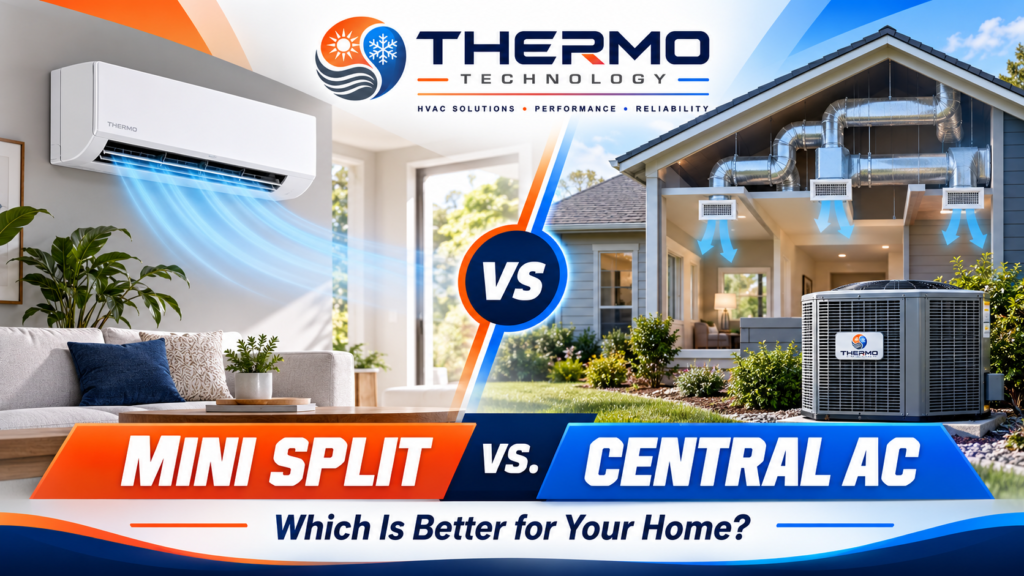
Mini Split vs Central AC: 13 Key Differences for Jacksonville FL Homes
Choosing between a mini split vs central AC system is an important decision for homeowners in Jacksonville, Florida. Both options can provide reliable cooling, but they differ in energy efficiency, zoning, installation, humidity control, maintenance, appearance, and overall comfort.
When comparing mini split vs central AC systems, the best choice depends on your home’s layout, existing ductwork, cooling load, budget, and how different areas of the property are used.
This mini split vs central AC guide from Thermo Technology explains 13 important differences to help Jacksonville homeowners understand which HVAC configuration may be more appropriate for their property.
What Is a Mini Split Air Conditioning System?
A mini split, also known as a ductless mini split, is an HVAC system that can cool and, in many cases, heat a home without conventional ductwork.
A typical mini split system includes:
- One outdoor condensing unit
- One or more indoor air-handling units
- Refrigerant piping
- Electrical wiring
- Communication wiring
- Condensate drainage
Instead of distributing conditioned air through ducts, each indoor unit delivers air directly into the room or zone where it is installed.
Single-Zone Mini Split
A single-zone mini split connects one outdoor unit to one indoor unit.
This configuration is commonly used for:
- Garages
- Home offices
- Sunrooms
- Bedrooms
- Workshops
- Home additions
- Guest houses
Multi-Zone Mini Split
A multi-zone mini split can connect one outdoor unit to multiple indoor units.
Each indoor unit can usually be controlled independently, allowing different areas of the home to operate at different temperatures.
This zoning capability is one of the biggest advantages of ductless HVAC systems.
What Is Central Air Conditioning?
Central air conditioning uses one primary HVAC system to condition multiple rooms throughout the home.
A typical central HVAC system includes:
- An outdoor condenser or heat pump
- An indoor air handler
- An evaporator coil
- Supply ductwork
- Return ductwork
- Air filters
- A thermostat
- Supply and return registers
Conditioned air travels through the duct system and is distributed throughout the home through supply vents.
Central AC remains very common in Jacksonville because many Florida homes were built with existing duct systems.
Mini Split vs Central AC: Quick Comparison
When comparing mini split vs central AC, homeowners should consider more than the purchase price of the equipment.
| Feature | Mini Split | Central AC |
|---|---|---|
| Requires ductwork | No | Usually yes |
| Individual room control | Excellent | Limited without zoning |
| Whole-home cooling | Possible | Excellent |
| Installation in additions | Excellent | Can be more complicated |
| Energy efficiency potential | Very high | High with proper equipment |
| Duct energy losses | None | Possible |
| Indoor equipment visibility | Usually visible | Mostly hidden |
| Humidity control | Good when properly sized | Very good when properly designed |
| Garages and additions | Excellent | May require duct modifications |
| Homes with existing ductwork | Depends on application | Often very practical |
How to Compare Mini Split vs Central AC Systems
When evaluating mini split vs central AC options, homeowners should compare the complete HVAC system instead of focusing only on equipment price.
The mini split vs central AC decision should include installation requirements, duct condition, energy efficiency, humidity removal, zoning needs, equipment location, maintenance, and long-term comfort.
For Jacksonville homes, Florida’s hot and humid climate makes equipment sizing and moisture control especially important.
1. Mini Split vs Central AC Energy Efficiency
Energy efficiency is one of the most important factors in the mini split vs central AC comparison.
Many modern mini split systems use inverter-driven compressors. Instead of operating only at full capacity and then shutting off, an inverter system can adjust compressor speed according to cooling demand.
This can provide:
- More stable indoor temperatures
- Reduced compressor cycling
- Better partial-load efficiency
- Quieter operation
- Improved comfort
Modern central heat pumps can also use inverter or variable-speed compressor technology, so this advantage is not exclusive to mini splits.
Ductwork Can Affect HVAC Efficiency
One major difference between mini split vs central AC systems is the way conditioned air is delivered.
Mini splits deliver conditioned air directly into individual rooms, while central AC systems typically distribute air through ductwork.
Duct systems can develop problems such as:
- Air leakage
- Damaged insulation
- Disconnected sections
- Poorly sealed joints
- Improper duct sizing
- Heat gain in attic spaces
According to
ENERGY STAR
,
ductless heating and cooling systems can be especially useful in homes without existing ductwork, additions, garages, and areas where extending ductwork would be difficult.
2. Mini Split vs Central AC for Humidity Control
Humidity control is another major factor when comparing mini split vs central AC systems in Jacksonville, FL.
Florida homes experience high outdoor humidity for much of the year. Removing moisture from indoor air is therefore an important part of HVAC performance.
Excess indoor humidity may contribute to:
- Sticky or uncomfortable conditions
- Musty odors
- Condensation
- Mold and mildew conditions
- Higher cooling demand
- Potential damage to building materials
Both mini split and central AC systems can provide effective dehumidification when properly designed and sized.
Proper sizing is critical.
An oversized air conditioner may cool the home quickly and shut down before operating long enough to remove sufficient moisture.
3. Zoning and Individual Temperature Control
Zoning is an important difference in the mini split vs central AC comparison.
A Jacksonville home might have:
- A home office occupied during the day
- A guest room that is rarely used
- A master bedroom occupied primarily at night
- A living room used mostly in the evening
A multi-zone mini split system allows individual areas to have separate temperature settings.
This can improve comfort and may reduce unnecessary cooling in unoccupied rooms.
Central HVAC systems can also provide zoning through motorized dampers and multiple thermostats, but the ductwork and controls must be properly designed.
4. Mini Split vs Central AC Installation
Installation requirements can significantly affect the mini split vs central AC decision.
Mini Split Installation
Mini splits do not require conventional ductwork.
This makes them especially useful for:
- Older homes without ducts
- Converted garages
- Room additions
- Florida rooms
- Workshops
- Detached garages
- Home offices
- Guest suites
Installation generally requires a relatively small penetration for refrigerant piping, wiring, communication cables, and condensate drainage.
Central AC Installation
If your Jacksonville home already has properly designed ductwork in good condition, replacing a central HVAC system may be relatively straightforward.
If the home does not have existing ductwork, installing central air conditioning can require substantially more construction.
Ductwork may need to pass through:
- Attics
- Ceilings
- Closets
- Wall cavities
- Soffits
5. Whole-Home Comfort
Central AC remains a practical option for whole-home cooling because one properly designed system can distribute conditioned air throughout the property.
Mini split systems can also cool an entire home, but larger properties may require multiple indoor units.
Indoor unit placement, cooling capacity, zoning design, and building layout become especially important in whole-home mini split installations.
6. Appearance and Indoor Equipment
Appearance can also influence the mini split vs central AC decision.
Central AC equipment is mostly hidden. Homeowners generally see only supply vents and return grilles.
Traditional wall-mounted mini split units are more visible.
However, modern mini split systems are available in several configurations:
- Wall-mounted units
- Ceiling cassettes
- Floor-mounted units
- Concealed ducted units
7. Noise Levels
Modern mini split systems can operate very quietly because many use inverter compressors and variable-speed fans.
Premium central HVAC equipment can also operate quietly when correctly installed.
Actual noise levels depend on:
- Equipment quality
- Compressor technology
- Fan speed
- Equipment location
- Duct design
- Air velocity
- Installation quality
- Maintenance condition
8. Mini Split vs Central AC Maintenance
Maintenance requirements also differ when comparing mini split vs central AC systems.
Mini Split Maintenance
- Clean indoor filters
- Inspect and clean evaporator coils
- Inspect blower wheels
- Check condensate drains
- Inspect condensate pumps when installed
- Check electrical connections
- Inspect refrigerant piping
- Clean the outdoor condenser coil
Neglected mini splits can develop buildup on evaporator coils and blower wheels, reducing airflow and overall system performance.
Central AC Maintenance
- Replace or clean air filters
- Clean evaporator coils
- Clean condenser coils
- Clear condensate drain lines
- Inspect electrical components
- Check refrigerant operation
- Inspect blower components
- Check thermostat operation
- Inspect accessible ductwork
In Jacksonville and throughout Florida, clogged condensate drain lines are a common HVAC problem because cooling systems remove significant moisture from indoor air.
9. Mini Split vs Central AC for Garages and Additions
For garages and additions, the mini split vs central AC comparison often changes because extending existing ductwork may not be practical.
A homeowner may convert a garage into:
- A home office
- A gym
- A bedroom
- A workshop
- A game room
Simply extending existing ductwork into the new space may create problems if the original central HVAC system was not sized for the additional cooling load.
A dedicated mini split can provide independent cooling without significantly modifying the main HVAC system.
10. Salt Air and Coastal Corrosion
For coastal Jacksonville properties, the mini split vs central AC decision should also consider salt-air exposure and outdoor equipment corrosion.
Homes near areas such as:
- Jacksonville Beach
- Atlantic Beach
- Neptune Beach
- Mayport
- Ponte Vedra Beach
can experience increased exposure to salt-laden coastal air.
Outdoor HVAC equipment contains metal components and heat exchangers that may deteriorate faster in corrosive environments.
This applies to both mini split condensers and conventional central AC or heat pump condensers.
For coastal properties, equipment selection, protective coil coatings, equipment placement, regular cleaning, and preventive maintenance can become especially important.
11. Mini Split vs Central AC Cost
Installation cost is another important consideration in the mini split vs central AC comparison.
A single-zone mini split installed in a garage or home office may cost less than making significant modifications to an existing central HVAC system.
However, a large multi-zone mini split system serving several rooms can become a substantial installation.
Replacing a central HVAC system with good existing ductwork is also very different from installing:
- New ductwork
- New electrical service
- New drain piping
- New controls
- New equipment platforms
The best comparison considers the complete installed system, not only the equipment purchase price.
12. When Does a Mini Split Make the Most Sense?
A mini split may be a practical choice when:
- Your home does not have ductwork
- You are adding a room
- You converted a garage
- You want independent temperature zones
- One area has persistent comfort problems
- Extending existing ducts would be difficult
- You want a dedicated HVAC system for one area
- Your existing central HVAC system does not need replacement
Mini splits can also work alongside an existing central HVAC system.
For example, a homeowner may keep central AC for the main house while installing a mini split in a garage, home office, addition, or other problem area.
13. When Does Central AC Make the Most Sense?
Central air conditioning may be the more practical solution when:
- Your home already has good ductwork
- You want consistent whole-home cooling
- You prefer HVAC equipment hidden from view
- Your existing central system needs replacement
- Your floor plan works well with centralized air distribution
- You want centralized filtration
- You want one primary system serving most of the home
Mini Split vs Central AC: Which Is Better in Jacksonville FL?
There is no universal winner in the mini split vs central AC comparison.
A mini split can be an excellent solution for garages, additions, homes without ductwork, or rooms requiring independent temperature control.
Central AC can be a practical solution for homes with properly designed ductwork that need consistent whole-home cooling.
Ultimately, the right mini split vs central AC solution depends on your home’s cooling load, duct system, floor plan, humidity requirements, comfort expectations, and budget.
Proper HVAC Sizing Is Critical in Florida
Proper equipment sizing is important regardless of whether you choose a mini split vs central AC system.
A residential cooling-load calculation, commonly known as a Manual J calculation, can evaluate factors such as:
- Home size
- Windows
- Insulation
- Building orientation
- Ceiling height
- Air leakage
- Construction materials
- Number of occupants
- Local climate
- Internal heat loads
An oversized air-conditioning system can create shorter operating cycles and may reduce humidity-removal performance.
Bigger is not always better. Correctly sized is better.
Professional Mini Split and Central AC Services in Jacksonville FL
If you are still deciding between mini split vs central AC, a professional HVAC evaluation can help determine which configuration better fits your property.
At Thermo Technology, we provide HVAC diagnostics, installation, repair, and preventive maintenance throughout Jacksonville and Northeast Florida.
Our HVAC services include:
- Mini split installation
- Central AC installation
- Heat pump installation
- Air-conditioning repair
- HVAC diagnostics
- Preventive maintenance
- Indoor comfort solutions
- Commercial HVAC services
Learn more about
HVAC services in Jacksonville FL
from Thermo Technology.
Need Help Choosing Between Mini Split and Central AC?
If you are considering a new HVAC system in Jacksonville, Florida, avoid choosing equipment based only on online pricing, square footage, or advertised BTU capacity.
A professional evaluation can help determine which system configuration is appropriate for your home.
Contact Thermo Technology for HVAC service in Jacksonville FL.
Thermo Technology — We keep your business running cold.
Frequently Asked Questions About Mini Split vs Central AC
Are mini splits good for Florida?
Yes. Properly designed mini split systems can provide efficient cooling and humidity removal in Florida homes. Proper sizing and installation are especially important in Jacksonville’s hot and humid climate.
Can a mini split cool an entire house?
Yes. Multi-zone systems can serve multiple rooms, and some homes use several indoor units connected to one or more outdoor units. Equipment selection and load calculations are important for whole-home applications.
Is a mini split cheaper to operate than central AC?
It can be, especially when zoning allows homeowners to condition only occupied areas or when an existing duct system has significant energy losses. Actual operating cost depends on equipment efficiency, building characteristics, thermostat settings, installation quality, and usage.
Which is more efficient: mini split vs central AC?
The answer depends on the equipment and installation. Mini splits eliminate traditional duct losses, while modern high-efficiency central systems can also provide excellent performance when paired with properly designed and sealed ductwork.
Does a mini split remove humidity?
Yes. Mini split systems remove moisture from indoor air while cooling. Equipment sizing and operating conditions strongly affect dehumidification performance.
Should I replace my central AC with mini splits?
Not necessarily. If your home already has good ductwork, replacing the existing central system may be more practical. Mini splits become especially attractive when ductwork is unavailable, difficult to install, or individual zoning is important.
Are mini splits good for garages in Florida?
Yes. Garages, workshops, home offices, and converted rooms are common mini split applications because the system can provide independent cooling without extending the home’s primary duct system.
Do mini splits need professional maintenance?
Yes. Filters require routine cleaning, while evaporator coils, blower wheels, drain systems, electrical components, refrigerant circuits, and outdoor coils should also be inspected and serviced as needed.