
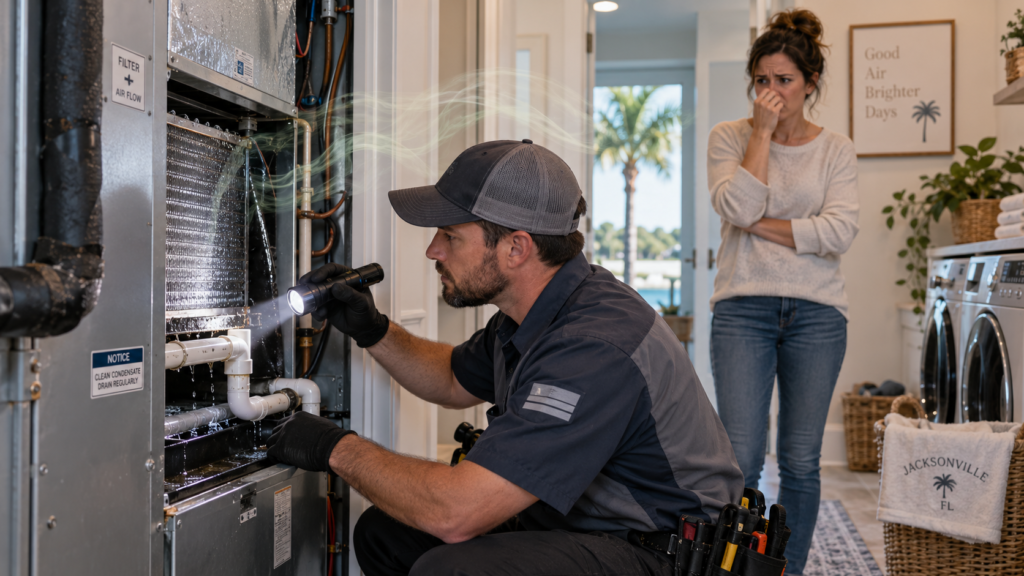
If your AC smells bad when it starts running, the odor may be telling you that something inside the HVAC system or your home needs attention.
Air conditioners move large volumes of air through filters, coils, drain pans, ductwork, and supply vents. Moisture, dust, electrical problems, drainage issues, or contaminants in these areas can sometimes produce unusual odors.
Jacksonville’s warm and humid climate can make moisture control especially important because residential air-conditioning systems remove significant amounts of humidity from indoor air.
Some odors may have a relatively simple explanation, while burning, electrical, or persistent musty smells deserve faster investigation.
Here are seven common AC odors Jacksonville homeowners may encounter, what they can mean, and when professional HVAC service is recommended.
When an AC Smells Bad, Should You Be Concerned?
Not every temporary odor indicates a serious equipment failure.
However, an AC smells bad problem deserves attention when the odor:
- Appears every time the AC starts
- Becomes stronger over time
- Spreads throughout several rooms
- Is accompanied by water around the HVAC system
- Occurs with poor cooling or weak airflow
- Smells like burning plastic or electrical wiring
- Occurs together with smoke or repeated breaker trips
The type of odor and where it originates can provide useful clues, but HVAC diagnosis should be based on inspection and testing rather than smell alone.
1. Musty or Moldy AC Smell
A musty odor is one of the most common complaints associated with residential HVAC systems.
Air-conditioning systems naturally create condensation as they remove humidity from the air.
If moisture remains where it should not, damp conditions may develop around:
- The evaporator coil
- Condensate drain pan
- Condensate drain line
- Insulation
- Ductwork
- Nearby building materials
The U.S. Environmental Protection Agency explains that moldy or musty odors can be associated with mold growth and that moisture control is essential when addressing mold problems.
Homeowners can review the
EPA guidance about moldy odors
.
If your AC smells bad with a persistent musty odor, simply using an air freshener does not address the source of the moisture or contamination.
2. Dirty Evaporator Coil or Drain Pan
The evaporator coil is located in the indoor portion of the HVAC system and becomes cold during cooling operation.
Moisture condenses on the coil and normally flows into a drain pan before leaving through the condensate drain.
Dust, dirt, moisture, and other material can accumulate around this area over time.
Possible signs of an indoor-unit problem include:
- Musty odor when cooling begins
- Standing water around the air handler
- Water in or around the drain pan
- Restricted condensate drainage
- Dirty coil surfaces
Professional inspection may be necessary when the evaporator assembly is not easily accessible.
3. Clogged Condensate Drain
Your air conditioner produces condensate while removing humidity from your home.
That water must travel through the condensate drain system.
If the drain becomes restricted, standing water can develop in the drain pan or drain line.
You may notice:
- Musty or stale odors
- Water near the air handler
- A full drain pan
- The AC shutting down because of a float switch
- Water stains near HVAC equipment
If you are also seeing water, read our guide about an
AC leaking water in Jacksonville FL
.
Drainage problems should be corrected before water damages surrounding ceilings, walls, flooring, or insulation.
4. Burning or Electrical Smell From the AC
A burning electrical odor should be treated differently from a musty smell.
Possible causes may include:
- Overheated wiring
- Loose electrical connections
- A failing motor
- Overheated electrical components
- Damaged insulation
- Control or circuit problems
If the AC smells bad like burning plastic, overheated electronics, or electrical insulation, turn the HVAC system off and request professional service.
Do not remove electrical panels or attempt to touch wiring, capacitors, contactors, or other energized components.
If smoke, visible arcing, or an immediate fire hazard is present, keep a safe distance and contact the appropriate emergency service.
5. Sour or Stale Smell
Some homeowners describe HVAC odors as sour, stale, or similar to old laundry.
Several conditions can produce these descriptions, including moisture accumulation, dirty components, drainage issues, or contaminants within the airflow path.
Areas that may deserve inspection include:
- Air filter
- Evaporator coil
- Drain pan
- Condensate drain
- Return-air area
- Ductwork
Replacing a dirty filter is a reasonable homeowner check, but persistent odor after filter replacement may require further inspection.
6. Chemical or Unusual Sweet Smell
An unusual chemical odor should not automatically be diagnosed as a refrigerant leak based on smell alone.
Different household products, insulation materials, electrical components, cleaning chemicals, and HVAC conditions can create unfamiliar odors.
If the smell occurs together with:
- Poor cooling
- Ice on refrigerant lines
- Long cooling cycles
- Abnormal HVAC operation
professional diagnosis can determine whether a refrigeration-system problem is present.
If cooling performance has also declined, see our guide:
AC Not Cooling? Common Causes and What You Can Do
.
7. Odor Coming From the Ductwork or Return Air
Sometimes the air conditioner itself is not the original source of the smell.
Because the HVAC system circulates air through the home, odors originating elsewhere may become noticeable when the blower starts.
Potential sources may include:
- Return-air contamination
- Damp duct insulation
- Moisture around ductwork
- Dust accumulation
- Nearby household odors entering the return system
Determining whether an odor originates at the air handler, ductwork, return grille, or another area of the home can help narrow the diagnosis.
Why Humidity Matters in Jacksonville Homes
Jacksonville’s climate creates demanding conditions for residential HVAC systems.
Air conditioners do two important jobs during cooling operation: lowering temperature and removing moisture from indoor air.
Excess indoor moisture can contribute to condensation and unwanted biological growth on damp surfaces.
The EPA recommends controlling indoor moisture and generally keeping relative humidity below 60 percent, ideally around 30 to 50 percent when practical.
If an AC smells bad and your home also feels unusually humid, both HVAC operation and possible moisture sources should be evaluated.
Can a Dirty Air Filter Make Your AC Smell Bad?
A dirty air filter can contribute to HVAC problems by restricting airflow and allowing dust and debris to accumulate.
Homeowners should inspect filters regularly and replace them according to the filter type, household conditions, and equipment requirements.
A dirty filter may also contribute to:
- Reduced airflow
- Longer cooling cycles
- Evaporator coil freezing
- Additional dust accumulation
- Higher system workload
Replacing the filter is one of the easiest homeowner maintenance tasks, but it will not correct a moisture, drain, coil, or electrical problem elsewhere in the system.
Why Does the Smell Appear Only When the AC Starts?
When the blower starts, air begins moving through the return system, air handler, ductwork, and supply vents.
An odor located somewhere along that airflow path may therefore become much more noticeable immediately after the HVAC system starts.
Pay attention to where you first notice the smell:
- At one supply vent
- At every supply vent
- Near the indoor air handler
- At the return grille
- Near the outdoor equipment
This information can help an HVAC technician determine where to begin inspecting the system.
AC Smells Bad After Being Off for a Long Time
Equipment that has been off for an extended period may temporarily circulate dust or odors when it first starts.
A brief odor that disappears quickly is different from a smell that returns during every cooling cycle.
Persistent musty, burning, or electrical odors should not simply be considered normal seasonal operation.
Can AC Maintenance Help Prevent Odors?
Preventive maintenance cannot eliminate every possible odor, but it can identify several HVAC conditions that contribute to unwanted smells.
Professional maintenance may include inspection of:
- Air filter condition
- Evaporator coil
- Condensate drain
- Drain pan
- Blower components
- Electrical components
- Indoor airflow
- System operation
ENERGY STAR recommends routine professional HVAC maintenance and inspection of condensate drainage as part of residential heating and cooling system care.
Learn more about
AC maintenance in Jacksonville FL
.
What Can Homeowners Safely Check?
If your AC smells bad, you can perform several basic observations without opening HVAC electrical equipment.
- Inspect the air filter.
- Look for visible water around the indoor HVAC unit.
- Check whether a drain pan appears to be overflowing.
- Look for visible ice on refrigerant lines.
- Determine which vents produce the strongest odor.
- Notice whether the odor occurs only while cooling is running.
Avoid opening electrical compartments, disassembling evaporator sections, or using chemicals inside HVAC equipment without knowing whether they are appropriate for the system.
When Should You Call an HVAC Technician?
Schedule professional service when the odor persists after simple filter and visual checks.
Service is particularly important if the AC smells bad together with:
- Burning or electrical odor
- Water around the air handler
- Repeated drain problems
- Visible ice
- Poor cooling
- Weak airflow
- Breaker trips
- Unusual HVAC noises
AC Smells Bad and Makes Strange Noises
Odor combined with abnormal sound can provide additional clues.
A burning smell with electrical buzzing, for example, deserves prompt attention.
If your HVAC system is also producing new noises, read:
Why Is My AC Making Noise?
AC Smells Bad and Keeps Tripping the Breaker
A burning or electrical odor combined with a circuit breaker that repeatedly trips can indicate an electrical or equipment problem that should not be ignored.
Do not repeatedly reset the breaker simply to keep the AC running.
Read our guide about what to do when an
AC breaker keeps tripping
.
Professional AC Odor Diagnosis in Jacksonville FL
Thermo Technology provides residential HVAC diagnostics for Jacksonville homeowners when an AC smells bad or develops another unusual operating condition.
Our approach is to identify the source of the odor before recommending repairs or cleaning.
Depending on the condition, inspection may include the air filter, evaporator coil, condensate drainage, blower system, electrical components, airflow, duct connections, and overall HVAC operation.
Thermo Technology also provides
residential AC repair in Jacksonville FL
when the odor is connected to an HVAC equipment failure.
Does Your AC Smell Bad?
Persistent musty, burning, electrical, or unusual HVAC odors should be investigated rather than covered with air fresheners.
Contact Thermo Technology for professional residential HVAC diagnosis in Jacksonville FL.
Call or text:
(904) 240-2725
Frequently Asked Questions About AC Odors
Why does my AC smell bad?
Possible causes include moisture, dirty HVAC components, condensate drainage problems, a dirty filter, duct contamination, electrical problems, or odors entering the return-air system.
Why does my AC smell musty?
Musty odors are commonly associated with excess moisture and may require inspection of the evaporator area, drain pan, condensate system, ductwork, or nearby building materials.
Why does my AC smell like something is burning?
A burning smell may indicate an overheated motor, wiring, electrical connection, or other component. Turn the HVAC system off and request professional service.
Can a dirty air filter make the AC smell?
A dirty filter can restrict airflow and contribute to dust accumulation, but persistent odor may originate from another part of the HVAC system.
Can a clogged AC drain cause a bad smell?
A restricted condensate drain can allow standing water and moisture to remain in the HVAC system, which may contribute to unpleasant odors.
Does a musty smell always mean mold?
No. Several moisture-related conditions can create unpleasant odors. The source should be inspected rather than diagnosed by smell alone.
Who can diagnose AC odors in Jacksonville FL?
Thermo Technology provides residential HVAC diagnostics, maintenance, and AC repair throughout Jacksonville and surrounding areas. Call or text (904) 240-2725 to request service.