
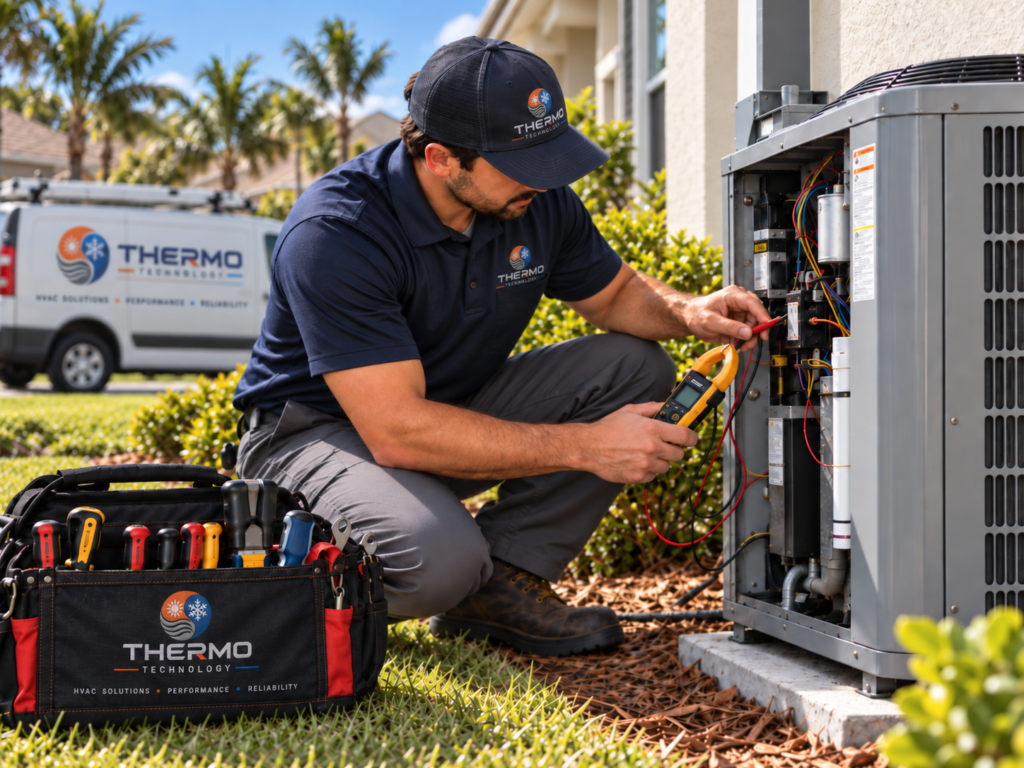
AC short cycling happens when an air conditioner turns on, runs for only a short period, shuts off, and then starts again soon afterward.
During a normal cooling cycle, your AC should operate long enough to remove heat and humidity from the home before reaching the thermostat setting and shutting down.
When the system repeatedly starts and stops, comfort may decrease, electricity use can increase, and important HVAC components may experience additional wear.
Jacksonville’s heat and humidity make reliable cooling especially important. If your system is starting and stopping every few minutes, here are seven common causes homeowners should know about.
What Is AC Short Cycling?
AC short cycling describes an air-conditioning system that does not complete a normal cooling cycle.
Instead of running steadily until the home reaches the thermostat setting, the system repeatedly starts and stops.
You may notice:
- The outdoor unit starts and stops every few minutes
- The thermostat setting is never reached
- The home feels warmer or more humid than usual
- Electricity consumption increases
- The AC starts much more frequently than before
- Cooling feels inconsistent between rooms
Occasional shorter cycles do not automatically indicate a problem. However, repeated rapid cycling deserves attention.
Why Is AC Short Cycling a Problem?
Air conditioners use significant electrical energy when compressors and motors start.
Frequent restarting can place additional stress on components while preventing the system from operating long enough to cool and dehumidify the house effectively.
Persistent AC short cycling may contribute to:
- Higher electricity use
- Reduced indoor comfort
- Poor humidity control
- Additional compressor wear
- Additional contactor and capacitor cycling
- Difficulty maintaining the thermostat setting
The key is identifying why the system is cycling excessively rather than simply allowing it to continue.
1. Dirty or Clogged Air Filter
A dirty air filter can restrict airflow through the HVAC system.
When airflow becomes too low, the evaporator coil may become excessively cold and eventually begin to freeze.
Restricted airflow may also make the system operate abnormally or activate protective controls.
Homeowners may notice:
- Weak airflow from vents
- Ice on refrigerant lines
- Long or irregular cooling cycles
- Reduced cooling performance
Homeowners can safely inspect the filter and replace it if it is visibly dirty.
If AC short cycling continues after replacing a dirty filter, another airflow, electrical, or refrigeration problem may be present.
2. Thermostat Location or Thermostat Problem
The thermostat determines when your air conditioner starts and stops.
If it receives an inaccurate temperature reading, the HVAC system may cycle incorrectly.
Problems may occur if the thermostat is:
- Near a supply vent
- Exposed to direct sunlight
- Near an appliance that produces heat
- Reading temperature incorrectly
- Experiencing an electrical or control problem
Check that the thermostat is set to COOL and that the temperature setting is reasonable.
If the displayed indoor temperature appears inaccurate, the thermostat or its location may deserve professional evaluation.
3. Frozen Evaporator Coil
A frozen evaporator can interfere with normal cooling operation.
Ice may develop because of:
- Restricted airflow
- Dirty filters
- Dirty evaporator coils
- Blower motor problems
- Refrigerant conditions
- Other HVAC faults
If the system freezes, cooling performance can drop significantly and the AC may begin operating abnormally.
If you see ice, do not scrape it from the coil.
Turn cooling mode off and allow the equipment to thaw. If freezing returns, professional diagnosis is recommended.
Read our guide about
why an AC freezes up
for more information.
4. Refrigerant Problem or Refrigerant Leak
Your air-conditioning system depends on the correct refrigerant conditions to transfer heat.
A properly sealed residential AC system should not routinely lose refrigerant.
If refrigerant is low because of a leak or another refrigeration-system problem, system pressures and temperatures can become abnormal.
Depending on the equipment, this can contribute to poor cooling, freezing, protective shutdowns, or AC short cycling.
Possible warning signs include:
- Poor cooling performance
- Ice formation
- Long or irregular cycles
- Difficulty reaching the thermostat setting
Refrigerant should not simply be added without determining why the system is low.
5. Electrical Components Are Failing
Residential HVAC systems rely on several electrical components to start and operate motors and compressors.
Depending on the system, problems may involve:
- Capacitors
- Contactors
- Relays
- Control boards
- Electrical connections
- Pressure or temperature controls
A deteriorating electrical component can sometimes cause intermittent operation or prevent the system from maintaining a normal cooling cycle.
Electrical diagnosis should be performed by a trained HVAC professional because air-conditioning equipment contains hazardous voltage and capacitors that can retain electrical energy.
6. Your AC System May Be Oversized
Bigger is not always better when it comes to air-conditioning equipment.
An AC system that is oversized for the home’s actual cooling load may lower the indoor temperature very quickly and then shut off before completing a longer cooling cycle.
The system may then restart again soon afterward.
Oversizing may contribute to:
- Frequent starting and stopping
- Poor humidity control
- Uneven temperatures
- Increased component cycling
Correct HVAC sizing involves much more than home square footage.
Insulation, windows, orientation, air leakage, ductwork, ceiling height, and other building characteristics should be considered when determining cooling load.
7. Compressor or Safety Control Problem
Air-conditioning systems contain protective controls designed to prevent operation under unsafe conditions.
If a system is overheating or experiencing abnormal electrical or refrigeration conditions, a safety control may interrupt operation.
The equipment may then restart later, creating a repeated cycling pattern.
Persistent AC short cycling accompanied by unusual noises, poor cooling, electrical trips, or compressor overheating should be professionally diagnosed.
Do not repeatedly reset breakers or bypass HVAC safety controls.
How Often Should an AC Normally Cycle?
There is no single number of minutes that applies to every home or air-conditioning system.
Cooling-cycle length depends on:
- Outdoor temperature
- Indoor temperature
- Humidity
- Equipment capacity
- Home insulation
- Solar heat gain
- Thermostat settings
- System design
During very hot Jacksonville weather, an AC may run for long periods.
The more important warning sign is when a system repeatedly operates for only a very short period before shutting down and restarting again.
AC Short Cycling vs. AC Running Constantly
These are two different HVAC problems.
With AC short cycling, the system turns on and off too frequently.
With an AC that runs constantly, the equipment may operate for extremely long periods without shutting down.
Both conditions can indicate airflow, refrigeration, electrical, thermostat, sizing, or equipment problems.
If your system rarely shuts off, read our guide about an
AC running constantly in Jacksonville FL
.
Can Short Cycling Increase Your Electric Bill?
Yes, frequent system cycling can contribute to unnecessary electricity consumption.
Motors and compressors require additional electrical energy during startup, and a system that repeatedly starts may operate less effectively than one completing normal cooling cycles.
Short cycles can also reduce the amount of time available for effective indoor humidity removal.
Homeowners can find additional information about residential HVAC efficiency through
ENERGY STAR heating and cooling resources
.
Can Preventive AC Maintenance Help?
Preventive maintenance cannot prevent every HVAC failure, but it can identify several conditions associated with abnormal cycling.
A professional maintenance visit may include inspection of:
- Air filters
- Indoor airflow
- Evaporator coil condition
- Outdoor condenser condition
- Electrical components
- Fan motors
- Thermostat operation
- Refrigeration-system performance
Regular
AC maintenance in Jacksonville FL
can help identify developing problems before they cause a complete cooling failure.
What Can Homeowners Check Before Calling for Service?
You can safely perform a few basic checks before scheduling professional AC repair.
- Confirm the thermostat is set to COOL.
- Check that the thermostat temperature is reasonable.
- Inspect the air filter.
- Make sure supply and return vents are open and unobstructed.
- Look for visible ice on the indoor unit or refrigerant lines.
- Observe how frequently the outdoor system starts and stops.
Avoid opening electrical panels, bypassing controls, handling capacitors, or attempting refrigerant repairs.
When Should You Call an HVAC Technician?
Professional service is recommended when AC short cycling continues after basic thermostat and filter checks.
Request service promptly if:
- The system starts and stops every few minutes
- The home cannot reach the thermostat setting
- Ice forms on the HVAC equipment
- The outdoor unit overheats
- The breaker repeatedly trips
- You hear unusual compressor or electrical noises
- Cooling performance has declined significantly
How Much Can Short Cycling Repair Cost?
Repair cost depends on the underlying cause.
Replacing a dirty filter or thermostat is very different from correcting refrigerant problems, electrical failures, or major compressor issues.
Before approving a major repair, the system should be properly diagnosed.
For more information about common repair expenses, see our guide to
AC repair cost in Jacksonville FL
.
Professional AC Short Cycling Diagnosis in Jacksonville
Thermo Technology provides residential HVAC diagnosis and repair for AC short cycling and other cooling problems throughout Jacksonville and surrounding areas.
Our goal is to identify why the system is turning on and off excessively before recommending component replacement.
Depending on the equipment, diagnosis may involve evaluating airflow, thermostat operation, electrical components, refrigerant conditions, coils, motors, safety controls, and overall HVAC performance.
Thermo Technology also provides
residential AC repair in Jacksonville FL
when short cycling is connected to another system failure.
Is Your AC Turning On and Off Too Often?
Repeated cycling can affect comfort, humidity control, and HVAC component life.
Contact Thermo Technology for professional AC short cycling diagnosis and residential AC service in Jacksonville FL.
Call or text:
(904) 240-2725
Frequently Asked Questions About AC Short Cycling
What causes AC short cycling?
Common causes include restricted airflow, dirty filters, thermostat problems, frozen evaporator coils, refrigerant issues, electrical problems, oversized equipment, and compressor or safety-control problems.
Is AC short cycling bad for the system?
Persistent short cycling can increase the number of compressor and motor starts, affect indoor comfort, reduce humidity control, and contribute to additional component wear.
Can a dirty filter cause short cycling?
Yes. A heavily restricted filter can reduce airflow and contribute to evaporator freezing or abnormal system operation.
Can low refrigerant cause short cycling?
Refrigerant problems can create abnormal operating pressures and temperatures that may contribute to poor cooling, freezing, protective shutdowns, or irregular cycling.
Can an oversized AC cause short cycling?
Yes. An oversized system may cool the air quickly and shut down before completing a longer cooling and dehumidification cycle.
Should I turn off an AC that keeps short cycling?
If cycling is extremely frequent, the system is freezing, a breaker is tripping, or unusual electrical or compressor noises are present, turning the system off and requesting professional service may help prevent additional stress.
Who repairs AC short cycling in Jacksonville FL?
Thermo Technology provides residential HVAC diagnostics, preventive maintenance, and AC repair throughout Jacksonville and surrounding areas. Call or text (904) 240-2725 to request service.