
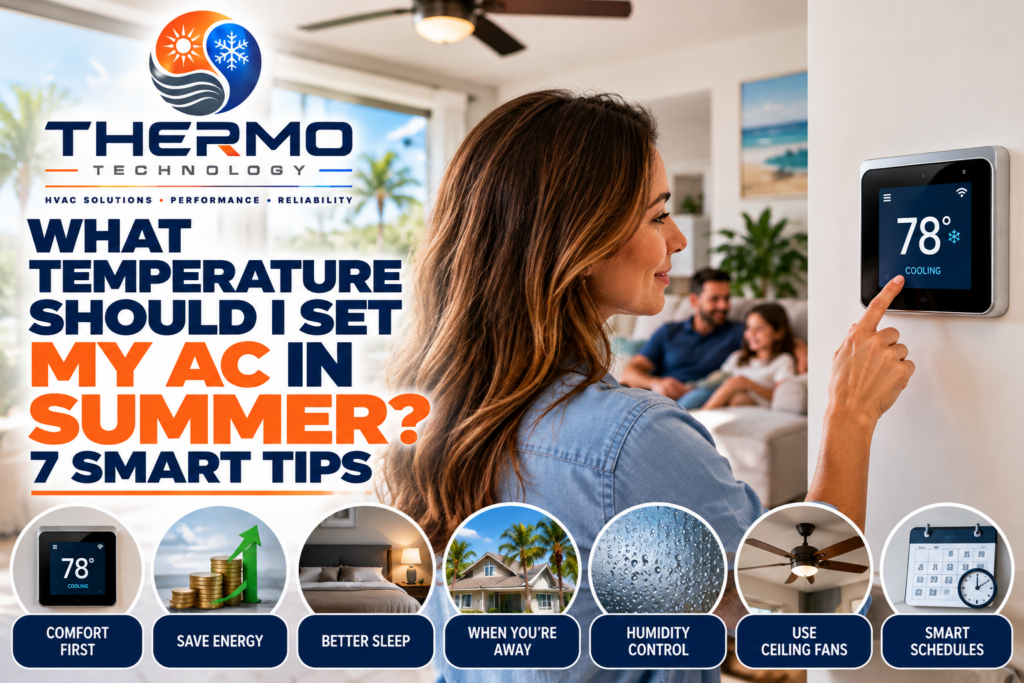
What temperature should I set my AC in summer? It sounds like a simple question, but there is no single thermostat setting that is perfect for every home and every family.
Your ideal summer AC temperature depends on comfort preferences, outdoor temperature, humidity, insulation, sunlight, occupancy, and how efficiently your HVAC system operates.
For homeowners trying to balance comfort and energy savings, the best approach is usually to set the thermostat as high as you can while still feeling comfortable rather than chasing one universal number.
This homeowner guide from Thermo Technology explains seven smart ways to choose your summer thermostat setting, including what to do when you are home, sleeping, away from the house, or dealing with Florida humidity.
What Temperature Should I Set My AC in Summer?
If you are asking what temperature should I set my AC in summer, a commonly referenced energy-saving starting point is around 78°F when you are home.
However, 78°F is not a mandatory setting and it is not necessarily the perfect comfort temperature for everyone.
The U.S. Department of Energy recommends setting the thermostat as high as is comfortably possible during summer and raising the temperature when you are sleeping or away.
ENERGY STAR also uses approximately 78°F as a typical energy-saving cooling setting.
The important word is comfortable.
If 78°F feels too warm for your household, you do not need to force your home to stay at that temperature just to follow a general recommendation.
Your goal should be to find the highest setting that still provides reasonable comfort and humidity control.
Is 78°F Really the Best AC Temperature?
Not necessarily.
When customers ask what temperature should I set my AC in summer, 78°F often appears in online recommendations because it provides a useful reference point for reducing cooling energy consumption.
But your actual comfort may be better at:
- 77°F
- 76°F
- 75°F
- 74°F
- Or another temperature
Several things influence how a thermostat setting feels.
For example, a home at 76°F with good humidity control may feel more comfortable than a home at 72°F with excessive indoor humidity.
Air movement also matters. A ceiling fan can make occupants feel cooler without actually lowering the room temperature.
1. Start With Comfort, Then Adjust Gradually
The first answer to what temperature should I set my AC in summer is to begin with a temperature your household already finds comfortable.
Then try increasing the thermostat by one degree.
Give the home enough time to stabilize before deciding whether the new setting is comfortable.
If everything still feels good, you can try another degree.
This gradual approach is usually more practical than suddenly changing the thermostat from 72°F to 78°F.
A Simple Example
If you normally keep the thermostat at 72°F, try:
- 73°F for a day
- Then 74°F
- Then 75°F if still comfortable
You may discover that your home remains comfortable at a warmer setting than you expected.
The higher comfortable setting can reduce the amount of time your air conditioner needs to operate.
2. What Temperature Should the AC Be When You Are Home?
When you are home and awake, comfort should be the primary consideration.
The Department of Energy recommends keeping the thermostat as high as comfortably possible during the summer because the smaller the temperature difference between indoors and outdoors, the lower the cooling demand.
For many homeowners, approximately 78°F can be used as an energy-saving reference point, not as a strict rule.
If your family prefers a cooler home, choose a setting that works for your household.
The important point is that moving from an unnecessarily low setting to a slightly higher comfortable setting can reduce AC runtime.
3. What Temperature Should I Set My AC When I Leave Home?
Another common version of what temperature should I set my AC in summer is what to do when nobody is home.
You usually do not need to maintain the same comfort temperature in an empty house.
Raising the thermostat while you are away can reduce cooling energy consumption.
The Department of Energy notes that adjusting thermostat settings for several hours can produce heating and cooling savings.
However, in hot and humid climates, turning the AC completely off for long periods may not always be the best approach.
Your air conditioner also helps control indoor humidity.
Allowing a Florida home to become extremely hot and humid can create:
- High indoor humidity
- Long recovery times
- Uncomfortable conditions when you return
- Moisture concerns
A better approach is often to raise the thermostat rather than completely turning the system off.
Should I Turn My AC Off When I Go to Work?
In most cases, completely shutting down the air conditioner every workday is unnecessary.
Instead, a programmable or smart thermostat can automatically raise the temperature while the home is empty and return to your preferred setting before you arrive.
This allows you to reduce unnecessary cooling without returning to an extremely hot house.
For homes in humid climates, keeping some cooling operation can also support moisture control.
4. What Temperature Should I Set My AC at Night?
Sleep temperature is highly personal.
Some people prefer significantly cooler bedrooms while others are comfortable at warmer temperatures.
When deciding what temperature should I set my AC in summer at night, consider:
- Your personal sleep comfort
- Bedroom location
- Ceiling fans
- Indoor humidity
- Bedding
- Airflow from the supply vents
Using a ceiling fan may allow you to maintain comfort at a slightly higher thermostat setting.
The Department of Energy notes that ceiling fans create a wind-chill effect and can allow occupants to raise the thermostat by several degrees while maintaining similar comfort.
Remember that fans cool people, not rooms.
Turn ceiling fans off when nobody is in the room.
5. Humidity Can Matter as Much as Temperature
This is especially important for homeowners in Florida.
Two houses can both be at 75°F and feel completely different depending on indoor humidity.
When humidity is high, the air can feel:
- Sticky
- Clammy
- Heavy
- Warmer than expected
This often causes homeowners to keep lowering the thermostat in an attempt to feel comfortable.
But the real problem may be moisture rather than temperature.
If your home feels uncomfortable at a thermostat setting that previously felt normal, check indoor relative humidity before assuming that the thermostat needs to be lowered.
You can learn more about humidity and HVAC performance in the Thermo Technology HVAC Blog.
What Indoor Humidity Is Comfortable in Summer?
Indoor humidity should generally remain below 60%, with lower levels often providing better comfort during warm weather.
Excess humidity can make occupants feel warmer even when the thermostat temperature appears reasonable.
If your AC is cooling the home but humidity remains consistently high, the system may need professional evaluation.
Possible causes can include:
- Oversized AC equipment
- Short cooling cycles
- Airflow problems
- Duct leakage
- Outdoor air infiltration
- Thermostat fan settings
6. Do Not Set the Thermostat Extremely Low to Cool Faster
A very common homeowner misconception is that setting the thermostat to 60°F will make the home cool faster than setting it to 74°F.
For most conventional residential air conditioners, that is not how the thermostat works.
If your home is 80°F and you set the thermostat to 74°F, the system will already call for cooling.
Lowering the setting to 60°F typically does not make a standard single-stage AC produce colder air or cool the home faster.
Instead, it simply tells the system to continue running toward a much lower target temperature.
The Department of Energy specifically advises against setting the thermostat colder than normal when turning on the AC because it does not cool the home faster and can lead to unnecessary cooling.
7. Use a Smart or Programmable Thermostat
If you frequently wonder what temperature should I set my AC in summer at different times of day, a smart thermostat can make the process easier.
You can create different settings for:
- Morning
- Work hours
- Evening
- Night
- Weekends
- Vacations
A thermostat schedule eliminates the need to manually adjust the temperature every time you leave or return home.
Some smart thermostats can also provide:
- Remote control
- Energy reports
- Humidity information
- Temperature schedules
- Occupancy-based adjustments
The best thermostat schedule is one that matches your actual routine rather than forcing your household to adapt to a generic schedule.
Does Setting the AC Higher Really Save Energy?
Generally, yes.
The greater the difference between the outdoor temperature and your indoor thermostat setting, the more work the air conditioner typically has to perform.
The Department of Energy recommends setting the thermostat as high as comfortably possible during summer as one way to reduce cooling energy use.
For example, maintaining 75°F indoors when it is 95°F outside creates a smaller indoor-outdoor temperature difference than maintaining 70°F.
That does not mean you must sacrifice comfort.
The goal is to avoid cooling the home significantly below the temperature your family actually needs.
Is 72°F Too Cold for AC in Summer?
No universal rule says that 72°F is too cold.
If 72°F is comfortable for your household, the air conditioner can maintain that setting under appropriate conditions.
However, a lower thermostat setting generally means:
- Longer AC runtime
- Greater cooling demand
- Potentially higher electricity consumption
If you can remain equally comfortable at 74°F, 75°F, or another warmer setting, you may reduce cooling energy use.
Comfort and efficiency should be balanced rather than treating one temperature as correct for everyone.
Is 75°F a Good AC Temperature?
For many households, 75°F can provide a reasonable balance between comfort and cooling demand.
But the correct answer still depends on the home and occupants.
A well-insulated home with good humidity control and ceiling fans may feel comfortable at a warmer setting.
A home with strong sunlight, duct problems, poor insulation, or high humidity may feel uncomfortable at exactly the same thermostat temperature.
Is 78°F Too Hot for a House?
It depends on the people living there.
ENERGY STAR has historically used approximately 78°F as an energy-saving reference for cooling.
Some households are comfortable at that setting, while others are not.
There is no requirement that homeowners keep their homes at 78°F.
In fact, the Department of Energy has explicitly stated that Americans should choose whatever thermostat temperature they prefer while using energy-saving guidance as a resource rather than a mandate.
The best setting is one that balances:
- Comfort
- Humidity
- Energy use
- Health considerations
- Household preferences
What Temperature Should I Set My AC in Florida?
For Florida homeowners asking what temperature should I set my AC in summer, humidity deserves additional attention.
Jacksonville and other Florida communities can experience hot, humid weather for extended periods.
A thermostat setting that works well in a dry climate may feel different in Florida because indoor moisture affects perceived comfort.
Instead of focusing only on temperature, monitor both:
- Indoor temperature
- Indoor relative humidity
If your home feels sticky at 73°F or 74°F, simply lowering the thermostat further may not solve the underlying comfort problem.
Proper AC sizing, airflow, ductwork, and humidity control can be just as important.
Should I Leave My Thermostat at One Temperature All Day?
You can, but it may not be the most energy-efficient approach if the house is empty for many hours.
A programmable thermostat lets you automatically raise the temperature while you are away and restore your preferred comfort setting before you return.
If someone is home throughout the day, maintaining a consistent comfortable setting may make more sense.
There is no need to constantly adjust the thermostat every few minutes.
Choose a schedule that reflects how the home is actually occupied.
Should the Thermostat Fan Be Set to ON or AUTO?
For many residential air-conditioning systems, AUTO is the preferred normal fan setting.
In AUTO mode, the indoor blower typically operates when the HVAC system is actively heating or cooling.
When set to ON, the fan may operate continuously.
Continuous fan operation can increase electrical use and, in humid climates, may sometimes allow moisture remaining on the evaporator coil to evaporate back into the indoor air after the compressor stops.
Specific HVAC systems may have different requirements, so follow the manufacturer’s recommendations.
Why Does My House Feel Hot Even When the Thermostat Says 72°F?
If your thermostat says 72°F but the home still feels uncomfortable, lowering the setting further may not be the best solution.
Other factors may be affecting comfort, including:
- High indoor humidity
- Poor airflow
- Hot rooms caused by sunlight
- Duct leakage
- Insulation problems
- Thermostat location
- Uneven cooling
Temperature is only one part of indoor comfort.
If the system runs constantly and the home still does not feel comfortable, professional HVAC evaluation may be more useful than continuing to lower the thermostat.
Can Ceiling Fans Help Me Set the AC Higher?
Yes.
Ceiling fans move air across the skin and create a cooling sensation.
The Department of Energy notes that ceiling fans can allow homeowners to increase thermostat settings by several degrees while maintaining comfort.
During summer, most ceiling fans should rotate counterclockwise when viewed from below to create downward airflow.
Just remember to turn the fan off when leaving the room because the fan cools people rather than reducing the actual room temperature.
Should I Lower My AC Temperature During a Heat Wave?
Not necessarily.
During extremely hot weather, your AC may operate for much longer periods than usual.
That does not automatically mean something is wrong.
If the system is maintaining the thermostat setting and indoor comfort remains acceptable, extended runtime can be normal during peak conditions.
Lowering the thermostat several degrees during a heat wave increases the difference between indoor and outdoor temperatures and can increase the cooling load even further.
If your home cannot maintain a normal setting it previously maintained easily, then HVAC performance may deserve evaluation.
What Temperature Should I Leave My AC on Vacation?
If you are leaving for several days, you can usually raise the thermostat because nobody needs normal comfort cooling.
However, especially in Florida, completely shutting the AC off may allow indoor temperatures and humidity to rise significantly.
Consider factors such as:
- Indoor humidity
- Pets
- Houseplants
- Electronics
- Furniture
- Length of the trip
A smart thermostat can be particularly useful during vacations because you can monitor and adjust the home remotely.
What If I Have Pets at Home?
Do not base an away-from-home setting only on energy savings when animals remain inside.
Different pets tolerate heat differently depending on species, breed, age, health, coat, access to water, and other factors.
Choose a safe temperature appropriate for the animals in your home and consult your veterinarian if you are uncertain about their heat tolerance.
What Temperature Should I Set My AC in Summer to Save Money?
If saving energy is the priority, the general principle is simple:
Use the highest indoor temperature that remains comfortable and appropriate for your household.
You can also reduce cooling demand by:
- Using ceiling fans when rooms are occupied
- Closing blinds during strong sunlight
- Sealing air leaks
- Maintaining HVAC filters
- Keeping outdoor equipment unobstructed
- Using thermostat schedules
- Improving insulation when needed
Your thermostat is important, but it is only one part of your home’s cooling energy use.
7 Smart Summer AC Settings to Remember
- When home: choose the highest temperature that remains comfortable.
- For energy savings: use approximately 78°F as a reference point, not a mandatory rule.
- When away: raise the thermostat instead of cooling an empty home normally.
- At night: adjust based on your sleep comfort and use ceiling fans when helpful.
- In humid weather: pay attention to humidity as well as temperature.
- When returning home: do not set the thermostat extremely low expecting faster cooling.
- For daily convenience: use a programmable or smart thermostat schedule.
What Temperature Should I Set My AC in Summer? The Simple Answer
So, what temperature should I set my AC in summer?
There is no single perfect number.
Around 78°F is commonly used as an energy-saving reference, but your actual setting should reflect your household’s comfort and humidity conditions.
The best strategy is to begin with a comfortable temperature and gradually raise the thermostat until you find the best balance between comfort and energy use.
In Florida, remember that humidity matters too.
If you constantly need extremely low thermostat settings just to feel comfortable, the problem may involve airflow, humidity control, ductwork, insulation, or HVAC performance rather than the thermostat setting itself.
Professional AC and Thermostat Service
If you are asking what temperature should I set my AC in summer because your home never feels comfortable regardless of the thermostat setting, the HVAC system may need evaluation.
Thermo Technology provides residential and commercial HVAC services including:
- AC maintenance
- Air-conditioning repair
- Thermostat installation
- Smart thermostat setup
- Humidity evaluation
- Airflow diagnostics
- HVAC replacement
- Heat pump service
Learn more about Thermo Technology HVAC services or visit our HVAC Blog for more homeowner questions and cooling tips.
Contact Thermo Technology for professional AC service and home comfort solutions.
Thermo Technology — HVAC Solutions • Performance • Reliability.
Frequently Asked Questions About Summer AC Temperature
What temperature should I set my AC in summer?
There is no universal perfect temperature. Approximately 78°F is commonly used as an energy-saving reference, but homeowners should choose the highest setting that remains comfortable and provides appropriate humidity control.
Is 78°F too hot for an air conditioner?
Not necessarily. Some households are comfortable at 78°F while others prefer cooler settings. It should be considered a reference for energy savings rather than a mandatory temperature.
Is 72°F too cold for AC in summer?
There is no rule preventing a 72°F setting, but maintaining a lower indoor temperature generally increases cooling demand compared with a warmer setting.
Is 75°F a good temperature for AC?
For many households, 75°F can provide comfortable conditions. Actual comfort depends on humidity, airflow, sunlight, insulation, clothing, and personal preference.
Should I turn my AC off when I leave the house?
Usually it is more practical to raise the thermostat rather than completely turn the AC off, particularly in hot and humid climates where the system also helps control indoor moisture.
Does setting the AC to 60°F cool the house faster?
Generally, no. A conventional air conditioner does not normally cool faster simply because the thermostat is set far below the desired temperature.
What temperature should I set my AC at night?
Nighttime temperature is a personal comfort decision. Ceiling fans, indoor humidity, bedding, and bedroom airflow can all influence the temperature that feels best for sleeping.
What temperature should I set my AC in Florida?
Choose a comfortable temperature while also monitoring indoor humidity. Florida’s humid climate can make a home feel warmer even when the thermostat temperature is relatively low.
Can a ceiling fan help reduce AC use?
Yes. Ceiling fans create air movement that can make occupants feel cooler and may allow a higher thermostat setting. Turn fans off when rooms are unoccupied.