
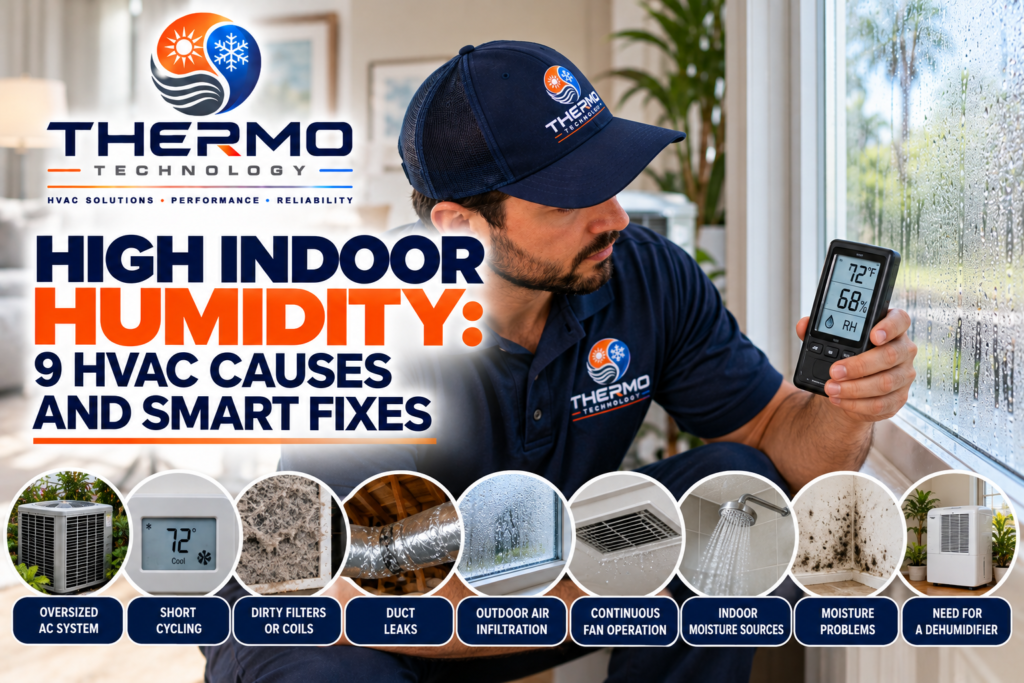
High Indoor Humidity: 9 HVAC Causes and Smart Fixes
High indoor humidity can make a home feel uncomfortable even when the air conditioner is running and the thermostat shows a reasonable temperature. The air may feel sticky, rooms may smell musty, and condensation may appear on windows, vents, or other cold surfaces.
In many homes, high indoor humidity is connected to the way the HVAC system is sized, installed, maintained, or operated. However, moisture can also enter the home through air leaks, building problems, showers, cooking, and outdoor air.
This guide from Thermo Technology explains nine common HVAC-related causes of excessive indoor humidity, warning signs homeowners should watch for, and practical ways to improve moisture control.
What Is High Indoor Humidity?
Humidity describes the amount of moisture present in the air.
Indoor humidity is commonly measured as relative humidity, or RH.
When indoor relative humidity becomes too high, the home may feel warmer and less comfortable because moisture evaporates from the skin less effectively.
According to the
U.S. Environmental Protection Agency
,
indoor relative humidity should generally remain below 60 percent, with approximately 30 to 50 percent considered ideal when possible.
Actual comfort can vary depending on outdoor conditions, indoor temperature, building construction, and individual preferences.
Common Signs of High Indoor Humidity
High indoor humidity can create several noticeable symptoms inside a home.
Common warning signs include:
- Sticky or clammy indoor air
- Condensation on windows
- Condensation around supply vents
- Musty odors
- Damp-feeling rooms
- Visible moisture on cold surfaces
- Difficulty maintaining comfort
- AC running without the home feeling comfortable
- Mold or mildew conditions in moisture-prone areas
These symptoms do not always mean the air conditioner itself has failed.
The source of the moisture should be identified before deciding how to correct the problem.
1. An Oversized AC Can Cause High Indoor Humidity
An oversized air conditioner is one of the most important HVAC-related causes of high indoor humidity.
A larger air conditioner can cool the home very quickly.
At first, that might sound like an advantage.
However, air conditioning performs two important jobs:
- Reducing indoor temperature
- Removing moisture from indoor air
Moisture removal requires the HVAC system to operate long enough for water vapor to condense on the cold evaporator coil and drain away.
If an oversized system reaches the thermostat temperature too quickly, it may shut off before enough moisture is removed.
Signs of an Oversized System
Possible signs include:
- Very short cooling cycles
- Frequent starts and stops
- Cold but clammy indoor conditions
- Uneven temperatures
- Poor humidity control
This is one reason selecting HVAC equipment based only on square footage can create problems.
2. Short Cycling Reduces Moisture Removal
Short cycling occurs when an air conditioner repeatedly turns on and off before completing a normal cooling cycle.
Short cycling can contribute to high indoor humidity because the evaporator coil may not remain cold long enough to remove sufficient moisture.
Possible causes of short cycling include:
- Oversized equipment
- Thermostat problems
- Electrical issues
- Frozen evaporator coil
- Airflow restrictions
- Refrigeration-system problems
If the system frequently starts and stops while the home remains humid, both the cycling problem and indoor moisture level should be evaluated.
3. Incorrect HVAC Airflow
Airflow plays an important role in controlling high indoor humidity.
The indoor blower must move air across the evaporator coil at an appropriate rate.
If airflow is significantly different from what the equipment requires, cooling and moisture removal can be affected.
Potential airflow problems include:
- Dirty air filters
- Dirty evaporator coils
- Incorrect blower settings
- Restricted return airflow
- Undersized ductwork
- Damaged ductwork
More Airflow Is Not Always Better
Increasing blower speed is not automatically the solution to humidity problems.
Excessive airflow across an evaporator coil may reduce the system’s ability to remove moisture under some operating conditions.
The correct airflow should be based on the equipment design, cooling load, and humidity requirements.
4. A Dirty Evaporator Coil Can Affect Dehumidification
The evaporator coil is where indoor air is cooled and moisture condenses out of the air.
If the evaporator coil becomes dirty, heat transfer and airflow can be affected.
This may contribute to:
- Reduced cooling performance
- Airflow restrictions
- Long operating cycles
- Coil freezing
- Poor moisture removal
A dirty evaporator coil can therefore contribute to high indoor humidity along with other comfort problems.
Because the evaporator coil is located inside the HVAC equipment, professional inspection may be required to determine its condition.
5. Duct Leaks Can Bring Humid Air Into the Home
Duct leakage can affect much more than cooling efficiency.
When return ductwork leaks in an attic, crawlspace, garage, or other humid area, the HVAC system may pull unwanted air into the duct system.
That air can introduce additional moisture into the home.
Supply duct leakage can also create pressure imbalances that encourage outdoor air to enter through gaps and cracks in the building.
This can contribute to high indoor humidity even when the air conditioner itself is operating.
Common Duct Problems Include:
- Disconnected duct sections
- Damaged flexible ducts
- Loose connections
- Leaking plenums
- Poorly sealed joints
- Damaged insulation
Ductwork located in a hot and humid attic deserves particular attention.
6. Outdoor Air Is Entering the Home
In humid climates, uncontrolled outdoor air infiltration can create significant high indoor humidity.
Outdoor air may enter through:
- Doors
- Windows
- Attic penetrations
- Wall penetrations
- Plumbing openings
- Unsealed duct penetrations
- Building-envelope gaps
The more humid outdoor air that enters the home, the more moisture the HVAC system must remove.
Some ventilation is necessary for indoor air quality, but uncontrolled infiltration is different from a properly designed ventilation system.
7. Thermostat Fan Set to ON Can Affect Humidity
The thermostat fan setting can sometimes contribute to high indoor humidity.
When the fan is set to ON, the indoor blower may continue operating after the compressor stops.
During cooling, moisture collects on the evaporator coil.
If the blower continues moving air across the wet coil after cooling stops, some of that moisture may evaporate back into the indoor air.
For many residential HVAC systems, operating the fan in AUTO allows the blower to stop when the cooling cycle ends.
System requirements vary, so thermostat settings should still follow the equipment design and installation recommendations.
8. The AC May Not Be Running Long Enough
Longer cooling cycles are not necessarily a problem.
During hot and humid weather, longer cycles can help an appropriately sized air conditioner remove moisture.
If the system runs only for a few minutes at a time, high indoor humidity may remain even though the thermostat temperature appears correct.
Possible reasons for unusually short runtime include:
- Oversized HVAC equipment
- Thermostat location
- Thermostat calibration problems
- Control issues
- Incorrect equipment staging
Modern variable-capacity systems may intentionally operate for longer periods at lower capacity to provide more stable temperatures and potentially improve moisture removal.
9. The Moisture Load May Be Greater Than the HVAC System Can Handle
Sometimes high indoor humidity is not caused by one HVAC failure.
The building may simply be experiencing a large moisture load.
Indoor moisture can come from:
- Cooking
- Showers
- Clothes dryers
- Indoor plants
- Water leaks
- Wet building materials
- Air infiltration
- Large numbers of occupants
The EPA notes that cooking, showering, leaks, and other moisture sources can increase indoor humidity.
Controlling moisture at the source is often just as important as HVAC operation.
High Indoor Humidity in Florida
High indoor humidity is especially important in Florida because outdoor air can contain significant moisture for much of the year.
Homes in Jacksonville and other parts of Florida often operate air conditioning for long periods, but cooling alone does not guarantee proper humidity control.
Florida homes may face additional factors such as:
- Long cooling seasons
- High outdoor humidity
- Hot attic spaces
- Ductwork located in attics
- Frequent door openings
- Coastal moisture conditions
A properly designed HVAC system should address both temperature and moisture.
Why Does My Home Feel Humid Even at 72°F?
Indoor comfort depends on both temperature and relative humidity.
A home at 72°F with high indoor humidity may feel less comfortable than a slightly warmer home with better humidity control.
This is why lowering the thermostat is not always the best solution.
Lowering the temperature further may increase energy consumption without correcting the underlying moisture problem.
The better approach is to determine why indoor humidity is elevated.
Can High Indoor Humidity Cause Condensation?
Yes.
Condensation forms when humid air contacts a surface that is cold enough for water vapor to change into liquid water.
You may notice condensation on:
- Windows
- Supply registers
- Refrigerant lines
- Cold water pipes
- Metal duct surfaces
The EPA recommends addressing condensation and indoor moisture because persistent dampness can contribute to moisture-related building problems.
Can High Indoor Humidity Contribute to Mold?
Persistent moisture can create conditions that support mold growth.
The EPA emphasizes that controlling moisture is one of the most important strategies for controlling mold indoors.
According to
EPA indoor air quality guidance
,
keeping indoor humidity approximately between 30 and 50 percent can help reduce moisture-related problems.
If visible mold or significant water damage already exists, the moisture source must also be corrected.
How Do You Measure Indoor Humidity?
Indoor relative humidity can be measured using a hygrometer or humidity monitor.
Many modern thermostats also display indoor humidity.
When evaluating high indoor humidity, avoid relying on only one momentary reading.
Humidity can change throughout the day depending on:
- Weather
- AC operation
- Cooking
- Showers
- Door openings
- Occupancy
Monitoring humidity over several days can provide a better picture of the home’s moisture conditions.
Should You Buy a Dehumidifier?
A dehumidifier can be useful when high indoor humidity continues even after the HVAC system and building are operating correctly.
Common options include:
- Portable dehumidifiers
- Whole-home dehumidifiers
Portable Dehumidifiers
A portable unit may be useful for a specific room or smaller area.
However, it may require frequent water removal unless it is connected to a drain.
Whole-Home Dehumidifiers
A whole-home dehumidifier can be integrated with the HVAC system to control humidity throughout a larger area.
This type of system may be particularly useful in homes with high moisture loads or situations where the AC alone cannot maintain desired humidity.
The
ENERGY STAR dehumidifier program
provides information about energy-efficient residential dehumidifiers.
Do You Need a Bigger Air Conditioner for High Humidity?
Usually, installing a larger air conditioner is not the correct response to high indoor humidity.
In fact, oversized equipment can make humidity problems worse by shortening cooling cycles.
Before replacing equipment, an HVAC contractor should evaluate:
- Cooling load
- Current equipment size
- Airflow
- Duct condition
- Thermostat operation
- Indoor humidity
- Building air leakage
Correct sizing is more important than simply installing more cooling capacity.
Can a Variable-Speed AC Help With Humidity?
Variable-speed and variable-capacity HVAC systems can offer advantages for humidity control in some homes.
Instead of operating only at full capacity, the system may run at a lower output for longer periods.
This can provide:
- Longer cooling cycles
- More stable temperatures
- Reduced temperature swings
- Better part-load efficiency
- Potentially improved moisture removal
However, variable-speed technology does not correct problems such as severe duct leakage, improper sizing, or uncontrolled outdoor air infiltration.
High Indoor Humidity and HVAC Maintenance
Regular HVAC maintenance can help identify problems that contribute to high indoor humidity.
A professional inspection may include:
- Air filter inspection
- Evaporator coil inspection
- Condensate drain inspection
- Blower operation
- Airflow evaluation
- Thermostat operation
- Cooling performance
- Duct inspection when accessible
The HVAC system should be evaluated as a complete system rather than focusing only on the thermostat temperature.
How HVAC Technicians Diagnose High Indoor Humidity
Diagnosing high indoor humidity may require measurements throughout the HVAC system and building.
A professional evaluation can include:
- Indoor relative humidity measurement
- Supply and return temperature measurements
- Airflow testing
- Static-pressure testing
- Equipment runtime evaluation
- Cooling-load review
- Duct inspection
- Thermostat configuration
- Moisture-source investigation
The goal is to determine whether excess humidity is primarily caused by the HVAC system, the building, internal moisture sources, or a combination of factors.
9 Smart Ways to Reduce High Indoor Humidity
Depending on the cause, strategies for controlling high indoor humidity may include:
- Use correctly sized HVAC equipment.
- Correct airflow problems.
- Repair duct leaks.
- Keep evaporator coils clean.
- Use bathroom and kitchen exhaust fans.
- Correct plumbing and building water leaks.
- Use the appropriate thermostat fan setting.
- Reduce uncontrolled outdoor air infiltration.
- Consider dedicated dehumidification when necessary.
The correct solution depends on what is actually creating the excess moisture.
Professional Humidity and HVAC Service
If high indoor humidity continues even while your air conditioner is running, a professional HVAC evaluation can help identify the cause.
At Thermo Technology, we provide residential and commercial HVAC diagnostics, repair, maintenance, and equipment installation.
Our services include:
- Indoor humidity evaluation
- HVAC airflow diagnostics
- Air-conditioning repair
- Heat pump service
- Preventive HVAC maintenance
- Duct inspection
- HVAC system replacement
- Commercial HVAC service
Learn more about
HVAC services from Thermo Technology
.
Visit the
Thermo Technology HVAC Blog
for additional information about air conditioning, airflow, equipment efficiency, humidity control, and HVAC maintenance.
Do Not Ignore High Indoor Humidity
High indoor humidity is more than a comfort problem.
Persistent moisture can contribute to condensation, musty odors, HVAC performance issues, and conditions that may support mold growth.
The correct solution starts by identifying whether the problem is caused by equipment sizing, airflow, duct leakage, short cycling, outdoor air infiltration, internal moisture sources, or another building condition.
Contact Thermo Technology for professional HVAC and indoor humidity diagnostics.
Thermo Technology — HVAC Solutions • Performance • Reliability.
Frequently Asked Questions About High Indoor Humidity
What humidity level is too high inside a home?
The EPA recommends keeping indoor relative humidity below 60 percent and ideally around 30 to 50 percent when possible. Persistent readings above 60 percent can indicate excessive indoor moisture.
Why is my house humid even with the AC running?
High indoor humidity while the AC is running may be related to oversized equipment, short cycling, airflow problems, duct leakage, thermostat settings, excessive outdoor air infiltration, or large indoor moisture loads.
Can an oversized AC cause high humidity?
Yes. An oversized air conditioner may cool the home too quickly and shut down before operating long enough to remove sufficient moisture.
Does lowering the thermostat reduce humidity?
Not necessarily. Lowering the thermostat may increase cooling runtime, but it does not correct problems such as equipment oversizing, duct leakage, airflow issues, or excessive moisture infiltration.
Can dirty AC coils cause high humidity?
Yes. A dirty evaporator coil can affect airflow and heat transfer, potentially reducing the HVAC system’s cooling and moisture-removal performance.
Can leaky ducts cause high indoor humidity?
Yes. Return duct leaks can draw humid air from attics, crawlspaces, or garages into the HVAC system, while supply leaks can create building pressure imbalances that increase outdoor air infiltration.
Should my thermostat fan be set to Auto for humidity control?
For many residential systems, AUTO can help because the blower stops when the cooling cycle ends. Continuous fan operation may allow some moisture on the evaporator coil to evaporate back into indoor air.
Do I need a whole-home dehumidifier?
A whole-home dehumidifier may be useful when humidity remains excessive after HVAC and building problems have been addressed. The need depends on climate, moisture load, system design, and indoor humidity goals.
Can high indoor humidity cause mold?
Persistent moisture can create conditions that support mold growth. Controlling indoor moisture and correcting water sources are important parts of mold prevention.