
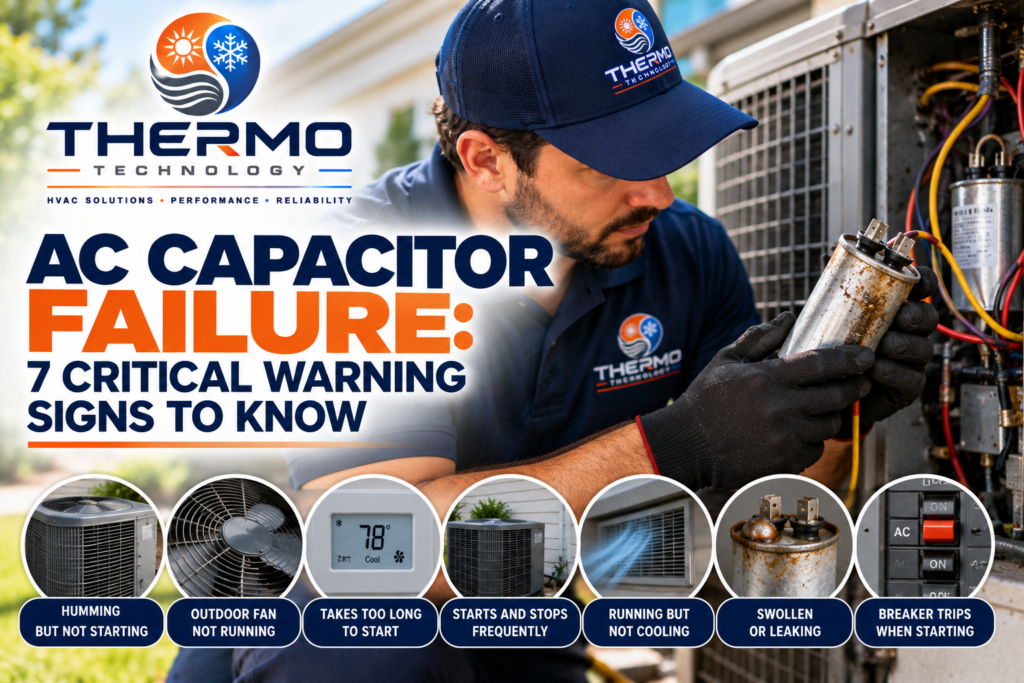
AC Capacitor Failure: 7 Critical Warning Signs to Know
An AC capacitor failure can prevent an air-conditioning system from starting correctly, stop the outdoor fan from operating, cause unusual humming noises, or leave your home without adequate cooling.
The capacitor is a relatively small electrical component, but it plays an important role in helping HVAC motors start and operate correctly. When an AC capacitor failure develops, the symptoms can sometimes look similar to compressor, fan motor, thermostat, or electrical problems.
This guide from Thermo Technology explains seven common warning signs of a failing AC capacitor, why capacitors fail, how HVAC technicians test them, and when professional repair is needed.
What Is an AC Capacitor?
An air-conditioning capacitor is an electrical component designed to store electrical energy and support the operation of certain HVAC motors.
Depending on the system design, capacitors may help:
- Start the compressor
- Start the condenser fan motor
- Keep motors operating correctly
- Provide the electrical characteristics required by the motor
Many residential outdoor HVAC units use a dual run capacitor that supports both the compressor and condenser fan motor in one component.
Other systems may use separate start and run capacitors.
According to
Carrier’s guide to AC capacitors
,
capacitors help provide the electrical energy HVAC motors need to start and continue operating.
What Happens During an AC Capacitor Failure?
During an AC capacitor failure, the capacitor may no longer provide the electrical characteristics required by the motor it supports.
The result may be a motor that:
- Cannot start
- Struggles to start
- Runs incorrectly
- Overheats
- Stops intermittently
The exact symptom depends on which capacitor section has failed and which HVAC component depends on it.
For example, a dual run capacitor may support both the compressor and condenser fan motor. One section can potentially fail while another section still functions.
1. Your AC Hums but Does Not Start
A humming outdoor unit is one of the most recognizable warning signs associated with AC capacitor failure.
You may hear the equipment trying to operate while the compressor or condenser fan does not start normally.
This can happen because the motor is receiving electrical power but does not have the electrical support required to start correctly.
Possible symptoms include:
- Humming from the outdoor unit
- Compressor attempting to start
- Fan motor not spinning
- System shutting down after attempting to start
A humming sound does not automatically confirm a bad capacitor. Motor failures, electrical problems, compressor problems, and control issues can create similar symptoms.
2. The Outdoor Fan Is Not Running
An AC capacitor failure can prevent the condenser fan motor from starting or operating correctly.
The condenser fan moves outdoor air across the condenser coil so the system can release heat.
If the fan stops operating while the compressor attempts to run, heat and pressure can build rapidly inside the refrigeration system.
Possible causes of a condenser fan not operating include:
- Failed capacitor
- Failed fan motor
- Electrical connection problems
- Contactor problems
- Control problems
- Loss of power
If the outdoor fan is not operating, do not assume the capacitor is automatically responsible.
Professional electrical testing can identify the actual cause.
3. Your AC Takes Too Long to Start
A weak capacitor may still function partially while gradually losing its ability to support motor startup.
This type of AC capacitor failure may cause a noticeable delay when the thermostat calls for cooling.
You might notice:
- The thermostat calls for cooling
- The indoor blower begins operating
- The outdoor unit hesitates
- The compressor starts after a delay
Delayed starting can also be caused by control delays, compressor problems, voltage issues, or other electrical components.
A technician should test the capacitor instead of diagnosing it based only on startup delay.
4. The AC Starts and Stops Frequently
Another possible symptom of AC capacitor failure is irregular starting or short cycling.
If a capacitor is no longer supporting a motor correctly, the HVAC system may struggle to maintain normal operation.
The air conditioner may:
- Attempt to start repeatedly
- Operate briefly and stop
- Restart after a short period
- Fail to complete normal cooling cycles
However, short cycling has many possible causes.
These include:
- Thermostat problems
- Frozen evaporator coil
- Incorrect refrigerant charge
- Oversized HVAC equipment
- Electrical faults
- Control problems
Because of this, capacitor testing should be part of a larger HVAC diagnostic process.
5. Your AC Is Running but Not Cooling Properly
An AC capacitor failure may contribute to poor cooling if the compressor or condenser fan cannot operate correctly.
You may notice:
- Warm air from the vents
- Room temperature increasing
- Longer cooling cycles
- The outdoor unit not operating normally
- Reduced cooling capacity
Poor cooling alone does not prove that a capacitor is bad.
Other possible causes include:
- Dirty air filter
- Dirty condenser coil
- Frozen evaporator coil
- Refrigerant leak
- Airflow problems
- Compressor failure
- Thermostat problems
A complete diagnostic evaluation helps avoid replacing a capacitor when another component is actually responsible.
6. The Capacitor Is Swollen or Leaking
Physical damage can be one of the clearest visual signs of AC capacitor failure.
A failed capacitor may sometimes appear:
- Swollen
- Bulged at the top
- Deformed
- Leaking oily material
- Heat damaged
A healthy cylindrical capacitor typically maintains its designed shape.
A noticeably swollen top or visible leakage is a strong reason to have the component professionally evaluated.
Carrier lists swelling or leakage among the visible signs that may indicate a failing AC capacitor.
7. The Breaker Trips When the AC Tries to Start
An electrical problem associated with an AC capacitor failure may contribute to abnormal startup conditions.
However, a tripping breaker is not specific to capacitor problems.
Other possible causes include:
- Compressor problems
- Motor failure
- Shorted wiring
- Contactor failure
- Electrical connection problems
- Incorrect voltage
- Ground faults
If the HVAC breaker repeatedly trips, do not continue resetting it.
A circuit breaker is a protective device. Repeated tripping means the cause should be identified before normal operation continues.
What Causes AC Capacitor Failure?
An AC capacitor failure can develop for several reasons.
Common contributing factors include:
- Extreme heat
- Electrical surges
- Voltage fluctuations
- Age and normal component deterioration
- Excessive motor stress
- Incorrect replacement capacitor
- Electrical system problems
Heat Is a Major Factor
Outdoor HVAC equipment often operates during the hottest part of the year.
The capacitor is installed inside the outdoor electrical compartment, where operating temperatures can become high.
Repeated exposure to heat can contribute to deterioration of electrical components over time.
This can be especially relevant in climates where air conditioners operate for long periods during summer.
AC Capacitor Failure in Hot Climates
AC capacitor failure can be particularly disruptive in hot climates because HVAC equipment may run many hours each day.
In areas such as Florida, outdoor condensers are exposed to:
- High ambient temperatures
- Strong sunlight
- Long cooling seasons
- High equipment operating hours
- Humidity
In coastal locations, salt exposure and corrosion can create additional stress on electrical connections and outdoor HVAC components.
Properties in Jacksonville and other parts of Florida therefore benefit from regular inspection of outdoor HVAC equipment.
Can a Bad AC Capacitor Damage the Compressor?
A significant AC capacitor failure can create abnormal operating conditions for the compressor or fan motor.
A motor that struggles to start may experience additional electrical and thermal stress.
That does not mean every failed capacitor automatically damages the compressor.
However, continuing to operate equipment that is repeatedly struggling to start is not recommended.
Carrier advises that a failing capacitor can place additional stress on compressor and fan motors and recommends professional diagnosis when capacitor symptoms appear.
Start Capacitor vs. Run Capacitor
Understanding different capacitor types can help explain how AC capacitor failure symptoms vary.
Start Capacitor
A start capacitor is designed to provide additional electrical support during motor startup.
It normally operates only briefly during the starting process.
Run Capacitor
A run capacitor remains part of the motor circuit during operation and helps the motor operate correctly.
Dual Run Capacitor
A dual run capacitor combines two capacitor functions inside one component.
Many residential condensers use terminals typically identified as:
- C — Common
- FAN — Condenser fan motor
- HERM — Compressor
The actual capacitor type depends on the HVAC equipment design.
How Does an HVAC Technician Test an AC Capacitor?
Diagnosing AC capacitor failure requires electrical testing.
A technician may evaluate:
- Capacitor physical condition
- Microfarad rating
- Measured capacitance
- Voltage rating
- Electrical connections
- Motor operation
- System startup behavior
Capacitance is typically measured in microfarads, often displayed as µF.
The technician compares the measured value with the capacitor’s rated value and permitted tolerance.
A capacitor outside its acceptable specifications may require replacement.
Why the Correct Capacitor Rating Matters
Replacing a capacitor is not simply a matter of finding a component that physically fits.
The replacement must match the electrical requirements of the HVAC equipment.
Important specifications include:
- Microfarad rating
- Voltage rating
- Capacitor type
- Equipment specifications
An incorrect capacitor can affect motor operation and potentially damage HVAC components.
Carrier recommends matching the required capacitance and voltage specifications when replacing an air-conditioning capacitor.
Can You Replace an AC Capacitor Yourself?
Capacitor replacement is not a recommended homeowner DIY repair.
An HVAC capacitor can retain electrical charge even after power to the equipment has been disconnected.
This means a person can potentially receive a dangerous electrical shock from the capacitor itself.
Both
Carrier
and
Trane
recommend professional service for capacitor problems because these components can retain potentially dangerous electrical energy.
Do not touch electrical terminals or attempt to discharge a capacitor unless you are trained and qualified to perform electrical HVAC service.
AC Capacitor Failure vs. Compressor Failure
An AC capacitor failure and a compressor problem can sometimes produce similar symptoms.
For example, the outdoor unit may hum but fail to start.
The difference is significant because replacing a capacitor is a very different repair from replacing a compressor.
A technician may need to evaluate:
- Capacitor condition
- Compressor winding resistance
- Electrical current
- Voltage
- Contactor operation
- Motor condition
- System controls
Professional diagnosis helps avoid assuming that an expensive compressor has failed when the actual problem is an electrical component.
AC Capacitor Failure vs. Contactor Failure
The contactor and capacitor are both located in the outdoor HVAC electrical system on many residential air conditioners.
However, they perform different functions.
The contactor acts as an electrically controlled switch that allows power to reach the outdoor equipment when cooling is requested.
The capacitor provides electrical support for motors.
Symptoms can overlap, which is another reason electrical testing is important.
How Long Does an AC Capacitor Last?
There is no exact lifespan that applies to every capacitor.
Service life depends on factors such as:
- Operating temperature
- Equipment runtime
- Electrical conditions
- Component quality
- Voltage fluctuations
- System condition
A capacitor may operate for many years, while another installed under more difficult conditions may fail sooner.
Rather than replacing capacitors based only on age, technicians can evaluate their actual electrical performance during HVAC maintenance.
Can Preventive Maintenance Find a Weak Capacitor?
Yes. One benefit of professional HVAC maintenance is the ability to identify some electrical components that are beginning to operate outside specifications.
During an inspection, a technician may check:
- Capacitance
- Electrical connections
- Contactor condition
- Motor operation
- Voltage
- Operating current
Finding a developing AC capacitor failure before the component completely stops functioning may help prevent an unexpected cooling outage.
What Should You Do if You Suspect AC Capacitor Failure?
If you suspect an AC capacitor failure, there are a few observations you can make safely without opening the equipment.
You can check whether:
- The thermostat is set to Cool
- The indoor blower is operating
- The outdoor fan is running
- The outdoor unit is humming
- The breaker has tripped
- The system is providing normal cooling
Do not remove the outdoor electrical panel or touch the capacitor.
If the equipment is not starting correctly or produces unusual electrical symptoms, schedule professional HVAC service.
Professional AC Capacitor Diagnosis and Repair
An AC capacitor failure is usually straightforward for a trained technician to test, but the symptoms can overlap with several other HVAC problems.
At Thermo Technology, we provide residential and commercial HVAC diagnostics, maintenance, repair, and installation.
Our services include:
- AC electrical diagnostics
- Capacitor testing
- Air-conditioning repair
- Compressor diagnostics
- Condenser fan diagnostics
- Heat pump repair
- Preventive HVAC maintenance
- HVAC equipment installation
Learn more about
HVAC services from Thermo Technology
.
Visit the
Thermo Technology HVAC Blog
for additional information about air-conditioning troubleshooting, HVAC maintenance, refrigerant problems, airflow, thermostats, and system performance.
Do Not Ignore AC Capacitor Failure Symptoms
An AC capacitor failure may begin with a small change in system operation but can eventually prevent the compressor or fan motor from starting correctly.
Humming, delayed startup, short cycling, poor cooling, a stopped condenser fan, or repeated electrical problems deserve professional evaluation.
Correct diagnosis is important because capacitor symptoms can closely resemble other electrical or mechanical HVAC failures.
Contact Thermo Technology for professional AC diagnostics and repair.
Thermo Technology — HVAC Solutions • Performance • Reliability.
Frequently Asked Questions About AC Capacitor Failure
What are the most common signs of AC capacitor failure?
Common signs of AC capacitor failure include humming, difficulty starting, a condenser fan that will not run, short cycling, poor cooling, visible capacitor swelling, and electrical startup problems.
Can a bad capacitor stop the AC from starting?
Yes. If the capacitor supporting the compressor or fan motor fails, the motor may struggle to start or may not start at all.
Can an AC capacitor fail even if it looks normal?
Yes. A capacitor can test outside its required electrical specifications without showing visible swelling or leakage.
Can a bad capacitor cause the AC fan to stop?
Yes. If the condenser fan motor depends on the failed capacitor section, the fan may have difficulty starting or fail to operate.
Can a bad AC capacitor damage the compressor?
A failing capacitor can create abnormal motor-starting conditions and additional stress. Persistent startup problems should be diagnosed before normal operation continues.
Is it safe to touch an AC capacitor after turning off the breaker?
No. Capacitors can retain electrical charge after power has been disconnected. They should be handled only by people trained to safely service HVAC electrical systems.
How does a technician know if an AC capacitor is bad?
Technicians can visually inspect the component and measure its capacitance with appropriate electrical testing equipment, comparing the measurement with the manufacturer’s specifications.
Should I replace my AC capacitor myself?
Capacitor replacement is not recommended as a homeowner DIY repair because the component can store dangerous electrical energy even after power is disconnected.
Can preventive HVAC maintenance identify a weak capacitor?
Yes. Electrical testing during preventive maintenance can identify some capacitors that are beginning to operate outside their specified range before complete failure occurs.