
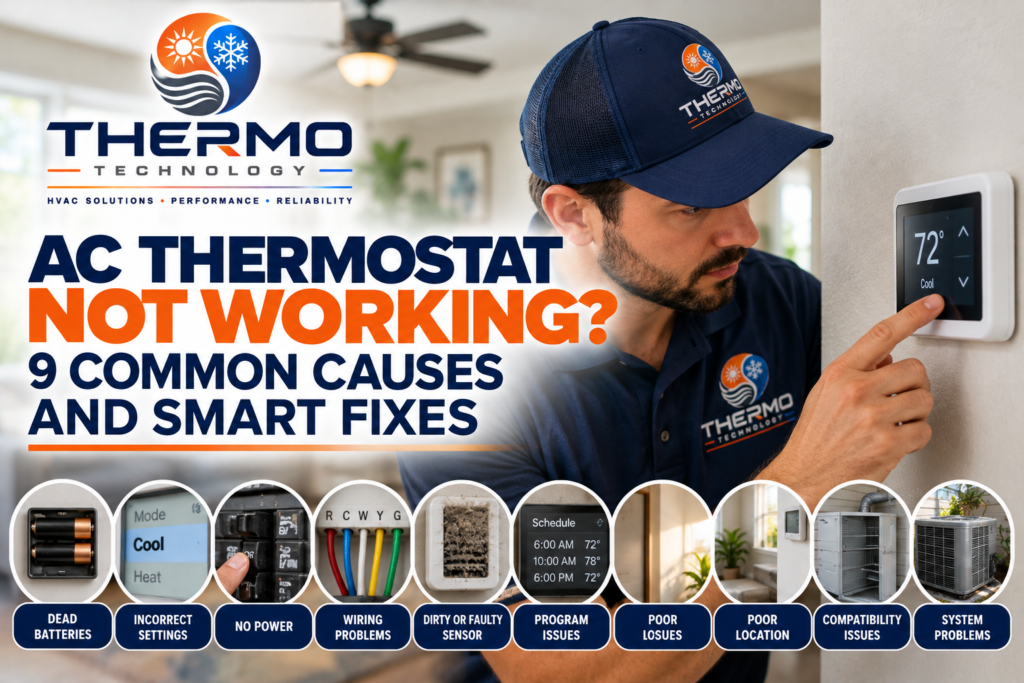
AC Thermostat Not Working? 9 Common Causes and Smart Fixes
An AC thermostat not working can make it seem like the entire air-conditioning system has failed, even when the actual problem is relatively small. In some cases, the thermostat may be blank, unresponsive, inaccurate, or unable to control the cooling system correctly.
When an AC thermostat not working disrupts normal operation, the issue may involve power loss, incorrect settings, wiring problems, sensor issues, installation errors, or problems elsewhere in the HVAC system.
This guide from Thermo Technology explains nine common causes of thermostat problems, what homeowners can safely check, and when professional HVAC diagnosis is the best next step.
What Happens When an AC Thermostat Is Not Working?
The thermostat acts as the control center of the HVAC system. It tells the air conditioner or heat pump when to start, when to stop, and what indoor temperature to maintain.
If the thermostat cannot perform that job correctly, several problems may occur, such as:
- The AC will not turn on
- The AC runs but does not shut off correctly
- The system does not respond to temperature changes
- The display is blank
- The room temperature reading is inaccurate
- The house feels too hot or too cold
Because the thermostat controls the system, even a minor issue can create major comfort problems.
Signs of an AC Thermostat Not Working
An AC thermostat not working may show up in different ways depending on the type of thermostat and HVAC system.
Common signs include:
- Blank thermostat screen
- AC does not start
- AC does not stop
- Wrong room temperature displayed
- Thermostat does not respond to button input
- Cooling starts and stops irregularly
- Fan settings do not work correctly
- System does not follow programmed settings
Some of these signs point directly to a thermostat issue, while others may also involve HVAC equipment, electrical supply, or wiring problems.
1. Dead Batteries
One of the simplest reasons for an AC thermostat not working is dead or weak batteries.
Many digital thermostats use batteries either as their main power source or as backup power.
If the batteries are weak, you may notice:
- A blank display
- A dim screen
- Intermittent operation
- Loss of programmed settings
- Poor response to commands
What You Can Do
If your thermostat uses replaceable batteries, install fresh batteries and check whether the thermostat returns to normal operation.
Be sure the batteries are installed correctly and match the thermostat manufacturer’s specifications.
2. Incorrect Thermostat Settings
Sometimes the thermostat appears to be malfunctioning when the issue is actually an incorrect setting.
If the AC thermostat is not working as expected, confirm the following:
- The thermostat is set to Cool
- The desired temperature is below the room temperature
- The fan setting is correct
- The thermostat schedule is not overriding manual settings
- The system mode matches the equipment type
Check the Fan Setting
If the fan is set to ON, the blower may continue running even when the cooling system is not actively cooling.
This can confuse homeowners and make it seem like the thermostat is not controlling the system correctly.
For typical operation, many systems use the fan setting on AUTO.
3. Loss of Power to the Thermostat
An AC thermostat not working may also result from loss of electrical power.
Depending on the thermostat and HVAC equipment, power issues may come from:
- Tripped breakers
- A furnace or air-handler switch turned off
- Blown low-voltage fuse
- Loose wiring
- Power interruption to the indoor unit
If the indoor air handler or furnace loses power, the thermostat may also stop working properly.
Safe Checks
You can safely check whether the HVAC breaker has tripped and whether the indoor system service switch is on.
If breakers repeatedly trip, do not keep resetting them without understanding why.
Repeated breaker trips may indicate an electrical problem that requires professional service.
4. Loose or Damaged Thermostat Wiring
Low-voltage thermostat wiring connects the thermostat to the HVAC system.
If wiring becomes loose, damaged, or disconnected, an AC thermostat not working can result.
Possible symptoms include:
- No response from the system
- Intermittent cooling
- Blank display on some models
- Fan not responding correctly
- Cooling not starting when requested
Thermostat wiring problems can occur because of age, vibration, installation errors, or physical damage.
Wiring inspection and repair should generally be handled by qualified HVAC personnel.
5. Dirty or Faulty Thermostat Sensor
Digital thermostats rely on temperature sensing to determine when cooling is needed.
If the sensor is dirty, damaged, or inaccurate, the thermostat may not control the system properly.
This can cause an AC thermostat not working symptom such as:
- Incorrect room temperature reading
- Short cycling
- Long cooling cycles
- Overcooling
- Poor comfort control
Why Accuracy Matters
If the thermostat believes the room is cooler or warmer than it really is, the entire cooling cycle may be affected.
That is why even a small sensor problem can create noticeable comfort issues.
6. Poor Thermostat Location
Sometimes the thermostat itself is functional, but its location causes misleading temperature readings.
A thermostat can perform poorly if it is installed in a location affected by:
- Direct sunlight
- Supply-air vents
- Exterior wall temperature swings
- Kitchens or heat-producing appliances
- Drafts
- Unusual airflow patterns
In this situation, homeowners may believe the AC thermostat is not working, when in reality the thermostat is responding to an unrepresentative local temperature.
7. Program or Smart Thermostat Issues
Modern programmable and smart thermostats can offer excellent control, but configuration issues can also cause problems.
An AC thermostat not working may actually be caused by:
- Incorrect scheduling
- App-based setting changes
- Wi-Fi connectivity issues
- Improper system configuration
- Software glitches
- Conflicting automatic settings
Review the Schedule
If your thermostat follows a schedule, confirm that the programmed settings match your intended cooling times and temperatures.
Sometimes a homeowner lowers the setpoint manually, but the schedule later overrides that change.
8. Thermostat Compatibility Problems
Not every thermostat is compatible with every HVAC system.
An AC thermostat not working may be caused by incorrect equipment matching, especially when a thermostat has been recently replaced.
Compatibility issues can involve:
- Single-stage vs. multi-stage systems
- Heat pump configuration
- Common wire requirements
- Fan control logic
- Voltage compatibility
- Smart thermostat installation requirements
A thermostat that is not correctly configured for the HVAC system may not control cooling, heating, or fan operation properly.
9. The Problem May Be in the HVAC System, Not the Thermostat
In some cases, homeowners assume they have an AC thermostat not working, but the actual issue is elsewhere in the HVAC system.
Examples include:
- Blown low-voltage fuse
- Control board problems
- Contactor failure
- Capacitor problems
- Air-handler issues
- Outdoor unit electrical problems
- Safety switch interruption
If the thermostat is sending a call for cooling but the system does not respond, the thermostat may not be the failed component.
This is why complete HVAC diagnosis is important before replacing parts unnecessarily.
AC Thermostat Not Working but Screen Is On
If the display is active but the system does not respond correctly, the thermostat may still have a control, wiring, compatibility, or internal failure.
Possible causes include:
- Wrong settings
- Programming conflicts
- Internal relay issues
- Sensor inaccuracies
- Low-voltage wiring problems
- HVAC equipment faults
A working screen does not always mean the thermostat is fully functional.
AC Thermostat Not Working and Screen Is Blank
A blank screen is one of the most obvious thermostat complaints.
If your AC thermostat is not working and the screen is blank, possible causes include:
- Dead batteries
- Loss of power from the HVAC system
- Tripped breaker
- Blown fuse
- Loose wiring
- Thermostat failure
Start with the simplest checks first, especially batteries and power supply.
Can a Bad Thermostat Cause the AC Not to Cool?
Yes. An AC thermostat not working correctly can prevent the cooling system from starting, stopping, or operating at the right times.
However, a thermostat issue is only one of many reasons an AC may fail to cool properly.
Other possible causes include:
- Dirty air filters
- Low refrigerant
- Frozen evaporator coils
- Dirty condenser coils
- Airflow problems
- Electrical component failures
You can also read more on the
Thermo Technology blog
for additional HVAC troubleshooting and maintenance topics.
What You Can Safely Check Yourself
Before calling for service, homeowners can safely perform a few basic checks when dealing with an AC thermostat not working.
- Replace the batteries if the thermostat uses them.
- Confirm the thermostat is set to Cool.
- Set the desired temperature lower than the room temperature.
- Check the fan setting.
- Inspect the breaker panel for a tripped HVAC breaker.
- Make sure the indoor air-handler or furnace switch is on.
- Review the thermostat schedule if it is programmable.
If the thermostat still does not work after these checks, professional diagnosis may be needed.
When Should You Call an HVAC Technician?
You should consider professional service if the AC thermostat is not working and:
- The screen remains blank after changing batteries
- The breaker trips repeatedly
- The system does not respond to thermostat commands
- The thermostat reading is clearly inaccurate
- The thermostat wiring may be damaged
- The thermostat was recently replaced and the system stopped working properly
- The cooling system still will not run after basic checks
A technician can determine whether the thermostat is faulty, incorrectly installed, or simply responding to another HVAC problem.
How HVAC Technicians Diagnose Thermostat Problems
Diagnosing an AC thermostat not working problem usually involves more than checking the display.
A professional HVAC evaluation may include:
- Thermostat setting verification
- Battery and power checks
- Voltage testing
- Low-voltage circuit inspection
- Wiring inspection
- Sensor evaluation
- HVAC control response testing
- Indoor and outdoor system operation checks
The goal is to identify whether the thermostat is the actual cause or whether another HVAC component is preventing normal operation.
Can You Replace a Thermostat Yourself?
Some homeowners replace simple thermostats themselves, but thermostat replacement is not always as straightforward as it appears.
Errors in wiring, configuration, or compatibility can create new HVAC problems.
This is particularly important for:
- Heat pump systems
- Multi-stage systems
- Smart thermostats
- Variable-speed equipment
- Systems requiring a common wire
If you are not fully confident about compatibility and wiring, professional installation is often the safer option.
How to Prevent Thermostat Problems
While not every thermostat issue can be prevented, several good practices can reduce the likelihood of control problems.
- Replace batteries when needed
- Keep the thermostat clean
- Check that schedules are configured correctly
- Avoid placing heat-producing devices near the thermostat
- Have HVAC controls inspected during maintenance visits
- Use compatible thermostat models
Routine HVAC maintenance can help identify control issues before they create major comfort problems.
According to
ENERGY STAR’s HVAC maintenance guidance
,
proper maintenance and HVAC system inspection can help support performance and efficiency.
Professional Thermostat and HVAC Service
If your AC thermostat is not working, a professional evaluation can identify whether the issue involves the thermostat itself or another HVAC system component.
At Thermo Technology, we provide residential and commercial HVAC diagnostics, repair, maintenance, and installation.
Our services include:
- Thermostat diagnostics
- Air-conditioning repair
- Heat pump service
- Preventive HVAC maintenance
- HVAC control troubleshooting
- Mini split service
- System installation
- Commercial HVAC service
Learn more about
HVAC services from Thermo Technology
.
Do Not Ignore an AC Thermostat Not Working
An AC thermostat not working can be a small issue, but it can also completely interrupt cooling and create major comfort problems.
Starting with a few basic checks may help, but persistent thermostat issues should be properly diagnosed so the correct repair can be made.
Contact Thermo Technology for professional thermostat and HVAC service.
Thermo Technology — HVAC Solutions • Performance • Reliability.
Frequently Asked Questions About an AC Thermostat Not Working
How do I know if my AC thermostat is bad?
Possible signs include a blank screen, inaccurate room temperature, unresponsive controls, irregular cooling cycles, and the HVAC system failing to respond to thermostat commands.
Can dead batteries cause the thermostat to stop working?
Yes. Dead or weak batteries are a common reason for a digital thermostat to become blank or unresponsive.
Why is my thermostat on but the AC is not running?
This can happen because of thermostat settings, wiring issues, low-voltage problems, HVAC control issues, breaker problems, or failures elsewhere in the system.
Can a thermostat cause the AC to run constantly?
Yes. A faulty sensor, bad settings, programming issues, or thermostat control problems can cause the system to run longer than expected.
Should I replace my thermostat myself?
Some simple thermostat replacements may be possible, but compatibility, wiring, and system configuration errors can create HVAC problems. Professional installation is often recommended for more complex systems.
Can a bad thermostat cause short cycling?
Yes. If the thermostat reads temperature incorrectly or is affected by poor placement, the system may start and stop too often.
What should I check before calling an HVAC company?
Check the batteries, thermostat mode, temperature setting, fan setting, breaker panel, indoor-unit switch, and thermostat schedule.
Can a thermostat go bad over time?
Yes. Like other HVAC components, thermostats can fail because of age, electrical issues, sensor problems, or internal component wear.
When should I call a technician for thermostat problems?
If the thermostat remains blank, inaccurate, unresponsive, or unable to control the HVAC system after basic checks, professional diagnosis is the best next step.