
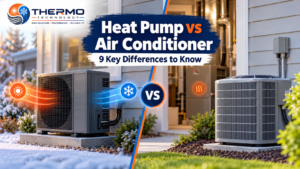
Heat Pump vs Air Conditioner: 9 Key Differences to Know
Choosing between a heat pump vs air conditioner can be confusing because both systems can cool your home and may look very similar from the outside. However, there is one major difference: a heat pump can typically provide both cooling and heating, while a conventional air conditioner is primarily designed for cooling.
When comparing a heat pump vs air conditioner, homeowners should consider climate, energy efficiency, installation cost, heating needs, maintenance, comfort, and the existing HVAC system in the home.
This guide from Thermo Technology explains nine important differences between heat pumps and air conditioners so you can better understand which system may fit your home.
What Is a Heat Pump?
A heat pump is an HVAC system capable of moving heat in either direction.
During cooling mode, it operates similarly to a conventional air conditioner by absorbing heat from inside the home and transferring that heat outdoors.
During heating mode, the refrigeration cycle is reversed. The system absorbs heat from the outdoor air and transfers it indoors.
A typical residential heat pump system may include:
- Outdoor heat pump unit
- Indoor air handler
- Evaporator and condenser coils
- Refrigerant piping
- Reversing valve
- Expansion device
- Blower motor
- Thermostat and controls
The reversing valve is one of the components that allows the system to switch between heating and cooling operation.
What Is an Air Conditioner?
A conventional central air conditioner is designed primarily to remove heat from inside the home and release it outdoors.
During the cooling cycle, refrigerant absorbs indoor heat at the evaporator coil and releases that heat outdoors through the condenser coil.
A central air-conditioning system typically works with:
- An outdoor condensing unit
- An indoor evaporator coil
- A furnace or air handler
- Ductwork
- A thermostat
Unlike a heat pump, a standard air conditioner normally requires another heating source when the home needs heat.
That heating source may be a gas furnace, electric furnace, or another heating system.
Heat Pump vs Air Conditioner: Quick Comparison
The biggest difference in the heat pump vs air conditioner comparison is heating capability.
| Feature | Heat Pump | Air Conditioner |
|---|---|---|
| Provides cooling | Yes | Yes |
| Provides heating | Yes | No, requires separate heat source |
| Refrigeration cycle | Reversible | Cooling direction only |
| Good for warm climates | Excellent option | Excellent option |
| Can replace separate furnace in some homes | Yes | No |
| Uses outdoor unit during winter | Yes | Usually no |
| Cooling efficiency potential | High | High |
| Maintenance requirements | Cooling and heating operation | Primarily cooling operation |
| Best choice | Depends on climate and home | Depends on heating system and home |
1. Heat Pump vs Air Conditioner Cooling Performance
When operating in cooling mode, the difference between a heat pump vs air conditioner may be smaller than many homeowners expect.
Both systems use a refrigeration cycle to:
- Absorb heat from indoor air
- Move refrigerant through the system
- Transfer heat outdoors
- Remove moisture from indoor air
- Deliver cooler air throughout the home
The actual cooling performance depends heavily on equipment efficiency, system sizing, airflow, duct condition, installation quality, and maintenance.
A properly installed high-efficiency air conditioner can provide excellent cooling performance.
A properly installed high-efficiency heat pump can do the same.
2. The Biggest Difference: Heating
The most important difference when comparing a heat pump vs air conditioner is what happens when outdoor temperatures drop.
A standard air conditioner does not reverse its refrigeration cycle to heat the home.
A heat pump does.
During heating operation, a heat pump extracts heat from outdoor air and transfers it indoors.
Even when outdoor temperatures feel cool, heat energy can still be present in the outside air.
According to
the U.S. Department of Energy
,
air-source heat pumps can provide both heating and cooling and are increasingly used in a wide range of climates.
What Happens With a Traditional AC System?
A home with a conventional central air conditioner typically uses another system for heating.
Common combinations include:
- Air conditioner plus gas furnace
- Air conditioner plus electric furnace
- Air conditioner plus electric resistance heat
This means the home’s cooling and heating functions may rely on separate pieces of equipment.
3. Heat Pump vs Air Conditioner Energy Efficiency
Energy efficiency is an important part of the heat pump vs air conditioner decision.
During cooling operation, both systems can achieve high efficiency depending on the specific model.
Modern equipment may also include:
- Variable-speed compressors
- Inverter technology
- Variable-speed blower motors
- Advanced electronic controls
- Smart thermostat compatibility
The major efficiency difference often appears during heating.
Heat pumps move heat instead of creating all of their heat through electric resistance.
ENERGY STAR
provides information on certified heat pumps and efficiency considerations for residential heating and cooling.
4. Heat Pumps Can Be Especially Practical in Warm Climates
Climate can strongly influence the heat pump vs air conditioner decision.
In warm regions where cooling dominates most of the year and winters are relatively mild, heat pumps can be particularly practical.
This includes many areas of:
- Florida
- Georgia
- South Carolina
- Texas
- Louisiana
- Other warm U.S. regions
In climates such as Florida, homeowners may need significant cooling throughout much of the year but only moderate heating during winter.
A heat pump can provide both functions using the same refrigeration system.
Heat Pumps in Jacksonville and Northeast Florida
For homes in Jacksonville and Northeast Florida, heat pumps are commonly considered because the climate creates a long cooling season and comparatively moderate winter heating requirements.
However, climate alone should not determine equipment selection.
The home’s insulation, ductwork, cooling load, heating load, electrical system, equipment condition, and comfort expectations should also be evaluated.
5. Installation Cost
Installation cost can differ when comparing a heat pump vs air conditioner.
However, equipment price alone does not provide a complete comparison.
The total project may involve:
- Outdoor equipment
- Indoor air handler
- Evaporator coil
- Thermostat
- Electrical modifications
- Refrigerant piping
- Drainage modifications
- Ductwork modifications
- Equipment platforms
A homeowner replacing an existing heat pump with another heat pump may face a very different installation than someone converting from a gas furnace and air conditioner.
The correct comparison should consider the complete installed HVAC system.
6. Heat Pump vs Air Conditioner Maintenance
Maintenance requirements are another factor in the heat pump vs air conditioner comparison.
Because a heat pump can operate during both summer and winter, the outdoor equipment may accumulate more annual operating hours than an air conditioner used only for cooling.
Heat Pump Maintenance May Include:
- Air-filter inspection
- Indoor coil inspection
- Outdoor coil cleaning
- Electrical inspection
- Condensate drain inspection
- Blower inspection
- Refrigerant performance evaluation
- Reversing valve operation
- Heating-cycle inspection
- Defrost controls when applicable
Air Conditioner Maintenance May Include:
- Air-filter inspection
- Evaporator coil inspection
- Condenser coil cleaning
- Electrical inspection
- Condensate drain cleaning
- Blower inspection
- Thermostat testing
- Refrigerant performance evaluation
Regular maintenance can help identify developing problems before they result in major equipment failure.
7. Equipment Wear and Operating Hours
One difference between a heat pump vs air conditioner is how often the outdoor equipment may operate during the year.
A central air conditioner may remain mostly inactive during colder months if another heating system serves the home.
A heat pump may continue operating because the same outdoor equipment provides heating.
This does not automatically mean a heat pump will have a short life.
Equipment life depends on many factors, including:
- Installation quality
- Operating hours
- Maintenance
- Climate
- Equipment quality
- System sizing
- Electrical conditions
- Coastal corrosion exposure
Two identical systems installed in different environments can experience very different service conditions.
8. Heat Pump Operation During Cold Weather
Cold-weather operation is another important part of the heat pump vs air conditioner discussion.
Heat-pump technology has improved significantly, and modern systems can operate at temperatures much lower than many older systems.
However, performance varies between equipment models.
Some systems may use supplemental heating during certain conditions.
Supplemental heat may include:
- Electric heat strips
- Gas furnace backup
- Dual-fuel configurations
The appropriate configuration depends on climate, equipment specifications, utility rates, and building requirements.
What Is Auxiliary Heat?
Some heat-pump systems use auxiliary electric heat when additional heating capacity is required.
The thermostat may display:
- AUX HEAT
- Auxiliary Heat
- Emergency Heat
Auxiliary heat does not automatically indicate a system failure.
However, unusually frequent auxiliary-heat operation can justify professional evaluation.
9. Heat Pump vs Air Conditioner Comfort
Comfort depends on more than choosing a heat pump vs air conditioner.
A properly designed HVAC system should consider:
- Cooling load
- Heating load
- Indoor humidity
- Duct design
- Airflow
- Insulation
- Air leakage
- Window performance
- Thermostat location
Equipment that is too large or too small can create comfort problems regardless of whether it is a heat pump or conventional air conditioner.
Heat Pump vs Air Conditioner for Humidity Control
Humidity control is especially important in hot and humid climates.
Both heat pumps and air conditioners remove moisture from indoor air while operating in cooling mode.
However, dehumidification depends heavily on:
- Correct equipment sizing
- Airflow
- Cooling cycle duration
- Indoor coil temperature
- Variable-speed operation
- Building moisture load
An oversized system may cool the home very quickly and shut off before removing enough moisture.
This can leave the indoor temperature relatively low while humidity remains uncomfortable.
Heat Pump vs Air Conditioner: Which Costs Less to Operate?
There is no universal answer to which heat pump vs air conditioner costs less to operate.
Operating cost depends on:
- Equipment efficiency
- Electricity rates
- Gas rates if applicable
- Climate
- Thermostat settings
- Insulation
- Duct losses
- Home size
- Heating and cooling demand
A heat pump may reduce the need for a separate heating appliance in some homes.
In other properties, a furnace-and-air-conditioner combination may still make sense.
The correct comparison should consider annual heating and cooling requirements rather than cooling cost alone.
When Does a Heat Pump Make Sense?
A heat pump may be a strong option when:
- You need both heating and cooling
- You live in a mild or warm climate
- You want one system for year-round comfort
- You are replacing an existing heat pump
- You want to reduce reliance on electric resistance heating
- Your home is suitable for the selected equipment
When Does a Traditional Air Conditioner Make Sense?
A conventional air conditioner may remain a practical solution when:
- Your home already has a good furnace
- You primarily need cooling equipment replacement
- Your heating system does not need replacement
- Your existing HVAC configuration works well
- A separate heating source is preferred
The goal should not be to select one technology simply because it is newer or more familiar.
The goal should be to select the HVAC configuration that fits the property.
Heat Pump vs Air Conditioner: Which Is Better?
There is no universal winner in the heat pump vs air conditioner comparison.
Both systems can provide excellent cooling when properly sized, installed, and maintained.
The major advantage of a heat pump is its ability to provide both heating and cooling.
A traditional air conditioner may make more sense when the home already has an effective separate heating system.
The best choice depends on:
- Climate
- Existing HVAC equipment
- Energy costs
- Heating requirements
- Cooling requirements
- Installation cost
- Home design
- Long-term plans for the property
Proper HVAC Sizing Matters More Than Equipment Type
Whether you choose a heat pump vs air conditioner, proper sizing is critical.
HVAC equipment should not be selected only by square footage.
A professional cooling and heating load calculation can consider:
- Home size
- Insulation
- Windows
- Building orientation
- Ceiling height
- Air leakage
- Local climate
- Occupancy
- Internal heat loads
Correct sizing can improve comfort, humidity control, efficiency, and equipment operation.
Professional Heat Pump and AC Services
If you are deciding between a heat pump vs air conditioner, a professional HVAC evaluation can help determine which configuration fits your home.
At Thermo Technology, we provide residential and commercial HVAC diagnostics, maintenance, repair, and equipment installation.
Our services include:
- Heat pump installation
- Central AC installation
- HVAC repair
- Heat pump repair
- Preventive maintenance
- Mini split service
- HVAC diagnostics
- Commercial HVAC service
Learn more about
HVAC services from Thermo Technology
.
Need Help Choosing a Heat Pump or Air Conditioner?
Choosing new HVAC equipment is a long-term decision.
Instead of comparing equipment based only on price or advertised efficiency, consider the entire home’s heating and cooling requirements.
A professional evaluation can help determine whether a heat pump, conventional air conditioner, or another HVAC configuration makes the most sense for your property.
Contact Thermo Technology for professional HVAC service and equipment evaluation.
Thermo Technology — HVAC Solutions • Performance • Reliability.
Frequently Asked Questions About Heat Pump vs Air Conditioner
What is the main difference between a heat pump and an air conditioner?
The main difference in a heat pump vs air conditioner is that a heat pump can typically provide both heating and cooling, while a conventional air conditioner primarily provides cooling and requires another heating source.
Does a heat pump cool as well as an air conditioner?
Yes. During cooling mode, a heat pump operates using the same basic refrigeration principles as an air conditioner. Actual cooling performance depends on equipment efficiency, sizing, airflow, installation quality, and maintenance.
Is a heat pump good for Florida?
Heat pumps can be particularly practical in warm climates because they provide cooling during long summer seasons and can also provide heating during relatively mild winters.
Does a heat pump use more electricity than an air conditioner?
During cooling, electricity consumption depends on the efficiency and operating conditions of the specific equipment. Annual energy use should also account for the heat pump’s ability to provide heating.
Do heat pumps need more maintenance?
A heat pump may operate during both heating and cooling seasons, so the equipment may accumulate more annual operating hours. Regular professional maintenance is important for either system.
Can a heat pump replace a furnace?
In some homes, yes. Whether a heat pump can replace a furnace depends on climate, heating load, equipment capacity, home construction, and the specific heat-pump technology selected.
How long does a heat pump last?
Service life varies based on operating hours, maintenance, installation quality, climate, equipment quality, system sizing, and environmental exposure. There is no single lifespan that applies to every installation.
Should I replace my AC with a heat pump?
It may make sense if you also need heating and the home is suitable for a heat-pump system. If your existing heating system is relatively new and operates efficiently, replacing only the air conditioner may also be reasonable.
Which is better in Florida: heat pump or air conditioner?
Both can provide effective cooling. A heat pump offers the additional ability to provide heating, which can make it attractive in Florida’s generally mild winter climate. The best choice depends on the individual property and existing HVAC system.