
HVAC Corrosion: 9 Ways Salt Air Damages Your AC
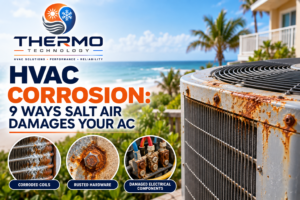
HVAC corrosion is a serious concern for homeowners and businesses located near the coast. Salt carried through the air can settle on outdoor air-conditioning equipment and gradually attack coils, cabinets, fasteners, electrical components, and other metal surfaces.
Homes near the ocean may experience accelerated HVAC corrosion because salt, moisture, heat, and humidity create an aggressive environment for outdoor equipment.
This guide from Thermo Technology explains nine ways salt air can affect an HVAC system, what components are most vulnerable, and what homeowners can do to help protect outdoor air-conditioning equipment.
What Is HVAC Corrosion?
HVAC corrosion occurs when metal components deteriorate through chemical or electrochemical reactions with their environment.
Outdoor air-conditioning equipment is constantly exposed to weather conditions. Near coastal areas, airborne salt can create an even more aggressive environment.
Salt particles may settle on:
- Condenser coils
- Aluminum fins
- Copper tubing
- Steel cabinets
- Fan guards
- Mounting hardware
- Electrical terminals
- Service valves
- Fasteners and brackets
When salt combines with moisture and oxygen, corrosion can progress more rapidly than it would in a cleaner inland environment.
Why Is HVAC Corrosion Worse Near the Coast?
Coastal environments combine several conditions that can contribute to HVAC corrosion.
- Airborne salt
- High humidity
- Frequent moisture exposure
- Warm temperatures
- Wind carrying salt particles inland
The amount of exposure can vary considerably depending on the property’s distance from the water, prevailing winds, surrounding buildings, vegetation, equipment location, and local environmental conditions.
According to
Carrier’s coastal HVAC guidance
,
distance from the ocean, wind direction, relative humidity, coil temperature, pollution, irrigation, and other contaminants can all influence corrosion severity.
1. Salt Air Can Attack the Outdoor Condenser Coil
The condenser coil is one of the most important components affected by HVAC corrosion.
The coil must transfer heat from the refrigerant to the outdoor air. Because of this, it needs a large amount of exposed surface area.
This surface area also means the coil is directly exposed to the surrounding environment.
Salt deposits can accumulate on coil surfaces and fins. Over time, corrosion may damage the metal and reduce its physical integrity.
Severe deterioration can eventually contribute to:
- Damaged fins
- Reduced coil integrity
- Refrigerant leaks
- Reduced heat-transfer performance
- Premature coil replacement
This is one reason coastal HVAC equipment deserves more frequent inspection than equipment operating in a mild inland environment.
2. Aluminum Fins Can Deteriorate
Most outdoor HVAC coils use thin metal fins to increase heat-transfer surface area.
These fins are intentionally very thin, which makes them effective for heat transfer but also leaves relatively little material available if significant corrosion develops.
Advanced HVAC corrosion may cause fins to:
- Become brittle
- Develop surface deterioration
- Separate from the tubing
- Lose structural strength
- Break during cleaning or service
Once large areas of fin material are severely deteriorated, simply cleaning the condenser cannot restore the lost metal.
3. Dissimilar Metals Can Create Galvanic Corrosion
Some HVAC assemblies contain more than one type of metal.
When dissimilar metals are electrically connected and moisture containing salts is present, conditions may develop that promote galvanic corrosion.
This is an important consideration when evaluating HVAC corrosion in coastal environments.
Modern manufacturers may use specific materials, protective coatings, isolation methods, or all-aluminum coil designs to improve corrosion resistance.
For example, Carrier states that some of its coastal products use welded aluminum coil technology and protective treatments specifically designed for seacoast conditions.
4. Steel Cabinets and Panels Can Rust
Corrosion is not limited to the refrigerant coil.
The outdoor cabinet protects many important components, including:
- Compressor
- Electrical controls
- Fan motor
- Refrigerant piping
- Contactor
- Capacitors
If protective paint or powder coating becomes damaged, the exposed metal underneath may begin to rust.
Coastal HVAC corrosion can be particularly visible around:
- Screws
- Edges
- Panel joints
- Drain openings
- Fan guards
- Equipment bases
Surface corrosion does not automatically mean the equipment has failed, but increasing deterioration can eventually affect structural components.
5. Electrical Connections Can Be Affected
Electrical components also deserve attention in coastal environments.
Moisture and contamination can affect exposed terminals, connections, and electrical hardware.
A professional HVAC inspection may include checking:
- Contactor terminals
- Ground connections
- Electrical lugs
- Disconnect connections
- Motor wiring
- Control wiring
Electrical problems should always be evaluated by a qualified HVAC professional.
6. Fasteners and Mounting Hardware Can Rust
Another common location for HVAC corrosion is mounting hardware.
Screws, bolts, brackets, clips, and supports may be made from materials that respond differently to coastal exposure.
Corroded hardware may become difficult to remove during future service.
In severe cases, deteriorated fasteners can also compromise panels or supporting structures.
This is particularly important for equipment installed:
- On rooftops
- On elevated platforms
- Near oceanfront properties
- In locations exposed directly to prevailing coastal winds
7. Corrosion Can Eventually Lead to Refrigerant Leaks
One of the most expensive consequences of severe HVAC corrosion can be refrigerant leakage.
Not every refrigerant leak is caused by corrosion. Leaks can result from vibration, manufacturing defects, mechanical damage, joints, valves, or other factors.
However, significant coil deterioration can weaken metal surfaces and contribute to leaks.
A refrigerant leak may result in:
- Reduced cooling performance
- Longer operating cycles
- Higher energy consumption
- Compressor stress
- Loss of cooling
If a coil is heavily corroded, the technician should evaluate whether repair or replacement is the more practical long-term solution.
8. Restricted Airflow Can Increase Operating Stress
Salt is not the only contaminant that reaches the outdoor coil.
Coastal condenser units can collect a combination of:
- Salt deposits
- Dirt
- Dust
- Pollen
- Vegetation
- Other airborne debris
When coil surfaces become restricted, the condenser may have more difficulty rejecting heat.
Keeping the outdoor coil clean is therefore important for both heat-transfer performance and HVAC corrosion management.
9. Corrosion Can Reduce the Useful Life of HVAC Equipment
The cumulative effect of HVAC corrosion can increase maintenance requirements and contribute to premature component failure.
Coastal equipment may experience deterioration differently from identical equipment installed farther inland.
Actual service life depends on many factors, including:
- Equipment design
- Material selection
- Coil construction
- Protective coatings
- Distance from the coast
- Wind exposure
- Maintenance frequency
- Cleaning practices
- Installation quality
There is therefore no single number of years that applies to every coastal air-conditioning system.
How to Protect Your AC From HVAC Corrosion
Preventing all HVAC corrosion may not be realistic in a severe coastal environment, but several measures can help reduce exposure and slow deterioration.
1. Choose Equipment Designed for Coastal Environments
When replacing an outdoor HVAC unit near the ocean, ask whether the manufacturer offers equipment specifically designed for coastal installations.
Some coastal models use:
- Enhanced coil coatings
- All-aluminum coil construction
- Improved cabinet coatings
- Additional zinc protection
- Protected fasteners
- Specialized corrosion-resistant materials
Carrier, for example, offers
coastal air-conditioning equipment
designed with additional corrosion protection for salt-air environments.
2. Keep the Outdoor Coil Clean
Removing accumulated salt and contamination can be an important part of coastal HVAC maintenance.
However, cleaning methods should follow the equipment manufacturer’s recommendations.
Avoid aggressive methods that can damage delicate coil fins or protective coatings.
A pressure washer, for example, can easily bend thin condenser fins when used improperly.
3. Increase Inspection Frequency Near the Ocean
Standard maintenance intervals may not be appropriate for every coastal property.
Equipment experiencing heavy salt exposure may require more frequent inspection and cleaning.
During preventive maintenance, a technician can evaluate:
- Coil condition
- Cabinet corrosion
- Electrical connections
- Fasteners
- Drainage
- Refrigerant operation
- Condenser airflow
4. Consider Equipment Location
The location of the outdoor unit can influence exposure.
When a new installation allows flexibility, the contractor may consider:
- Prevailing coastal winds
- Building protection
- Required manufacturer clearances
- Service access
- Drainage
- Airflow
Never block condenser airflow simply to protect the equipment from wind or salt.
The outdoor unit still requires adequate clearance to reject heat properly.
5. Inspect Protective Coatings
Protective finishes can help isolate metal surfaces from the surrounding environment.
If coatings become damaged, scratched, or worn away, corrosion may begin at the exposed area.
Coastal maintenance should therefore include visual inspection of accessible protective finishes.
Are Coil Coatings Worth It Near the Coast?
Protective coil coatings can be valuable in environments where HVAC corrosion is a major concern.
However, not every coating is appropriate for every coil or HVAC system.
Factory-applied corrosion protection is generally preferable because the manufacturer can design and test the coating as part of the equipment.
Aftermarket coatings should be compatible with:
- The coil material
- Heat-transfer requirements
- Refrigerant system construction
- Manufacturer warranty requirements
Before applying any aftermarket coating, verify whether it could affect the manufacturer’s warranty or service procedures.
What About Sacrificial Anodes on Air Conditioners?
Sacrificial anodes are widely used to protect certain metal structures from corrosion, especially in marine, plumbing, and water-heating applications.
However, attaching a sacrificial anode to a conventional outdoor AC cabinet is not a standard substitute for manufacturer-designed coastal corrosion protection.
The effectiveness of cathodic protection depends on electrical continuity, materials, electrolyte conditions, geometry, and system design.
Simply attaching a piece of sacrificial metal somewhere on an outdoor condenser does not guarantee that the condenser coil, cabinet, or other components will receive meaningful protection.
For HVAC equipment, proven strategies generally include:
- Corrosion-resistant materials
- Factory-applied coatings
- Proper equipment placement
- Routine cleaning
- Regular inspection
- Coastal-rated equipment
HVAC Corrosion in Florida Coastal Areas
HVAC corrosion is particularly relevant in Florida because the state combines warm temperatures, high humidity, extensive coastline, and heavy air-conditioning use.
Properties located in coastal communities such as Jacksonville Beach, Atlantic Beach, Neptune Beach, Mayport, Ponte Vedra Beach, and other Florida coastal areas may experience more aggressive salt exposure than inland properties.
However, two properties located the same distance from the ocean can experience very different conditions depending on wind direction, building orientation, vegetation, nearby structures, and local weather patterns.
When Should a Corroded AC Unit Be Replaced?
Visible HVAC corrosion does not automatically mean an air conditioner needs to be replaced.
A professional evaluation should consider the overall condition of the system.
Replacement may become more practical when corrosion is combined with:
- Repeated refrigerant leaks
- Severe condenser deterioration
- Structural cabinet damage
- Major electrical deterioration
- Expensive compressor problems
- Frequent service calls
- Age-related component failures
The decision should consider repair cost, equipment condition, efficiency, availability of replacement parts, and expected future reliability.
Professional HVAC Corrosion Inspection and Maintenance
Regular preventive maintenance can help identify HVAC corrosion before severe damage develops.
At Thermo Technology, we provide HVAC inspection, repair, installation, and preventive maintenance for residential and commercial properties.
Our services include:
- Air-conditioning inspection
- Condenser coil evaluation
- Preventive HVAC maintenance
- AC repair
- Heat pump service
- Mini split service
- HVAC system replacement
- Commercial HVAC maintenance
Learn more about
HVAC services from Thermo Technology
.
Protect Your HVAC System From Coastal Corrosion
Salt air is part of life near the coast, but severe HVAC corrosion should not simply be ignored.
Choosing appropriate equipment, maintaining clean coils, inspecting corrosion-prone components, and using manufacturer-approved protection can help reduce the effects of aggressive coastal exposure.
If your outdoor AC unit already shows signs of corrosion, an HVAC inspection can help determine whether the damage is cosmetic, requires maintenance, or indicates a developing equipment problem.
Contact Thermo Technology for professional HVAC service and coastal AC system evaluation.
Thermo Technology — HVAC Solutions • Performance • Reliability.
Frequently Asked Questions About HVAC Corrosion
Does salt air damage air conditioners?
Yes. Salt carried through coastal air can contribute to corrosion of coils, cabinets, fasteners, and other metal components. Exposure varies depending on distance from the coast, wind, humidity, equipment location, and environmental conditions.
How can I prevent HVAC corrosion near the ocean?
You can help reduce HVAC corrosion by choosing coastal-rated equipment, maintaining clean coils, inspecting the system regularly, protecting factory coatings, and following manufacturer-approved maintenance procedures.
How often should a coastal AC unit be cleaned?
There is no universal cleaning interval for every property. Equipment with heavy salt exposure may need more frequent inspection and cleaning than equipment farther inland. Maintenance frequency should be based on actual environmental exposure and manufacturer recommendations.
Are coastal AC units different from regular air conditioners?
Some manufacturers offer coastal HVAC models with additional corrosion-resistant features such as specialized coil construction, protective finishes, improved hardware coatings, and enhanced cabinet protection.
Can corrosion cause an AC refrigerant leak?
Severe coil deterioration can contribute to refrigerant leaks, although corrosion is only one possible cause. Vibration, joints, mechanical damage, manufacturing defects, and other issues may also cause leaks.
Can I paint my outdoor AC condenser to prevent corrosion?
Do not apply ordinary paint directly to condenser coils or other HVAC components without manufacturer approval. Incorrect coatings can interfere with heat transfer, airflow, serviceability, or warranty requirements.
Do sacrificial anodes protect outdoor AC units?
Sacrificial anodes are effective in appropriately engineered cathodic-protection systems, but simply attaching an anode to an outdoor AC unit does not guarantee useful protection. HVAC manufacturers generally rely on corrosion-resistant materials, coatings, and specialized coastal equipment designs instead.
Should I replace an AC unit that has rust?
Not necessarily. Light cosmetic corrosion does not automatically require replacement. A technician should evaluate coil condition, cabinet structure, electrical components, refrigerant integrity, age, repair history, and overall system reliability.