
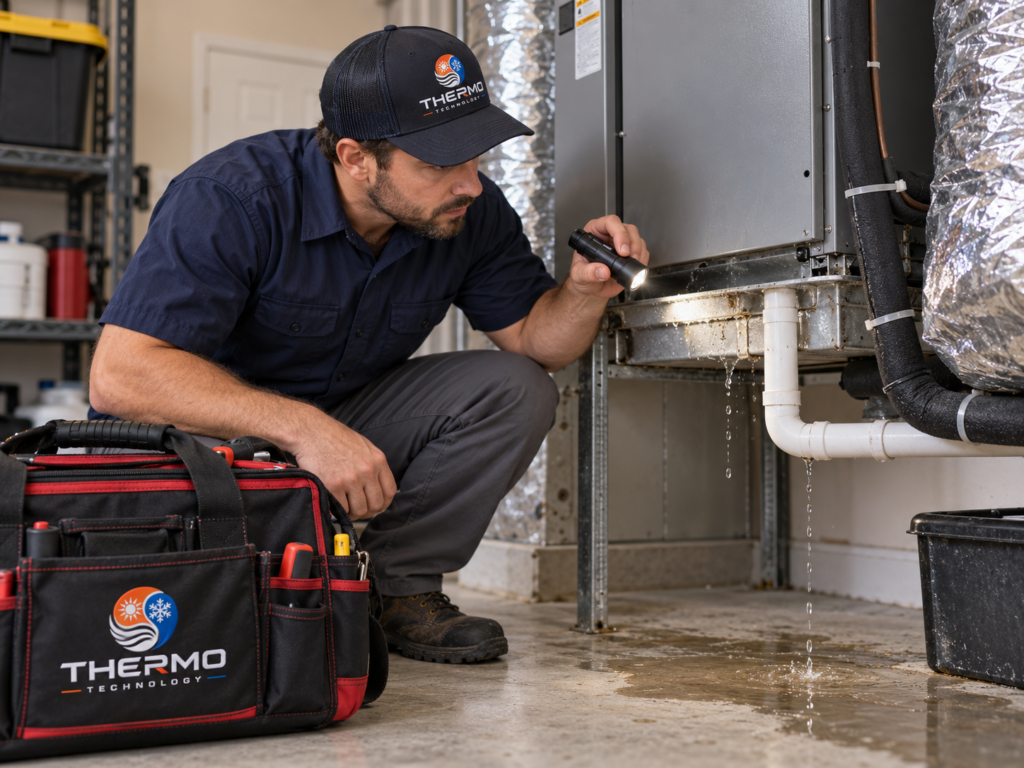
An AC leaking water Jacksonville FL homeowners depend on can quickly become more than a cooling problem. Water around an indoor air handler can damage ceilings, walls, flooring, insulation, and nearby belongings if the cause is not corrected.
Air conditioners naturally remove moisture from indoor air. Under normal conditions, that moisture collects in a drain pan and leaves the HVAC system through a condensate drain line.
When water begins appearing around the indoor unit, dripping from a ceiling, or collecting in an HVAC closet, something may be preventing the condensate system from draining correctly.
In other situations, water may actually come from melting ice caused by an airflow or refrigeration problem.
Here are seven common reasons an air conditioner may leak water and what Jacksonville homeowners can safely check before the problem becomes more serious.
Why Does an Air Conditioner Produce Water?
Your air conditioner does more than lower indoor temperature. It also removes moisture from the air.
Warm household air passes across the cold evaporator coil. Moisture in the air condenses on the coil and normally flows into a drain pan.
From there, the water travels through the condensate drain line and safely leaves the HVAC system.
Jacksonville’s humid climate can cause residential AC systems to remove significant amounts of moisture, especially during long summer cooling cycles.
That makes proper drainage especially important.
1. Clogged Condensate Drain Line
A clogged condensate drain is one of the most common causes of an AC leaking water Jacksonville FL homeowners may encounter.
Over time, moisture inside the drain system can combine with dust, dirt, biological buildup, or debris and restrict the drain line.
When water cannot leave the system properly, it may back up into the drain pan.
Possible signs include:
- Water around the indoor air handler
- A full or overflowing drain pan
- Water stains on a ceiling
- The AC suddenly shutting off
- Standing water near the HVAC equipment
Many residential systems include a float switch designed to shut down cooling when the drain system backs up.
If your AC suddenly stops working and you also notice water near the air handler, a drainage problem may be involved.
2. Dirty Air Filter Causing a Frozen Evaporator Coil
A severely dirty filter can restrict airflow through the HVAC system.
When too little warm air passes across the evaporator coil, the coil can become excessively cold and begin to freeze.
When that ice eventually melts, the amount of water can overwhelm the drain pan or drainage system.
Warning signs may include:
- Weak airflow from vents
- Ice on refrigerant lines
- Ice around the indoor coil
- Poor cooling performance
- Water appearing after the AC is turned off
Homeowners can safely inspect the air filter and replace it if it is visibly dirty.
If the system is heavily frozen, simply changing the filter may not solve the entire problem.
Read our guide about
why an AC freezes up
for additional information.
3. Damaged or Rusted Drain Pan
Condensate water normally collects in a drain pan beneath the evaporator coil.
Over time, some drain pans can crack, corrode, rust, or develop another type of damage.
Instead of flowing toward the drain connection, water may leak directly through the damaged area.
This can be especially concerning when an air handler is installed in:
- An attic
- A closet
- Above a finished ceiling
- Another area where water damage can spread unnoticed
If the drain pan is damaged, repair or replacement may be necessary.
4. Condensate Pump Failure
Some HVAC installations use a condensate pump to move water away from the air-conditioning system.
If the pump fails, loses power, becomes clogged, or its reservoir fills without draining, water can overflow.
A failed condensate pump may cause an AC leaking water Jacksonville FL problem even when the main drain line itself is relatively clear.
Depending on the installation, the pump may also be connected to a safety switch that stops AC operation when water levels become too high.
5. Evaporator Coil Is Frozen
A frozen evaporator coil can produce a surprising amount of water when the ice begins to melt.
Possible causes of evaporator freezing include:
- Restricted airflow
- Dirty air filter
- Dirty evaporator coil
- Blower motor problems
- Refrigerant problems
- Control issues
If you see heavy ice on the indoor HVAC equipment or refrigerant lines, continuing normal cooling operation may make the condition worse.
Turn cooling mode off and allow the system to thaw rather than trying to scrape or remove the ice manually.
If freezing returns, professional diagnosis is recommended.
6. Condensate Drain Installation or Connection Problem
A drain line must be installed so condensate can move away from the HVAC equipment correctly.
Problems may develop if:
- A drain connection becomes loose
- A PVC fitting cracks
- The drain line becomes disconnected
- The line does not maintain proper drainage
- A previous repair or installation was completed incorrectly
Even a relatively small leak can become significant because residential air conditioners may remove large amounts of moisture during humid weather.
7. Refrigerant or Airflow Problems
Sometimes the visible water is only the result of another HVAC problem.
Incorrect refrigerant conditions or inadequate airflow can cause the evaporator coil to freeze.
When the ice melts, homeowners may assume the problem is only a clogged drain even though the underlying failure involves cooling-system performance.
An AC leaking water Jacksonville FL problem accompanied by poor cooling, ice formation, or unusually long operating cycles deserves a complete HVAC diagnosis.
If your home is also not cooling correctly, see our guide:
AC Not Cooling? Common Causes and What You Can Do
.
What Should You Do If Your AC Is Leaking Water?
The appropriate response depends on how much water is leaking and where it is located.
Homeowners can safely:
- Turn off cooling if water is actively overflowing.
- Check whether the air filter is heavily dirty.
- Look for visible ice on the refrigerant lines or indoor unit.
- Check for standing water around the air handler.
- Move belongings away from the affected area.
- Use towels or a container to limit immediate water damage when safe.
- Schedule service if the source is not obvious.
Do not open electrical panels or reach into HVAC equipment when water is present near electrical components.
Should You Turn Off an AC That Is Leaking Water?
If water is actively overflowing, dripping through a ceiling, or collecting around electrical HVAC equipment, turning off the cooling system is generally the safer approach until the cause can be evaluated.
Continuing operation may allow additional condensate to accumulate.
If the system is frozen, turning cooling off also allows the ice to thaw.
However, remember that melting ice can temporarily increase the amount of water around the indoor unit.
Can a Clogged AC Drain Cause the System to Stop Working?
Yes.
Many HVAC systems use a condensate safety switch or float switch designed to interrupt AC operation when water rises above a safe level.
This helps reduce the risk of an overflowing drain pan causing extensive water damage.
If your AC has suddenly stopped cooling and there is water near the indoor equipment, the drainage system should be inspected.
Why AC Drain Problems Are Common in Jacksonville
Jacksonville’s warm and humid weather can result in significant condensate production during the cooling season.
The more moisture the AC removes from the air, the more important it becomes for the drain pan, drain line, safety switches, and related components to remain in good condition.
Professional AC leaking water Jacksonville FL diagnosis often includes checking both the drainage system and the cooling system because one problem can lead to another.
Can AC Maintenance Help Prevent Water Leaks?
Preventive maintenance cannot prevent every possible leak, but it can help identify several common causes before water damage occurs.
During professional maintenance, a technician may inspect:
- Condensate drain line
- Drain pan
- Float switch
- Evaporator coil
- Air filter and airflow
- Blower operation
- Refrigeration-system performance
The existing Thermo Technology guide to
AC maintenance in Jacksonville FL
explains why drainage inspection is an important part of preventive HVAC service.
ENERGY STAR also recommends regular HVAC maintenance and inspection of condensate drainage as part of residential heating and cooling system care.
Homeowners can review the
ENERGY STAR HVAC Maintenance Checklist
.
Can an AC Water Leak Cause Property Damage?
Yes.
Depending on where the air handler is installed, an unnoticed leak can affect:
- Ceilings
- Drywall
- Flooring
- Insulation
- Cabinetry
- Stored belongings
An air handler located in an attic can be especially concerning because water may travel before the homeowner notices a ceiling stain or active dripping.
Addressing an AC leaking water Jacksonville FL issue early may reduce the chance of damage extending beyond the HVAC system itself.
How Much Does It Cost to Repair an AC Water Leak?
Repair cost depends entirely on the cause.
Clearing a drain restriction is different from replacing a condensate pump, repairing a drain pan, addressing a frozen evaporator coil, or repairing a refrigerant leak.
Before approving repairs, the cause of the water should be identified.
For more information about residential HVAC repair pricing, read our guide to
AC repair cost in Jacksonville FL
.
When Should You Call an HVAC Technician?
Request professional service if:
- The AC repeatedly leaks water
- The drain pan is overflowing
- Water is dripping through a ceiling
- The system repeatedly shuts down because of a float switch
- Ice is forming on the HVAC equipment
- The AC is also not cooling properly
- You suspect a condensate pump failure
- Water is near electrical HVAC components
Repeatedly removing water without correcting the underlying cause usually does not solve the problem.
Professional AC Leaking Water Jacksonville FL Service
Thermo Technology provides professional diagnosis for AC leaking water Jacksonville FL homeowners throughout Jacksonville and surrounding areas.
Our approach is to determine where the water is coming from and why it is occurring before recommending repairs.
Depending on the system, diagnosis may include evaluating the condensate drain, drain pan, safety switches, evaporator coil, airflow, blower operation, and refrigeration-system performance.
Thermo Technology also provides
residential AC repair in Jacksonville FL
when a drainage problem is connected to another HVAC failure.
Is Your AC Leaking Water?
Do not wait for a small HVAC leak to become ceiling, wall, or flooring damage.
Contact Thermo Technology for professional AC leaking water Jacksonville FL diagnostics and residential HVAC service.
Call or text:
(904) 240-2725
Frequently Asked Questions About an AC Leaking Water
Why is my AC leaking water inside the house?
Common causes include a clogged condensate drain, damaged drain pan, frozen evaporator coil, dirty air filter, condensate pump failure, drainage installation problems, or another HVAC issue.
Can a dirty air filter cause my AC to leak water?
Yes. A severely dirty filter can restrict airflow, contribute to evaporator coil freezing, and create excess water when the ice melts.
Should I turn off my AC if it is leaking water?
If water is actively overflowing, leaking near electrical components, or dripping through a ceiling, shutting off cooling until the cause can be evaluated can help reduce additional water accumulation.
Why does my AC drain keep clogging?
Moisture, dust, dirt, biological buildup, and debris can gradually restrict condensate drainage. Repeated blockages may require inspection of the complete drainage system.
Can a frozen AC cause a water leak?
Yes. A frozen evaporator coil can release a significant amount of water as the ice melts, especially if the drain system cannot handle the additional water.
Can AC maintenance help prevent water leaks?
Maintenance can help identify drain restrictions, damaged pans, airflow problems, dirty filters, and other conditions that may contribute to water leaks.
Who repairs an AC leaking water in Jacksonville FL?
Thermo Technology provides residential HVAC diagnostics, maintenance, and AC repair throughout Jacksonville and surrounding areas. Call or text (904) 240-2725 to request service.