
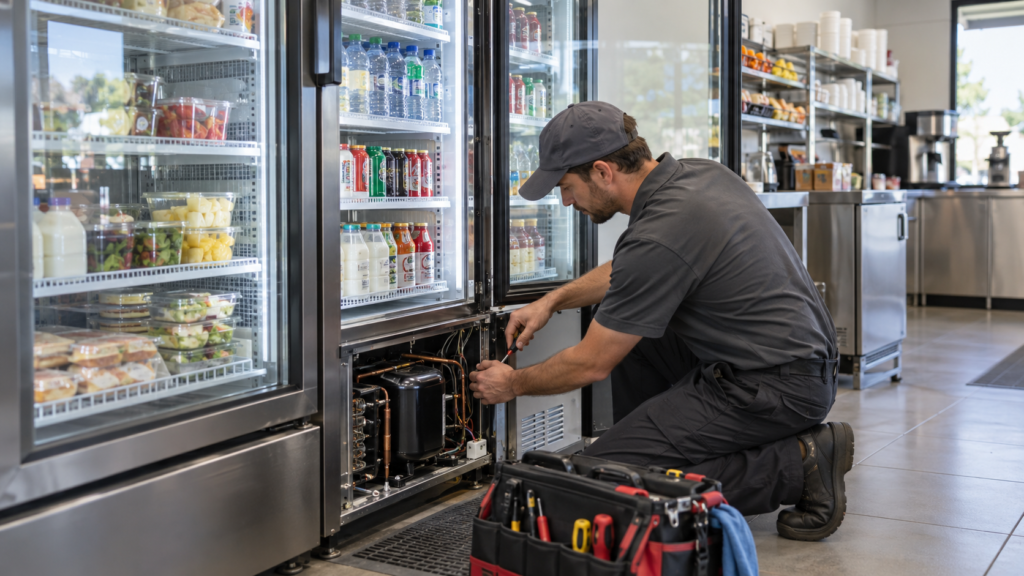
Commercial refrigeration maintenance in Jacksonville FL is essential for restaurants, grocery stores, convenience stores, commercial kitchens, and other businesses that depend on reliable refrigeration every day.
A walk-in cooler that suddenly stops maintaining temperature, a freezer that begins icing excessively, or a reach-in refrigerator that fails during a busy weekend can quickly become an expensive problem.
Lost products, interrupted operations, emergency repairs, and unexpected equipment failures can cost significantly more than routine preventive maintenance.
Regular inspections help identify developing refrigeration problems before they result in product loss, higher energy consumption, expensive repairs, or equipment downtime.
Why Commercial Refrigeration Maintenance Matters
Commercial refrigeration systems often operate continuously.
Equipment installed in restaurants and commercial facilities may run 24 hours a day while dealing with frequent door openings, heavy product loads, kitchen heat, grease, dust, humidity, and demanding operating conditions.
Even a relatively small problem can gradually affect equipment performance.
- A dirty condenser can increase operating pressure.
- A damaged door gasket can allow warm air into the cabinet.
- A restricted drain can cause water or ice accumulation.
- A failing fan motor can reduce airflow.
- A refrigerant leak can reduce cooling capacity.
- Loose electrical connections can create intermittent failures.
Professional commercial refrigeration maintenance in Jacksonville FL can help identify these conditions before they develop into more serious equipment failures.
Regular commercial refrigeration maintenance in Jacksonville FL can also help businesses identify developing equipment problems before they interrupt daily operations or place refrigerated products at risk.
What Commercial Refrigeration Equipment Needs Maintenance?
Preventive refrigeration maintenance applies to many types of equipment commonly used in restaurants, markets, convenience stores, commercial kitchens, and other businesses.
- Walk-in coolers
- Walk-in freezers
- Reach-in refrigerators
- Reach-in freezers
- Prep tables
- Display coolers
- Display freezers
- Undercounter refrigerators
- Beverage coolers
- Refrigerated merchandisers
- Refrigerated display cases
- Ice-making equipment
- Condensing units
- Remote refrigeration systems
Maintenance procedures should be adapted to the equipment type, manufacturer recommendations, operating environment, usage, and service history.
1. Condenser Coil Inspection and Cleaning
The condenser is one of the most important components in a commercial refrigeration system.
Its job is to release the heat removed from the refrigerated space.
When condenser coils become dirty, the refrigeration system may have difficulty rejecting heat efficiently.
Commercial kitchen condenser coils commonly accumulate:
- Dust
- Grease
- Lint
- Food particles
- Airborne debris
A heavily contaminated condenser may contribute to:
- Higher operating pressures
- Increased compressor workload
- Longer operating cycles
- Reduced cooling capacity
- Higher electricity consumption
- Component overheating
- Premature equipment failure
Condenser inspection and cleaning should therefore be an important part of a commercial refrigeration preventive maintenance program.
2. Evaporator Coil Inspection
The evaporator coil absorbs heat from inside the refrigerated space.
For proper operation, air must move effectively across the evaporator coil.
Problems can develop when the evaporator becomes:
- Dirty
- Blocked
- Covered with excessive ice
- Contaminated with grease or debris
Poor evaporator airflow can result in uneven temperatures, longer operating cycles, ice formation, and reduced refrigeration performance.
Excessive ice should not simply be removed without investigating why it formed.
Ice accumulation may be related to airflow problems, defrost failures, door issues, controls, sensors, refrigerant conditions, or other refrigeration faults.
For restaurants and food-service businesses, commercial refrigeration maintenance in Jacksonville FL is especially important because refrigeration equipment may operate continuously under demanding kitchen conditions.
3. Check Door Gaskets and Door Alignment
Damaged door gaskets are a common source of refrigeration inefficiency.
If a gasket is torn, loose, hardened, or no longer sealing correctly, warm and humid air can continuously enter the refrigerated space.
This may cause:
- Longer compressor operation
- Temperature fluctuations
- Excessive moisture
- Ice formation
- Higher energy consumption
- Additional stress on refrigeration components
Door alignment should also be inspected because even a good gasket cannot seal correctly if the door does not close properly.
4. Inspect Evaporator and Condenser Fans
Commercial refrigeration equipment depends heavily on proper airflow.
Fan motors and fan blades should be checked for abnormal operation.
Possible problems include:
- Slow fan motors
- Intermittent fan operation
- Damaged fan blades
- Ice blocking the fan
- Loose components
- Excessive vibration
- Electrical problems
- Debris restricting airflow
Reduced airflow can create temperature problems even when the compressor itself continues operating.
Regular commercial refrigeration maintenance in Jacksonville FL can help identify fan and airflow problems before refrigerated products are placed at risk.
5. Check Drain Lines and Condensate Systems
Evaporator condensate and defrost water need a clear path to drain away from refrigeration equipment.
When drain lines become restricted, you may notice:
- Water inside the equipment
- Water around the equipment
- Ice accumulation
- Unpleasant odors
- Overflowing drain pans
- Wet or slippery floors near the equipment
Commercial kitchens can be particularly vulnerable to drain contamination because of grease, food particles, dirt, and biological buildup.
6. Evaluate Refrigerant System Performance
Refrigerant is essential to the refrigeration process.
A properly operating sealed refrigeration system should not routinely lose refrigerant simply because the equipment is being used.
Possible warning signs of a refrigeration-system problem include:
- Equipment struggling to reach temperature
- Long compressor cycles
- Ice forming in unusual locations
- Changes in refrigerant line temperatures
- Reduced cooling capacity
- Compressor overheating
- Abnormal operating pressures
Simply adding refrigerant without identifying the underlying cause may provide only temporary improvement.
If refrigerant is low, the system should be diagnosed to determine whether a leak or another refrigeration problem exists.
7. Inspect Electrical Components
Commercial refrigeration systems contain multiple electrical components operating under demanding conditions.
Preventive maintenance may include inspection of:
- Contactors
- Capacitors
- Relays
- Electrical terminals
- Wiring
- Fan motors
- Compressor connections
- Control boards
- Temperature controls
- Defrost controls
Heat, vibration, moisture, corrosion, and continuous operation can gradually affect these components.
Professional commercial refrigeration maintenance in Jacksonville FL can help identify loose connections, deteriorated components, and other developing electrical problems before unexpected downtime occurs.
Scheduling commercial refrigeration maintenance in Jacksonville FL also allows technicians to monitor changes in electrical performance and equipment condition over time.
8. Check Temperature Controls and Sensors
Maintaining the correct temperature is one of the primary responsibilities of commercial refrigeration equipment.
A control or sensor that is not operating correctly may affect product temperature even when the compressor appears to be running normally.
Technicians may evaluate:
- Thermostat operation
- Temperature sensors
- Control settings
- Compressor cycling
- Defrost operation
- Actual refrigerated-space temperatures
9. Inspect the Defrost System
Freezers and many commercial refrigeration systems rely on properly functioning defrost controls.
Depending on the equipment, the defrost system may include:
- Defrost heaters
- Temperature sensors
- Timers
- Control boards
- Defrost termination controls
- Drain components
When the defrost system does not operate correctly, ice can accumulate on the evaporator and restrict airflow.
Removing the ice may temporarily restore operation, but it does not correct the underlying problem.
10. Inspect the Compressor and Operating Conditions
The compressor is one of the most important and expensive components in a refrigeration system.
Preventive maintenance cannot prevent every compressor failure, but it can help identify operating conditions that place unnecessary stress on the compressor.
These conditions may include:
- Dirty condenser coils
- Abnormal operating pressures
- Poor airflow
- Electrical problems
- Refrigerant issues
- Repeated short cycling
- Excessive operating temperatures
Signs Your Commercial Refrigeration Equipment Needs Service
Businesses should not wait for refrigeration equipment to stop completely before requesting service.
Warning signs may include:
- Products feeling warmer than usual
- Equipment taking longer to reach temperature
- Compressor running almost continuously
- Excessive ice accumulation
- Water leaking around the equipment
- Unusual noises
- Excessive vibration
- Doors that do not seal properly
- Condensation around doors
- Repeated temperature alarms
- Burning or unusual odors
- Equipment unexpectedly shutting down
A developing refrigeration problem may be easier to correct before the equipment experiences a complete failure.
A consistent commercial refrigeration maintenance in Jacksonville FL program can make it easier to identify warning signs and plan repairs before unexpected equipment failures disrupt business operations.
How Often Should Commercial Refrigeration Equipment Be Maintained?
There is no single maintenance interval that is appropriate for every commercial refrigeration system.
Maintenance frequency depends on:
- Equipment type
- Manufacturer recommendations
- Operating hours
- Equipment condition
- Kitchen environment
- Dust and grease exposure
- Frequency of door openings
- Product load
- Age of the equipment
- Previous repair history
Businesses that schedule commercial refrigeration maintenance in Jacksonville FL on a regular basis can build a better service history for each refrigeration system.
Over time, this information can make it easier to identify recurring problems and equipment that may require increasingly frequent repairs.
A planned commercial refrigeration maintenance in Jacksonville FL schedule also gives businesses an opportunity to address recommended repairs before the equipment reaches a critical failure point.
Commercial Kitchen Refrigeration Needs Extra Attention
Commercial kitchens are especially demanding environments for refrigeration equipment.
Cooking equipment, airborne grease, high temperatures, heavy usage, and frequent door openings can all affect refrigeration performance.
A condenser located near a cooking area may accumulate grease considerably faster than similar equipment operating in a cleaner environment.
For this reason, commercial refrigeration maintenance in Jacksonville FL should consider actual equipment conditions rather than relying only on a fixed calendar interval.
Preventive Maintenance vs. Emergency Refrigeration Repair
Reactive Approach
In a reactive approach, refrigeration equipment continues operating until a failure occurs.
The business may then need to deal with:
- Emergency refrigeration repair
- Possible product loss
- Operational disruption
- Staff downtime
- Unexpected repair expenses
- Urgent equipment replacement decisions
Preventive Approach
With a preventive approach, refrigeration equipment is inspected periodically so developing conditions can be identified before they become emergencies.
A structured commercial refrigeration maintenance in Jacksonville FL program can help businesses plan repairs, monitor equipment condition, and reduce the risk of avoidable failures.
Preventive maintenance cannot eliminate every breakdown, but it improves the chances of identifying problems earlier.
Energy Efficiency and Commercial Refrigeration
Refrigeration equipment with dirty coils, damaged door seals, poor airflow, or control problems may need to operate longer to maintain temperature.
Keeping equipment in good operating condition can help reduce unnecessary system operation.
Businesses can also review efficiency information through ENERGY STAR commercial food service equipment .
What Businesses Can Do Between Maintenance Visits
Business owners and employees can help protect refrigeration equipment between professional service visits.
- Keep condenser areas clear.
- Avoid blocking evaporator airflow.
- Do not overload refrigerated cabinets.
- Make sure doors close completely.
- Report damaged door gaskets.
- Monitor equipment temperatures.
- Investigate unusual noises.
- Keep equipment areas clean.
- Report water or ice accumulation.
- Do not ignore temperature alarms.
Employees are often the first people to notice changes in refrigeration performance.
Create a Commercial Refrigeration Maintenance Record
Businesses operating multiple refrigeration systems can benefit from maintaining detailed equipment records.
Consider documenting:
- Equipment identification
- Equipment location
- Model and serial number
- Maintenance dates
- Temperature readings
- Repairs performed
- Components replaced
- Refrigerant-related work
- Reported problems
- Technician recommendations
Companies using regular commercial refrigeration maintenance in Jacksonville FL can use these records to identify equipment that is requiring increasingly frequent repairs.
Commercial Refrigeration Maintenance in Jacksonville FL
Thermo Technology provides professional commercial refrigeration maintenance in Jacksonville FL for restaurants, commercial kitchens, grocery stores, convenience stores, and other businesses that depend on reliable refrigeration.
Our technicians can evaluate:
- Walk-in coolers
- Walk-in freezers
- Reach-in refrigerators
- Reach-in freezers
- Prep tables
- Refrigerated display equipment
- Commercial coolers
- Condensing units
- Restaurant refrigeration equipment
Our approach focuses on evaluating actual equipment condition, identifying developing problems, and providing clear recommendations.
Thermo Technology helps local businesses establish commercial refrigeration maintenance in Jacksonville FL based on equipment type, operating conditions, usage, and service requirements.
Schedule Commercial Refrigeration Service in Jacksonville
Protect your refrigeration equipment before a small problem becomes an expensive breakdown.
Contact Thermo Technology for professional commercial refrigeration maintenance in Jacksonville FL and surrounding areas.
Call or text: (904) 240-2725
Frequently Asked Questions
How often should commercial refrigeration equipment be serviced?
Service frequency depends on equipment type, operating conditions, manufacturer recommendations, equipment age, environmental conditions, and usage. Equipment in busy commercial kitchens may require more frequent inspection.
Why does my commercial refrigerator run constantly?
Continuous operation can be caused by dirty condenser coils, damaged door seals, excessive heat load, airflow restrictions, refrigerant problems, control issues, or component failures.
Why is my walk-in cooler not maintaining temperature?
Possible causes include airflow problems, dirty coils, damaged door seals, fan failures, refrigerant issues, control problems, compressor problems, or excessive product load.
Can dirty condenser coils damage refrigeration equipment?
A heavily contaminated condenser can reduce heat transfer and force the refrigeration system to operate under more demanding conditions.
Should refrigerant be added during every maintenance visit?
No. Refrigerant should not normally need to be routinely added to a sealed refrigeration system. If refrigerant is low, the cause should be diagnosed.
Can preventive maintenance prevent every refrigeration breakdown?
No. Components can still fail unexpectedly. Preventive maintenance helps identify developing problems and reduce the risk of avoidable failures.
Do you provide commercial refrigeration maintenance in Jacksonville FL?
Yes. Thermo Technology provides commercial refrigeration maintenance in Jacksonville FL, including service for restaurants, commercial kitchens, markets, convenience stores, and other businesses.