
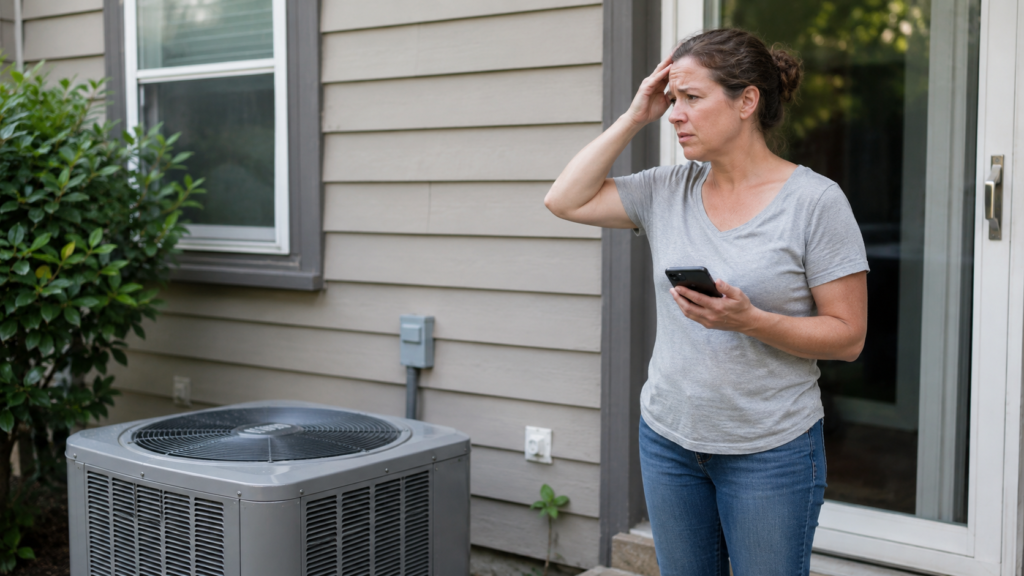
AC not cooling is one of the most frustrating problems a Jacksonville homeowner can experience during a hot Florida day.
You may hear the system running, feel air coming from the vents, and see the thermostat working normally, yet the house remains warm or never reaches the temperature you selected.
Sometimes the solution is relatively simple, such as correcting a thermostat setting or replacing a dirty air filter. In other situations, the problem may involve airflow, electrical components, refrigerant, coils, fan motors, or the compressor.
If your AC not cooling problem continues after basic homeowner checks, professional diagnosis can help identify the actual failure before parts are replaced unnecessarily.
Here are seven common reasons an air conditioner may run without cooling your home properly.
1. Check the Thermostat First
Before assuming the air-conditioning system has a major problem, check the thermostat.
Confirm that:
- The thermostat is set to COOL
- The temperature setting is lower than the current indoor temperature
- The thermostat display is operating normally
- The batteries are good, when applicable
- The fan setting is appropriate
If the thermostat fan is set to ON, the indoor blower may continue moving air even when the outdoor unit is not actively cooling.
In most residential applications, the fan is normally set to AUTO unless an HVAC professional has recommended another setting.
If the thermostat settings are correct but the AC not cooling condition continues, move on to the next checks.
2. A Dirty Air Filter Can Reduce Cooling
Your HVAC system needs adequate airflow across the indoor evaporator coil.
A filter that becomes heavily restricted with dust, pet hair, or debris can reduce the amount of air moving through the system.
Restricted airflow may contribute to:
- Weak airflow from vents
- Longer cooling cycles
- Uneven room temperatures
- Higher energy consumption
- Evaporator coil freezing
Homeowners can safely remove and visually inspect the HVAC filter.
If it is visibly dirty, replace it with the correct size and type recommended for the system.
If a new filter does not restore cooling, the problem may involve another component or system condition.
3. The Outdoor Condenser May Not Be Working Properly
Your air-conditioning system removes heat from inside the house and releases that heat outdoors through the condenser.
If the outdoor unit is not operating correctly, the indoor blower may continue moving air while the home receives little or no actual cooling.
Possible outdoor-unit problems can include:
- Failed capacitor
- Contactor problem
- Condenser fan motor failure
- Electrical problem
- Control issue
- Compressor-related problem
From a safe distance, homeowners can check whether the outdoor unit appears to be operating while the thermostat is calling for cooling.
Do not open electrical panels or touch internal electrical components. HVAC equipment contains high voltage and capacitors that can retain electrical energy.
4. A Dirty Condenser Coil Can Affect AC Performance
The condenser coil needs adequate airflow to release heat outdoors.
Because the outdoor equipment is exposed to the environment, the coil may collect:
- Dirt
- Dust
- Grass clippings
- Leaves
- Vegetation
- Other debris
A heavily restricted condenser may reduce heat transfer and force the system to operate under more demanding conditions.
Keep vegetation and stored objects away from the outdoor unit so air can circulate properly.
Professional coil cleaning may be necessary when the condenser is heavily contaminated.
5. The Evaporator Coil May Be Frozen
A frozen evaporator is another common reason for an AC not cooling properly.
Ice can restrict airflow through the indoor coil and significantly reduce the system’s ability to remove heat from the home.
Possible signs include:
- Ice on refrigerant lines
- Ice around the indoor coil
- Weak airflow
- Warm air from supply vents
- Water appearing after the ice melts
Evaporator freezing can be associated with dirty filters, airflow restrictions, fan problems, coil contamination, refrigerant conditions, or other HVAC issues.
Melting the ice may temporarily restore airflow, but it does not identify why the system froze.
For a more detailed explanation, read our guide: Why Is My AC Freezing Up?
6. Refrigerant Problems Can Cause Poor Cooling
Refrigerant is essential to the air-conditioning process because it allows the system to transfer heat from inside the home to the outdoors.
A properly sealed air-conditioning system should not routinely lose refrigerant.
If refrigerant is low, a leak or another refrigeration-system problem may exist.
Possible symptoms include:
- AC running but not cooling sufficiently
- Long cooling cycles
- Difficulty reaching the thermostat setting
- Evaporator coil freezing
- Ice on refrigerant lines
If an AC not cooling condition is caused by low refrigerant, simply adding refrigerant without identifying the reason it is low may provide only temporary improvement.
Refrigerant diagnosis and repair should be performed by a qualified HVAC professional.
7. Compressor or Major Component Problems
The compressor is one of the most important components in a central air-conditioning system.
However, a home that is not cooling does not automatically mean the compressor has failed.
Problems involving capacitors, contactors, electrical controls, refrigerant conditions, fan motors, or other components can sometimes produce similar symptoms.
This is why major component replacement should follow proper diagnosis rather than assumptions based on one symptom.
AC Not Cooling but the Fan Is Running?
If the indoor fan runs but the air is warm, the blower may be operating while the refrigeration side of the system is not producing cooling.
Possible causes may include:
- Incorrect thermostat setting
- Outdoor unit not operating
- Failed capacitor
- Contactor problem
- Refrigerant problem
- Frozen evaporator
- Compressor-related issue
Professional troubleshooting can determine whether the problem is electrical, mechanical, airflow-related, or connected to the refrigeration circuit.
What Can You Safely Check Before Calling for AC Repair?
Homeowners can perform several basic checks without opening the HVAC equipment.
- Confirm the thermostat is set to COOL.
- Set the thermostat below the current indoor temperature.
- Set the fan to AUTO.
- Inspect the air filter.
- Make sure supply and return vents are not blocked.
- Check whether the outdoor unit appears to be operating.
- Look for visible ice on refrigerant lines or indoor equipment.
- Make sure vegetation is not blocking the condenser.
Do not bypass safety controls, open electrical compartments, handle capacitors, or attempt refrigerant repairs without proper training.
Can Regular Maintenance Help Prevent Cooling Problems?
Preventive maintenance cannot eliminate every possible equipment failure, but it can help identify conditions that may eventually result in an AC not cooling properly.
Professional maintenance may include evaluation of:
- Air filters and airflow
- Evaporator coil condition
- Condenser coil condition
- Electrical components
- Fan motors
- Condensate drainage
- Thermostat operation
- Refrigeration-system performance
Learn more about AC maintenance in Jacksonville FL .
ENERGY STAR also recommends regular professional HVAC maintenance and filter checks as part of keeping residential heating and cooling systems operating efficiently.
Homeowners can review the ENERGY STAR HVAC Maintenance Checklist for additional information.
Why Jacksonville Homes Can Experience More AC Stress
Jacksonville’s long cooling season and high humidity can result in extensive HVAC operating time.
During hot summer conditions, residential systems may run for long periods every day.
This makes problems such as dirty coils, clogged filters, drainage restrictions, electrical wear, and declining components especially important to identify before they result in a complete loss of cooling.
If your system seems to operate almost continuously, you may also want to read our guide about an AC running constantly in Jacksonville FL .
How Much Does AC Repair Cost?
Repair cost depends on the component that failed, equipment brand, system age, parts availability, labor, warranty coverage, refrigerant requirements, and accessibility.
Replacing a capacitor is very different from repairing an evaporator coil or compressor-related problem.
Before approving a major repair, homeowners should understand what failed, why it failed, and what condition the rest of the HVAC system is in.
Read our guide to AC repair cost in Jacksonville FL for more information.
When Should You Call an HVAC Technician?
Schedule professional service if the AC not cooling problem continues after basic thermostat and filter checks.
You should also request service if:
- The outdoor unit will not operate
- The system repeatedly trips a breaker
- Ice is forming on the equipment
- Airflow is unusually weak
- The system makes unusual noises
- You notice water near the indoor unit
- The house cannot reach the thermostat setting
Early diagnosis may prevent additional stress on components and help homeowners understand their repair options before the problem becomes more serious.
Residential AC Repair in Jacksonville FL
Thermo Technology provides residential HVAC diagnostics and AC repair in Jacksonville FL for homeowners throughout Jacksonville and surrounding areas.
When an AC not cooling problem occurs, our approach is to diagnose the system first and identify the actual reason cooling performance has declined.
Depending on the equipment, this may involve evaluating airflow, electrical components, coils, refrigerant conditions, fan motors, thermostat operation, drainage, and compressor performance.
Is Your AC Not Cooling?
Do not wait for a cooling problem to become a complete system failure.
Contact Thermo Technology for professional residential AC diagnostics and repair in Jacksonville FL.
Call or text: (904) 240-2725
Frequently Asked Questions About an AC Not Cooling
Why is my AC running but not cooling my house?
Possible causes include thermostat settings, restricted airflow, dirty filters, dirty coils, electrical failures, refrigerant problems, fan failures, or compressor-related issues.
Can a dirty filter cause my AC to stop cooling?
Yes. A severely restricted filter can reduce airflow through the evaporator coil, lower cooling performance, and contribute to coil freezing.
Why is my AC blowing air but the air is not cold?
The indoor blower may be operating while the outdoor refrigeration system is not cooling correctly. Electrical problems, refrigerant conditions, frozen coils, or outdoor-unit failures may be involved.
Should I turn off my AC if it is frozen?
If significant ice is visible, continuing to operate the system can make the condition worse. Professional diagnosis may be needed to determine why freezing occurred.
Does low refrigerant mean my AC only needs a recharge?
Not necessarily. A properly sealed system should not routinely lose refrigerant. If refrigerant is low, the cause should be identified rather than automatically adding more.
Can AC maintenance help prevent cooling problems?
Maintenance cannot prevent every breakdown, but it can identify dirty coils, restricted filters, electrical wear, drainage problems, and other developing conditions before they result in loss of cooling.
Who repairs an AC not cooling in Jacksonville FL?
Thermo Technology provides residential AC diagnostics, maintenance, and repair throughout Jacksonville and surrounding areas. Call or text (904) 240-2725 to request service.